Alaerts Kaat, Geerlings Franca, Herremans Lynn, Swinnen Stephan P, Verhoeven Judith, Sunaert Stefan, Wenderoth Nicole
Department of Kinesiology, Movement Control & Neuroplasticity Research Group, KU Leuven, Leuven, Belgium; Department of Rehabilitation Sciences, Neuromotor Rehabilitation Research Group, KU Leuven, Leuven, Belgium.
Department of Kinesiology, Movement Control & Neuroplasticity Research Group, KU Leuven, Leuven, Belgium.
PLoS One. 2015 Aug 28;10(8):e0137020. doi: 10.1371/journal.pone.0137020. eCollection 2015.
The ability to recognize, understand and interpret other's actions and emotions has been linked to the mirror system or action-observation-network (AON). Although variations in these abilities are prevalent in the neuro-typical population, persons diagnosed with autism spectrum disorders (ASD) have deficits in the social domain and exhibit alterations in this neural network.
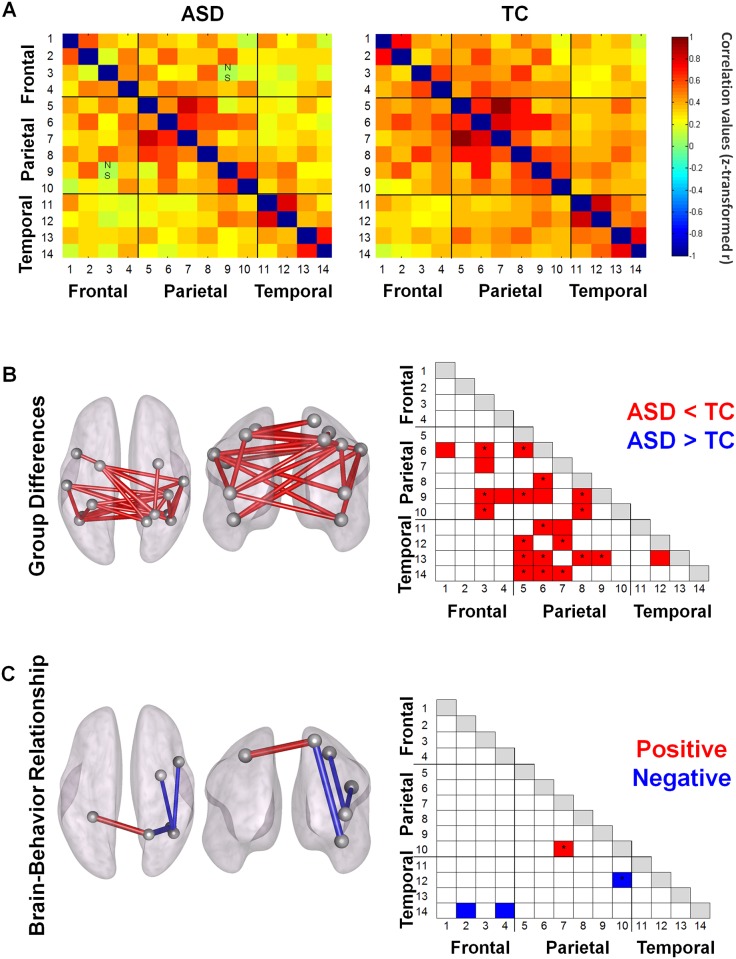
Here, we examined functional network properties of the AON using graph theory measures and region-to-region functional connectivity analyses of resting-state fMRI-data from adolescents and young adults with ASD and typical controls (TC).
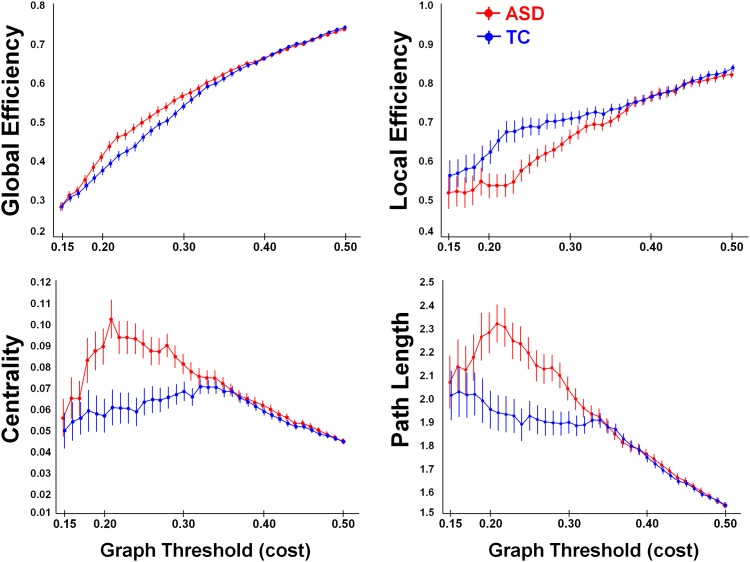
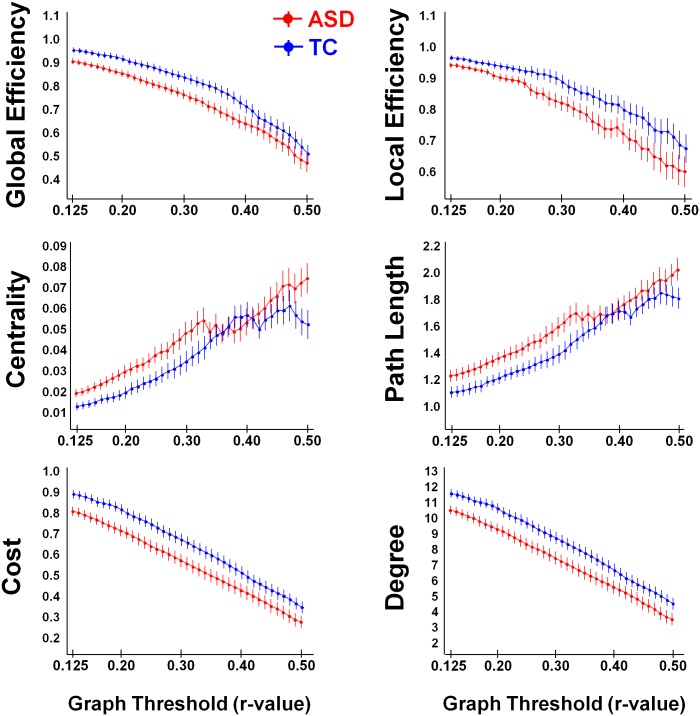
Overall, our graph theory analyses provided convergent evidence that the network integrity of the AON is altered in ASD, and that reductions in network efficiency relate to reductions in overall network density (i.e., decreased overall connection strength). Compared to TC, individuals with ASD showed significant reductions in network efficiency and increased shortest path lengths and centrality. Importantly, when adjusting for overall differences in network density between ASD and TC groups, participants with ASD continued to display reductions in network integrity, suggesting that also network-level organizational properties of the AON are altered in ASD.
While differences in empirical connectivity contributed to reductions in network integrity, graph theoretical analyses provided indications that also changes in the high-level network organization reduced integrity of the AON.
识别、理解和解读他人行为及情感的能力与镜像系统或动作观察网络(AON)相关。尽管这些能力的个体差异在神经正常人群中普遍存在,但被诊断为自闭症谱系障碍(ASD)的人在社交领域存在缺陷,且该神经网络表现出改变。
在此,我们使用图论测量方法以及对患有ASD的青少年和青年以及典型对照组(TC)静息态功能磁共振成像(fMRI)数据进行区域间功能连接分析,来研究AON的功能网络特性。
总体而言,我们的图论分析提供了趋同证据,表明ASD患者的AON网络完整性发生改变,且网络效率降低与整体网络密度降低(即整体连接强度降低)有关。与TC相比,ASD患者的网络效率显著降低,最短路径长度增加,中心性增加。重要的是,在调整ASD组和TC组之间网络密度的总体差异后,ASD患者仍表现出网络完整性降低,这表明ASD患者的AON在网络层面的组织特性也发生了改变。
虽然经验性连接的差异导致了网络完整性的降低,但图论分析表明,高级网络组织的变化也降低了AON的完整性。