Piao Ying, Li Ying, Xu Qian, Liu Jing-wei, Xing Cheng-zhong, Xie Xiao-dong, Yuan Yuan
Tumor Etiology and Screening Department of Cancer Institute and General Surgery, the First Affiliated Hospital of China Medical University, and Key Laboratory of Cancer Etiology and Prevention (China Medical University), Liaoning Provincial Education Department, Shenyang, People's Republic of China; Oncology Department, General Hospital of Shenyang Military Region, Shenyang, Liaoning, People's Republic of China.
Tumor Etiology and Screening Department of Cancer Institute and General Surgery, the First Affiliated Hospital of China Medical University, and Key Laboratory of Cancer Etiology and Prevention (China Medical University), Liaoning Provincial Education Department, Shenyang, People's Republic of China.
PLoS One. 2015 Aug 28;10(8):e0136447. doi: 10.1371/journal.pone.0136447. eCollection 2015.
The phosphoinositide 3-kinase (PI3K)/protein kinase B (PKB, AKT)/mammalian target of rapamycin (mTOR) signaling pathway plays a critical role in angiogenesis and cell growth, proliferation, metabolism, migration, differentiation, and apoptosis. Genetic diversity in key factors of this pathway may influence protein function and signal transduction, contributing to disease initiation and progression. Studies suggest that MTOR rs1064261 and AKT rs1130233 polymorphisms are associated with risk and/or prognosis of multiple cancer types. However, this relationship with gastric cancer (GC) remains unclear. The aim of this study was to investigate the role of MTOR and AKT polymorphisms in the risk and prognosis of GC.
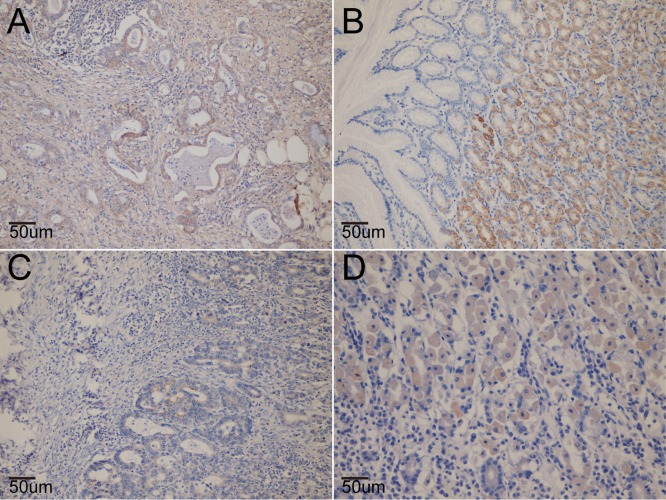
The Sequenom MassARRAY platform was used to genotype 1842 individuals for MTOR rs1064261 T→C and AKT rs1130233 G→A polymorphisms. ELISA was used to detect Helicobacter pylori antibodies in serum. Immunohistochemical analysis was used to detect total and phosphorylated MTOR and AKT proteins.
The MTOR rs1064261 (TC+CC) genotype and the AKT rs1130233 (GA+AA) genotype were associated with increased risk of GC in men (P = 0.049, P = 0.030). In H. pylori-negative individuals, the AKT rs1130233 GA and (GA+AA) genotypes were related to increased risk of atrophic gastritis (AG; P = 0.012, P = 0.024). Notably, the AKT rs1130233 (GA+AA) genotype demonstrated significant interactions with H. pylori in disease progression from healthy controls (CON) to AG (P = 0.013) and from AG to GC (P = 0.049). Additionally, for individuals with the AKT rs1130233 variant, those in the H. pylori-positive group had higher levels of phosphorylated AKT (p-AKT) expression. The AKT rs1130233 genotype was found to be associated with clinicopathological parameters including lymph node metastasis and alcohol drinking (P<0.05).
MTOR rs1064261and AKT rs1130233 polymorphisms were associated with increased GC risk in males and increased AG risk in H. pylori-negative individuals. A significant interaction existed between the AKT rs1130233 genotype and H. pylori infection in CON→AG→GC disease progression. The AKT rs1130233 genotype influenced p-AKT protein expression in H. pylori-infected individuals.
磷酸肌醇3激酶(PI3K)/蛋白激酶B(PKB,AKT)/雷帕霉素哺乳动物靶蛋白(mTOR)信号通路在血管生成以及细胞生长、增殖、代谢、迁移、分化和凋亡过程中发挥着关键作用。该通路关键因子的基因多样性可能会影响蛋白质功能和信号转导,从而导致疾病的发生和进展。研究表明,mTOR rs1064261和AKT rs1130233多态性与多种癌症类型的风险和/或预后相关。然而,其与胃癌(GC)的关系仍不明确。本研究旨在探讨mTOR和AKT多态性在GC风险和预后中的作用。
采用Sequenom MassARRAY平台对1842名个体的mTOR rs1064261 T→C和AKT rs1130233 G→A多态性进行基因分型。采用酶联免疫吸附测定法(ELISA)检测血清中的幽门螺杆菌抗体。采用免疫组化分析检测总mTOR和磷酸化mTOR以及总AKT和磷酸化AKT蛋白。
mTOR rs1064261(TC+CC)基因型和AKT rs1130233(GA+AA)基因型与男性GC风险增加相关(P = 0.049,P = 0.030)。在幽门螺杆菌阴性个体中,AKT rs1130233 GA和(GA+AA)基因型与萎缩性胃炎(AG)风险增加相关(P = 0.012,P = 0.024)。值得注意的是,AKT rs1130233(GA+AA)基因型在从健康对照(CON)到AG(P = 0.013)以及从AG到GC(P = 0.049)的疾病进展过程中与幽门螺杆菌存在显著相互作用。此外,对于携带AKT rs1130233变异的个体,幽门螺杆菌阳性组的磷酸化AKT(p-AKT)表达水平更高。发现AKT rs1130233基因型与包括淋巴结转移和饮酒在内的临床病理参数相关(P<0.05)。
mTOR rs1064261和AKT rs1130233多态性与男性GC风险增加以及幽门螺杆菌阴性个体AG风险增加相关。在CON→AG→GC疾病进展过程中,AKT rs1130233基因型与幽门螺杆菌感染之间存在显著相互作用。AKT rs1130233基因型影响幽门螺杆菌感染个体的p-AKT蛋白表达。