Nouraie Mehdi, Kansal Vandana, Belfonte Cassius, Ghazvini Mohammad, Haidari Tahmineh, Shahnazi Anahita, Brim Hassan, Soliman Elsayed Z, Ashktorab Hassan
Cancer Research Center, and Department of Medicine, Howard University College of Medicine, Washington, District of Columbia, United States of America.
Department of Medicine, Division of Cardiology, Howard University College of Medicine, Washington, District of Columbia, United States of America.
PLoS One. 2015 Aug 28;10(8):e0135609. doi: 10.1371/journal.pone.0135609. eCollection 2015.
Colorectal cancer (CRC) and atrial fibrillation/flutter (AF) share several risk factors including increasing age and obesity. However, the association between CRC and AF has not been thoroughly examined, especially in African Americans. In this study we aimed to assess the prevalence of AF and its risk factors in colorectal neoplasia in an African American.
We reviewed records of 527 African American patients diagnosed with CRC and 1008 patients diagnosed with benign colonic lesions at Howard University Hospital from January 2000 to December 2012. A control group of 731 hospitalized patients without any cancer or colonic lesion were randomly selected from the same time and age range, excluding patients who had diagnosis of both CRC and/or adenoma. The presence or absence of AF was based upon ICD-9 code documentation. The prevalence of AF in these three groups was compared by multivariate logistic regression.
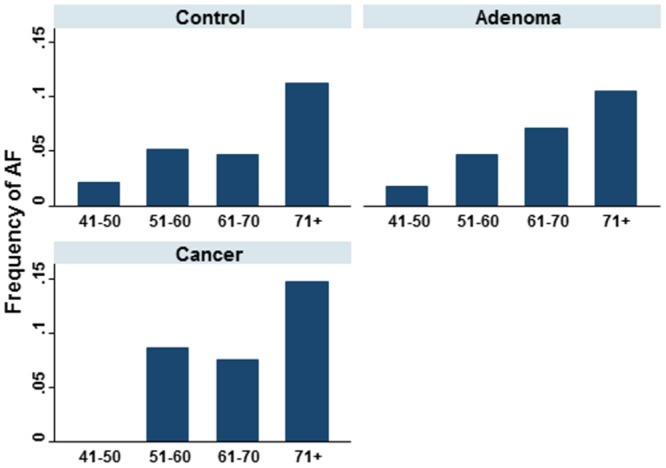
The prevalence of AF was highest among CRC patients (10%) followed by adenoma patients (7.2%) then the control group (5.4%, P for trend = 0.002). In the three groups of participants, older age (P<0.008) and heart failure (P<0.001) were significantly associated with higher risk of AF. After adjusting for these risk factors, CRC (OR: 1.4(95%CI):0.9-2.2, P = 0.2) and adenoma (OR: 1.1(95%CI):0.7-1.6, P = 0.7) were not significantly associated AF compared to control group.
AF is highly prevalent among CRC patients; 1 in 10 patients had AF in our study. The predictors of AF in CRC was similar to that in adenoma and other patients after adjustment for potential confounders suggesting that the increased AF risk in CRC is explained by higher prevalence of AF risk factors.
结直肠癌(CRC)和心房颤动/扑动(AF)有若干共同的风险因素,包括年龄增长和肥胖。然而,CRC与AF之间的关联尚未得到充分研究,尤其是在非裔美国人中。在本研究中,我们旨在评估非裔美国人结直肠肿瘤中AF的患病率及其风险因素。
我们回顾了2000年1月至2012年12月在霍华德大学医院诊断为CRC的527例非裔美国患者以及诊断为良性结肠病变的1008例患者的记录。从同一时期和年龄范围内随机选择731例无任何癌症或结肠病变的住院患者作为对照组,排除同时诊断为CRC和/或腺瘤的患者。AF的有无基于国际疾病分类第九版(ICD-9)编码记录。通过多因素逻辑回归比较这三组中AF的患病率。
AF的患病率在CRC患者中最高(10%),其次是腺瘤患者(7.2%),然后是对照组(5.4%,趋势P值 = 0.002)。在三组参与者中,年龄较大(P<0.008)和心力衰竭(P<0.001)与AF风险较高显著相关。在调整这些风险因素后,与对照组相比,CRC(比值比:1.4(95%置信区间):0.9 - 2.2,P = 0.2)和腺瘤(比值比:1.1(95%置信区间):0.7 - 1.6,P = 0.7)与AF无显著关联。
AF在CRC患者中高度流行;在我们的研究中,每10名患者中有1例患有AF。在调整潜在混杂因素后,CRC中AF的预测因素与腺瘤及其他患者相似,这表明CRC中AF风险增加是由AF风险因素的较高患病率所解释的。