Semahegn Agumasie, Mengistie Bezatu
College of Health and Medical Sciences, Haramaya University, Po. Box- 235, Harar, Ethiopia.
Reprod Health. 2015 Aug 29;12:78. doi: 10.1186/s12978-015-0072-1.
Violence against women is now widely recognized as a serious human right abuse, and an important public health problem with substantial consequences physical, mental, sexual, and reproductive health. Data on systematic review of domestic violence are needed to support policy and program recommendations. Therefore, the overall purpose of this systematic review was to assess magnitude of domestic violence against women and associated factors in Ethiopia.
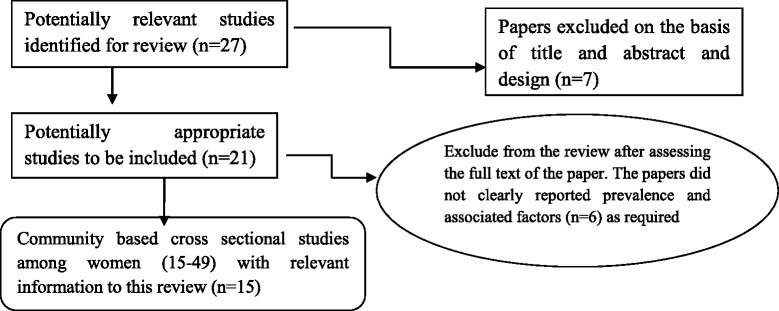
Studies systematically reviewed in Federal Democratic Republic of Ethiopia from 2000 to 2014. Systematic review was employed on published research works from databases such as Pubmed, popline, Hinari, and Google using key words. We also consulted public health experts. Community based studies with a study population (15-49 years) were included for review. Thirteen peer reviewed papers and two consecutive Ethiopian demographic and health surveys (2005 and 2011) were included to the systematic review. Twenty seven available in open access journals were retrieved and assessed based on the criteria's such as community based study, cross sectional study design, clearly report prevalence and associated factors were included in the systematic review work. Finally, 15 papers were included in this review.
Lifetime prevalence of domestic violence against women by husband or intimate partner among 10 studies ranged from 20 to 78 %. The lifetime domestic physical violence by husband or intimate partner against women ranged from 31 to 76.5 %. The life time domestic sexual violence against women by husband or intimate partner ranged from 19.2 to 59 %. The mean life time prevalence of domestic emotional violence was 51.7 %. Significant number of women experienced violence during their pregnancy period. Domestic violence against women significantly associated with alcohol consumption, chat chewing, family history of violence, occupation, religion, educational status, residence and decision making power.
Domestic violence against women was relatively high in different parts of Ethiopia. Domestic violence has direct relationship with sociodemographic characteristics of the victim as well as perpetrator. Therefore, appropriate health promotion information activities needed to tackle associated factors of domestic violence against women or to prevent and control the problem to save women from being victim.
对妇女的暴力行为如今已被广泛视为严重侵犯人权的行为,也是一个对身体、心理、性健康和生殖健康产生重大影响的重要公共卫生问题。需要有关家庭暴力的系统综述数据来支持政策和项目建议。因此,本系统综述的总体目的是评估埃塞俄比亚针对妇女的家庭暴力程度及相关因素。
对2000年至2014年在埃塞俄比亚联邦民主共和国进行的研究进行系统综述。使用关键词对来自PubMed、Popline、Hinari和谷歌等数据库的已发表研究成果进行系统综述。我们还咨询了公共卫生专家。纳入了以社区为基础、研究人群为15至49岁的研究进行综述。十三篇经同行评审的论文以及埃塞俄比亚连续两次人口与健康调查(2005年和2011年)被纳入该系统综述。检索了开放获取期刊上的27篇文献,并根据诸如以社区为基础的研究、横断面研究设计、明确报告患病率和相关因素等标准进行评估,将符合条件的文献纳入系统综述工作。最后,15篇论文被纳入本综述。
在10项研究中,丈夫或亲密伴侣对妇女的终身家庭暴力患病率在20%至78%之间。丈夫或亲密伴侣对妇女的终身家庭暴力身体暴力患病率在31%至76.5%之间。丈夫或亲密伴侣对妇女的终身家庭暴力性暴力患病率在19.2%至59%之间。家庭情感暴力的平均终身患病率为51.7%。相当数量的妇女在孕期遭受暴力。对妇女的家庭暴力与饮酒、嚼恰特草、暴力家族史、职业、宗教、教育程度、居住地和决策权显著相关。
埃塞俄比亚不同地区针对妇女的家庭暴力发生率相对较高。家庭暴力与受害者以及施暴者的社会人口学特征直接相关。因此,需要开展适当的健康促进宣传活动,以应对针对妇女的家庭暴力相关因素,或预防和控制这一问题,使妇女免遭侵害。