Regeer Madelien V, van Rosendael Philippe J, Kamperidis Vasileios, Schalij Martin J, Bax Jeroen J, Marsan Nina Ajmone, Delgado Victoria
Heart Lung Center Leiden, Leiden University Medical Center, Leiden, The Netherlands.
Department of Cardiology, Leiden University Medical Center, Albinusdreef 2, 2333 ZA, Leiden, The Netherlands.
Int J Cardiovasc Imaging. 2015 Dec;31(8):1583-90. doi: 10.1007/s10554-015-0749-0. Epub 2015 Aug 29.
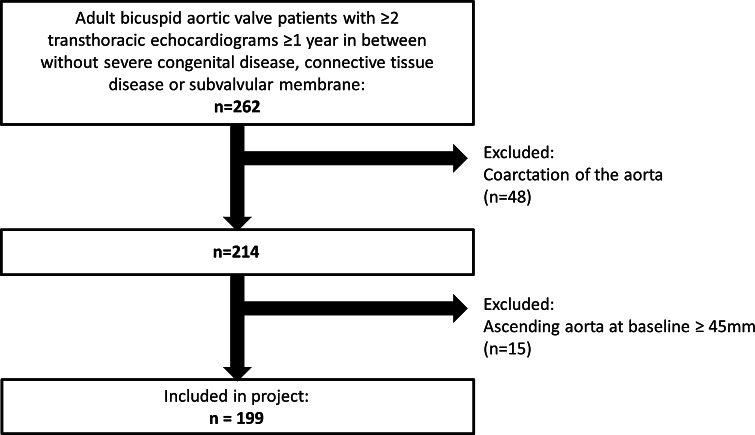
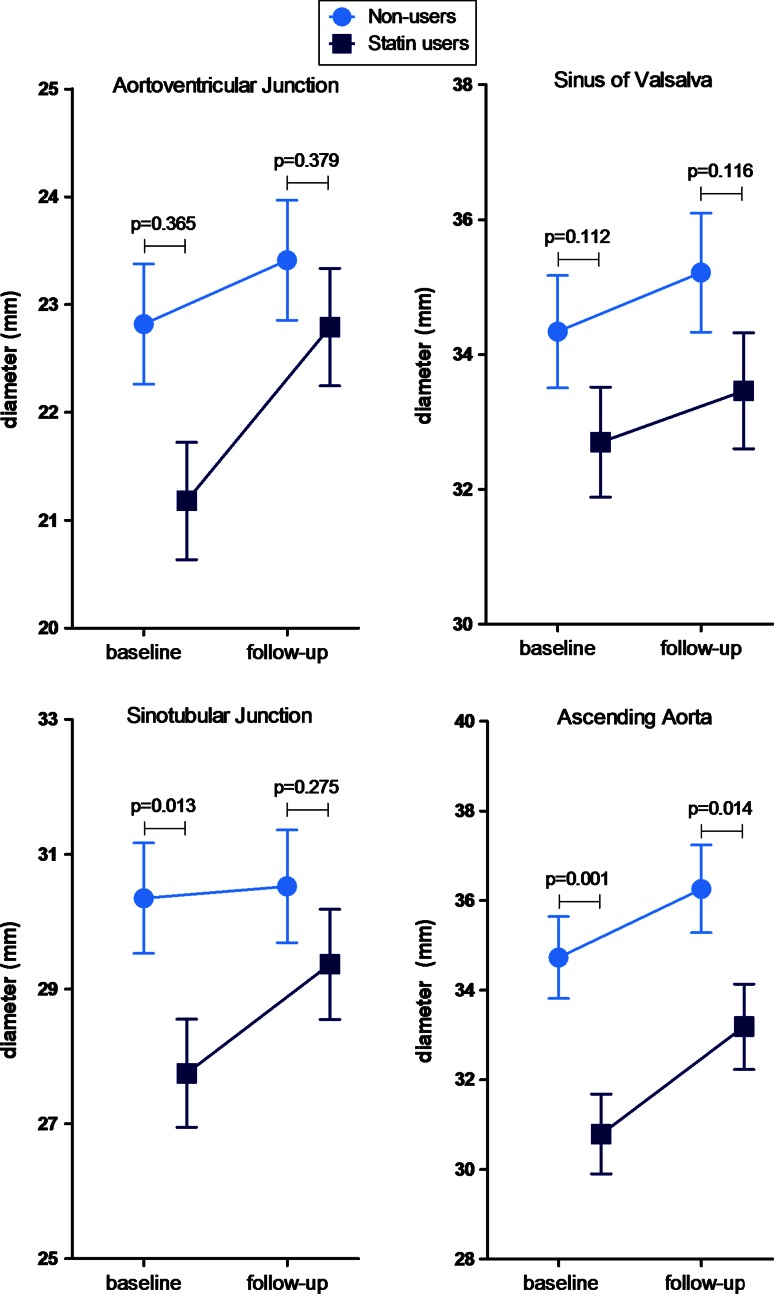
Bicuspid aortic valve (BAV) anatomy is associated with increased growth rate of the aortic root compared to tricuspid aortic valves. Statins decrease the growth rate of abdominal aneurysms; however their effect on the aortic root growth rate has not been elucidated. The present study evaluated the association between use of statins and aortic root growth in patients with BAV. A total of 199 patients (43 ± 15 years, 69% male) with BAV who underwent ≥ 2 echocardiographic measurements of the aortic root ≥ 1 year apart were included in this retrospective observational study. Median follow-up duration was 4.7 years (interquartile range 2.7-8.3 years). Growth rate (mm/year) of the aortic root was compared between statin users (n = 41) and non-users (n = 158). Statin users were significantly older and had more cardiovascular risk factors than their counterparts. Ascending aorta diameter was significantly smaller at baseline and at follow-up in statin users compared with non-users when adjusted for coronary artery disease, age and medication. The average annual growth rate was 0.08 mm/year (95% confidence interval 0.03-0.13) for the aortoventricular junction, 0.16 mm/year (0.11-0.21) for the sinus of Valsalva, 0.12 mm/year (0.07-0.17) for the sinotubular junction and 0.45 mm/year (0.37-0.53) for the ascending aorta. The dilation rate of the aortic segments was not different between statin users and non-users. In conclusion, in patients with BAV, although the use of statins was associated with smaller ascending aorta, the annual dilation rate of the aortic root was not influenced by the use of statins.
与三尖瓣主动脉瓣相比,二叶式主动脉瓣(BAV)的解剖结构与主动脉根部生长速率增加有关。他汀类药物可降低腹主动脉瘤的生长速率;然而,其对主动脉根部生长速率的影响尚未阐明。本研究评估了BAV患者使用他汀类药物与主动脉根部生长之间的关联。这项回顾性观察性研究纳入了总共199例(43±15岁,69%为男性)BAV患者,这些患者接受了间隔≥1年的≥2次主动脉根部超声心动图测量。中位随访时间为4.7年(四分位间距2.7 - 8.3年)。比较了他汀类药物使用者(n = 41)和非使用者(n = 158)之间主动脉根部的生长速率(mm/年)。他汀类药物使用者比非使用者年龄显著更大,且有更多心血管危险因素。在调整冠状动脉疾病、年龄和用药情况后,他汀类药物使用者在基线和随访时的升主动脉直径均显著小于非使用者。主动脉心室连接处的年均生长速率为0.08 mm/年(95%置信区间0.03 - 0.13),主动脉瓣窦为0.16 mm/年(0.11 - 0.21),窦管交界处为0.12 mm/年(0.07 - 0.17),升主动脉为0.45 mm/年(0.37 - 0.53)。他汀类药物使用者和非使用者之间主动脉各节段的扩张速率没有差异。总之,在BAV患者中,尽管使用他汀类药物与较小的升主动脉有关,但主动脉根部的年扩张速率不受他汀类药物使用的影响。