Sinha Debasish, Valapala Mallika, Shang Peng, Hose Stacey, Grebe Rhonda, Lutty Gerard A, Zigler J Samuel, Kaarniranta Kai, Handa James T
Wilmer Eye Institute, The Johns Hopkins University School of Medicine, Baltimore, MD, USA.
Wilmer Eye Institute, The Johns Hopkins University School of Medicine, Baltimore, MD, USA.
Exp Eye Res. 2016 Mar;144:46-53. doi: 10.1016/j.exer.2015.08.018. Epub 2015 Aug 28.
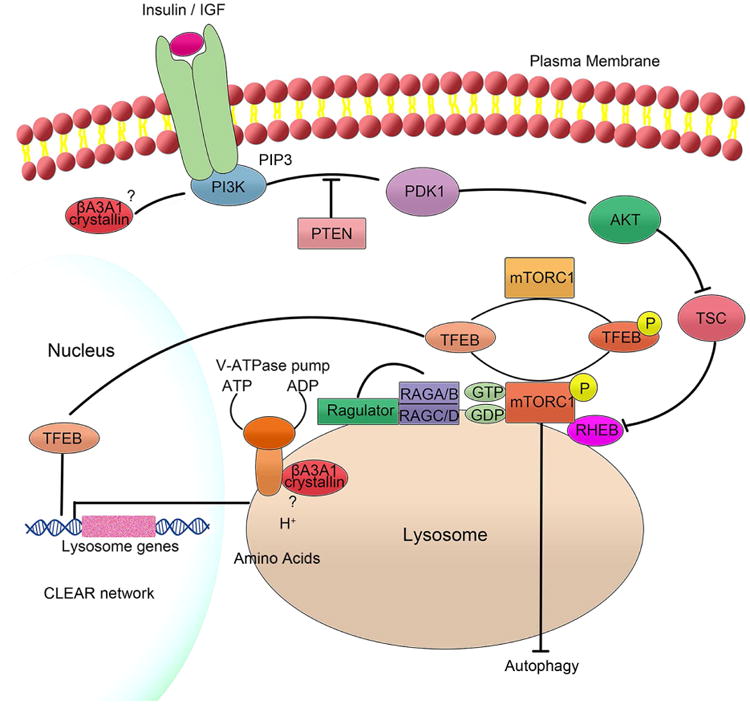
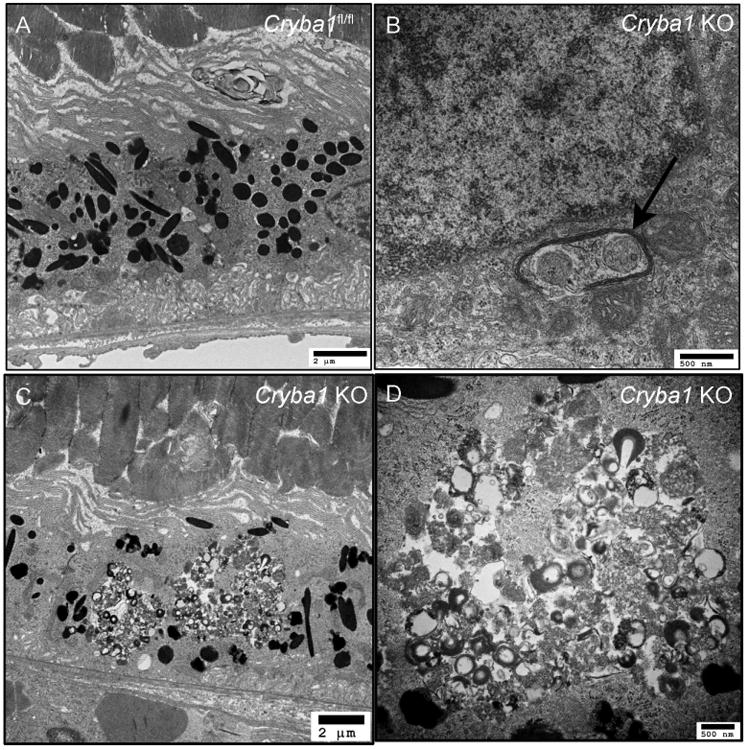
The retinal pigmented epithelium (RPE) is critically important to retinal homeostasis, in part due to its very active processes of phagocytosis and autophagy. Both of these processes depend upon the normal functioning of lysosomes, organelles which must fuse with (auto)phagosomes to deliver the hydrolases that effect degradation of cargo. It has become clear that signaling through mTOR complex 1 (mTORC1), is very important in the regulation of lysosomal function. This signaling pathway is becoming a target for therapeutic intervention in diseases, including age-related macular degeneration (AMD), where lysosomal function is defective. In addition, our laboratory has been studying animal models in which the gene (Cryba1) for βA3/A1-crystallin is deficient. These animals exhibit impaired lysosomal clearance in the RPE and pathological signs that are similar to some of those seen in AMD patients. The data demonstrate that βA3/A1-crystallin localizes to lysosomes in the RPE and that it is a binding partner of V-ATPase, the proton pump that acidifies the lysosomal lumen. This suggests that βA3/A1-crystallin may also be a potential target for therapeutic intervention in AMD. In this review, we focus on effector molecules that impact the lysosomal-autophagic pathway in RPE cells.
视网膜色素上皮(RPE)对视网膜内环境稳定至关重要,部分原因在于其活跃的吞噬作用和自噬过程。这两个过程均依赖于溶酶体的正常功能,溶酶体是一种细胞器,必须与(自)吞噬体融合以提供能降解货物的水解酶。目前已经明确,通过mTOR复合物1(mTORC1)进行的信号传导在溶酶体功能的调节中非常重要。这条信号通路正成为包括年龄相关性黄斑变性(AMD)在内的溶酶体功能缺陷疾病治疗干预的靶点。此外,我们实验室一直在研究βA3/A1 - 晶体蛋白基因(Cryba1)缺陷的动物模型。这些动物的RPE中溶酶体清除功能受损,并且表现出与AMD患者所见的一些病理体征相似的症状。数据表明,βA3/A1 - 晶体蛋白定位于RPE中的溶酶体,并且它是V - ATPase的结合伴侣,V - ATPase是使溶酶体腔酸化的质子泵。这表明βA3/A1 - 晶体蛋白也可能是AMD治疗干预的潜在靶点。在这篇综述中,我们重点关注影响RPE细胞中溶酶体 - 自噬途径的效应分子。