Nagata Keiko, Okuno Keisuke, Ochi Marika, Kumata Keisuke, Sano Hitoshi, Yoneda Naohiro, Ueyama Jun-Ichi, Matsushita Michiko, Kuwamoto Satoshi, Kato Masako, Murakami Ichiro, Kanzaki Susumu, Hayashi Kazuhiko
Division of Molecular Pathology, Department of Pathology, Faculty of Medicine, Tottori University, 86 Nishi-cho, Yonago, Tottori 683-8503 Japan.
Division of Pediatrics and Perinatology, Department of Multidisciplinary Internal Medicine, Tottori University, 36-1 Nishi-cho, Yonago, Tottori 683-8504 Japan.
Springerplus. 2015 Aug 27;4:456. doi: 10.1186/s40064-015-1236-8. eCollection 2015.
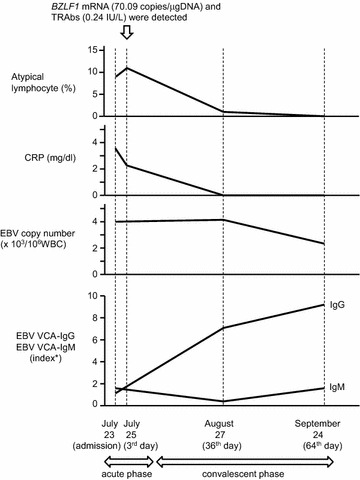
Various autoantibodies have been reported to be detected during the progression of infectious mononucleosis. We observed a case of infectious mononucleosis due to Epstein-Barr virus primary infection for 2 months, and noticed the transiently increased titer of thyrotropin receptor autoantibodies detected at the acute phase on the 3rd day after admission. At that time, real-time quantitative PCR also revealed the mRNA expressions of an immediate early lytic gene, BZLF1, and a latent gene, EBNA2. The expression of BZLF1 mRNA means that Epstein-Barr virus infects lytically, and EBNA2 protein has an important role in antibody production as well as the establishment of Epstein-Barr virus latency. These results suggest that Epstein-Barr virus lytic infection is relevant to thyrotropin receptor autoantibody production. Thyrotropin receptor autoantibodies stimulate thyroid follicular cells to produce excessive thyroid hormones and cause Graves' disease. Recently, we reported the thyrotropin receptor autoantibody production from thyrotropin receptor autoantibody-predisposed Epstein-Barr virus-infected B cells by the induction of Epstein-Barr virus lytic infection in vitro. This case showed in vivo findings consistent with our previous reports, and is important to consider the pathophysiology of Graves' disease and one of the mechanisms of autoimmunity.
据报道,在传染性单核细胞增多症进展过程中可检测到多种自身抗体。我们观察了一例因爱泼斯坦-巴尔病毒初次感染导致的传染性单核细胞增多症患者,病程2个月,发现入院后第3天急性期促甲状腺素受体自身抗体滴度短暂升高。当时,实时定量PCR还显示了即刻早期裂解基因BZLF1和潜伏基因EBNA2的mRNA表达。BZLF1 mRNA的表达意味着爱泼斯坦-巴尔病毒进行裂解感染,而EBNA2蛋白在抗体产生以及爱泼斯坦-巴尔病毒潜伏的建立中具有重要作用。这些结果表明,爱泼斯坦-巴尔病毒裂解感染与促甲状腺素受体自身抗体的产生有关。促甲状腺素受体自身抗体刺激甲状腺滤泡细胞产生过量甲状腺激素,从而导致格雷夫斯病。最近,我们报道了在体外通过诱导爱泼斯坦-巴尔病毒裂解感染,从易产生促甲状腺素受体自身抗体的爱泼斯坦-巴尔病毒感染的B细胞中产生促甲状腺素受体自身抗体。该病例显示的体内结果与我们之前的报道一致,对于理解格雷夫斯病的病理生理学和自身免疫机制之一具有重要意义。