Pal Shekhar, Juyal Deepak, Adekhandi Shamanth, Sharma Munesh, Prakash Rajat, Sharma Neelam, Rana Amit, Parihar Ashwin
Department of Microbiology and Immunology, Veer Chandra Singh Garhwali Government Medical Sciences and Research Institute, Srinagar Garhwal, Uttarakhand, India.
Department of Medical Microbiology, Post Graduate Institute of Medical Education and Research, Chandigarh, India.
Adv Biomed Res. 2015 Jul 27;4:144. doi: 10.4103/2277-9175.161553. eCollection 2015.
Global burden of hospital-associated infection (HAI) is on the rise and contributes significantly to morbidity and mortality of the patients. Mobile phones are indispensible part of communication among doctors and other health care workers (HCWs) in hospitals. Hands of HCWs play an important role in transmission of HAI and mobile phones which are seldom cleaned and often touched during or after the examination of patients without hand washing can act as a reservoir for transmission of potent pathogens. This study aimed to investigate the rate of bacterial contamination of mobile phones among HCWs in our tertiary care hospital and to compare it with personal mobile phones of non-HCWs (control group).
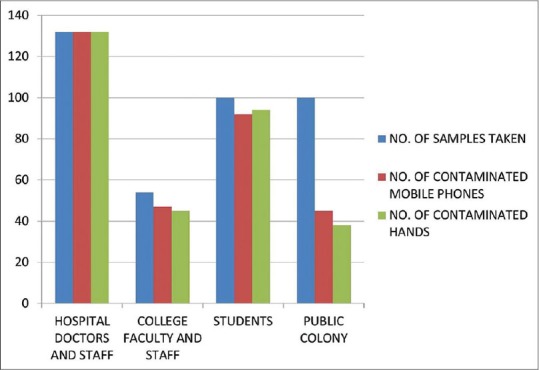
The mobile phones and dominant hands of 386 participants were sampled from four different groups, hospital doctors and staff (132), college faculty and staff (54), medical students (100) and control group (100). Informed consent and questionnaire was duly signed by all the participants. Samples were processed according to standard guidelines.
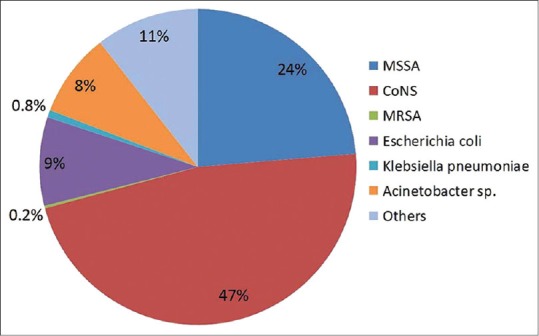
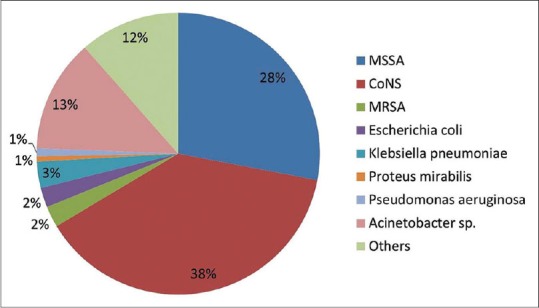
316 mobile phones (81.8%) and 309 hand swab samples (80%) showed growth of bacterial pathogens. The most predominant isolates were Coagulase-negative Staphylococcus, Staphylococcus aureus, Acinetobacter species, Escherichia coli, Klebsiella pneumoniae, Pseudomonas species and Enterococcus species.
Hundred percent contamination was found in mobile phones and hands of HCWs indicating mobile phones can be the potential source of nosocomial pathogens. Our study results suggest that use of mobile phones in health care setup should be restricted only for emergency calls. Strict adherence to infection control policies such as proper hand hygiene practices should be followed.
医院感染(HAI)的全球负担正在上升,对患者的发病率和死亡率有重大影响。手机是医院医生和其他医护人员(HCW)之间沟通不可或缺的一部分。医护人员的手在医院感染传播中起重要作用,而手机很少清洁,在检查患者期间或之后经常被触摸且未洗手,可能成为强效病原体传播的储存库。本研究旨在调查我们三级护理医院中医护人员手机的细菌污染率,并将其与非医护人员的个人手机(对照组)进行比较。
从四个不同组中抽取386名参与者的手机和优势手样本,分别是医院医生和工作人员(132名)、高校教职员工(54名)、医学生(100名)和对照组(100名)。所有参与者均签署了知情同意书和问卷。样本按照标准指南进行处理。
316部手机(81.8%)和309份手部拭子样本(80%)显示有细菌病原体生长。最主要的分离株是凝固酶阴性葡萄球菌、金黄色葡萄球菌、不动杆菌属、大肠杆菌、肺炎克雷伯菌、假单胞菌属和肠球菌属。
在医护人员的手机和手上发现了100%的污染,表明手机可能是医院病原体的潜在来源。我们的研究结果表明,在医疗环境中使用手机应仅限于紧急呼叫。应严格遵守感染控制政策,如正确的手部卫生习惯。