Burchell Ann N, Gardner Sandra, Light Lucia, Ellis Brooke M, Antoniou Tony, Bacon Jean, Benoit Anita, Cooper Curtis, Kendall Claire, Loutfy Mona, McGee Frank, Raboud Janet, Rachlis Anita, Wobeser Wendy, Rourke Sean B
*Ontario HIV Treatment Network, Toronto, Ontario, Canada; Departments of †Epidemiology; ‡Biostatistics, Dalla Lana School of Public Health, University of Toronto, Toronto, Ontario, Canada; §Li Ka Shing Knowledge Institute, St. Michael's Hospital, Toronto, Ontario, Canada; ‖Department of Family and Community Medicine, St. Michael's Hospital and University of Toronto, Toronto, Ontario, Canada; ¶Women's College Research Institute, Women's College Hospital, Toronto, Ontario, Canada; #Ottawa Hospital Research Institute, Ottawa, Ontario, Canada; **Bruyère Research Institute, Ottawa, Ontario, Canada; ††Department of Family Medicine, University of Ottawa, Ottawa, Ontario, Canada; ‡‡Institute of Health Policy, Management and Evaluation, Dalla Lana School of Public Health, University of Toronto, Toronto, Ontario, Canada; §§Department of Medicine, Women's College Research Institute, Women's College Hospital, Toronto, Ontario, Canada; ‖‖Department of Medicine, University of Toronto, Toronto, Ontario, Canada; ¶¶AIDS Bureau, Ontario Ministry of Health and Long-Term Care, Toronto, Ontario, Canada; ##Toronto General Research Institute, University Health Network, Toronto, Ontario, Canada; ***Sunnybrook Health Sciences Centre, Toronto, Ontario, Canada; †††Department of Medicine, Queen's University, Kingston, Ontario, Canada; ‡‡‡Hotel Dieu Hospital, Kingston, Ontario, Canada; and §§§Department of Psychiatry, University of Toronto, Toronto, Ontario, Canada.
J Acquir Immune Defic Syndr. 2015 Sep 1;70(1):e10-9. doi: 10.1097/QAI.0000000000000690.
Ensuring that people living with HIV are accessing and staying in care is vital to achieving optimal health outcomes including antiretroviral therapy (ART) success. We sought to characterize engagement in HIV care among participants of a large clinical cohort in Ontario, Canada, from 2001 to 2011.
The Ontario HIV Treatment Network Cohort Study (OCS) is a multisite HIV clinical cohort, which conducts record linkage with the provincial public health laboratory for viral load tests. We estimated the annual proportion meeting criteria for being in care (≥1 viral load per year), in continuous care (≥2 viral load per year ≥90 days apart), on ART, and with suppressed viral load <200 copies per milliliter. Ratios of proportions according to socio-demographic and clinical characteristics were examined using multivariable generalized estimating equations with a log-link.
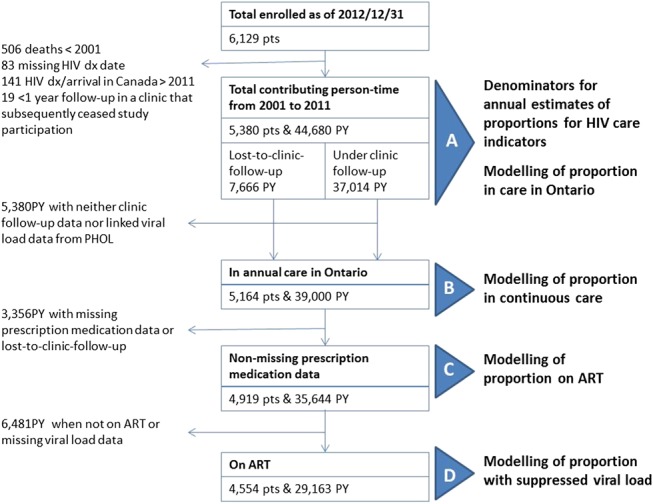
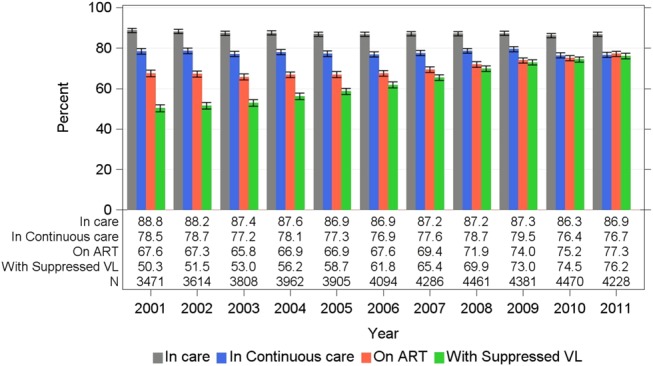
A total of 5380 participants were followed over 44,680 person-years. From 2001 to 2011, we observed high and constant proportions of patients in HIV care (86.3%-88.8%) and in continuous care (76.4%-79.5%). There were statistically significant rises over time in the proportions on ART and with suppressed viral load; by 2011, a majority of patients were on ART (77.3%) and had viral suppression (76.2%). There was minimal variation in HIV engagement indicators by socio-demographic and HIV risk characteristics.
In a setting with universal health care, we observed high proportions of HIV care engagement over time and an increased proportion of patients attaining successful virologic suppression, likely due to improvements in ART regimens and changing guidelines.
确保艾滋病毒感染者获得并持续接受治疗对于实现包括抗逆转录病毒疗法(ART)成功在内的最佳健康结果至关重要。我们试图描述2001年至2011年加拿大安大略省一个大型临床队列参与者在艾滋病毒治疗方面的参与情况。
安大略省艾滋病毒治疗网络队列研究(OCS)是一个多地点的艾滋病毒临床队列,它与省级公共卫生实验室进行记录链接以进行病毒载量检测。我们估计了每年符合接受治疗标准(每年≥1次病毒载量检测)、持续接受治疗(每年≥2次病毒载量检测且间隔≥90天)、接受抗逆转录病毒治疗以及病毒载量被抑制至<200拷贝/毫升的比例。根据社会人口统计学和临床特征的比例比值,使用带有对数链接的多变量广义估计方程进行检验。
在44680人年的时间里,共对5380名参与者进行了随访。从2001年到2011年,我们观察到接受艾滋病毒治疗的患者比例较高且保持稳定(86.3%-88.8%),持续接受治疗的比例也较高(76.4%-79.5%)。接受抗逆转录病毒治疗和病毒载量被抑制的比例随时间有统计学意义的上升;到2011年,大多数患者接受了抗逆转录病毒治疗(77.3%)且病毒得到抑制(76.2%)。艾滋病毒参与指标在社会人口统计学和艾滋病毒风险特征方面的差异最小。
在全民医疗保健的环境中,我们观察到随着时间推移,艾滋病毒治疗的参与比例较高,且实现病毒学成功抑制的患者比例有所增加,这可能归因于抗逆转录病毒治疗方案的改进和指南的变化。