Lupberger Joachim, Casanova Claudia, Fischer Benoit, Weiss Amelie, Fofana Isabel, Fontaine Nelly, Fujiwara Toshinobu, Renaud Mickael, Kopp Arnaud, Schuster Catherine, Brino Laurent, Baumert Thomas F, Thoma Christian
Inserm U1110, Institut de Recherche sur les Maladies Virales et Hépatiques Strasbourg, France.
Université de Strasbourg, France.
Sci Rep. 2015 Sep 1;5:13344. doi: 10.1038/srep13344.
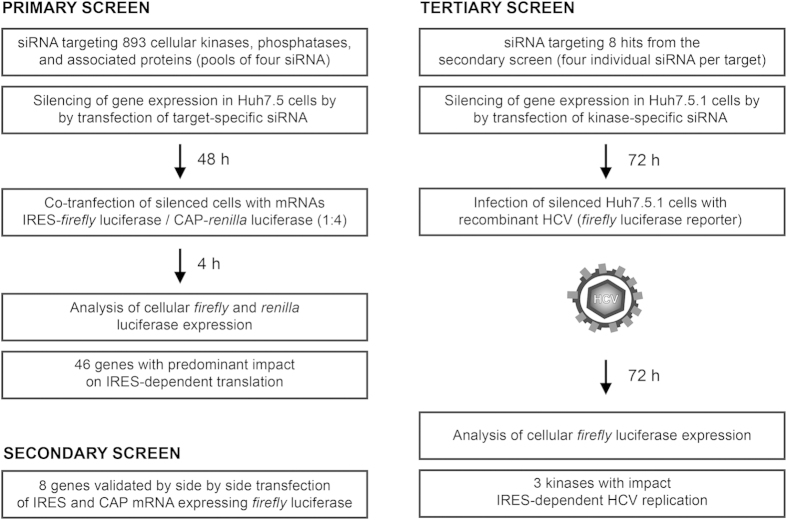
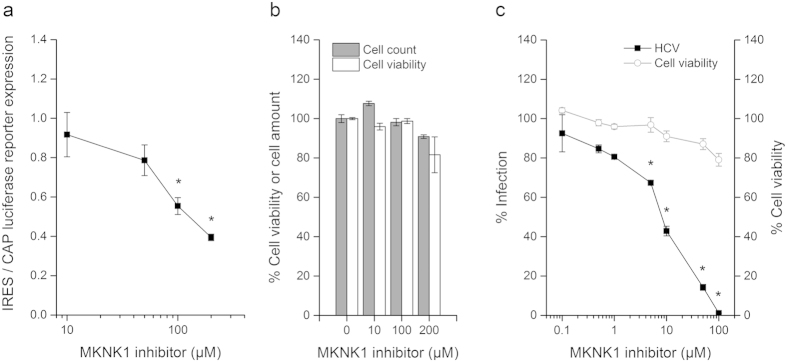
Cellular translation is down-regulated by host antiviral responses. Picornaviridae and Flaviviridae including hepatitis C virus (HCV) evade this process using internal ribosomal entry sequences (IRESs). Although HCV IRES translation is a prerequisite for HCV replication, only few host factors critical for IRES activity are known and the global regulator network remains largely unknown. Since signal transduction is an import regulator of viral infections and the host antiviral response we combined a functional RNAi screen targeting the human signaling network with a HCV IRES-specific reporter mRNA assay. We demonstrate that the HCV host cell cofactors PI4K and MKNK1 are positive regulators of HCV IRES translation representing a novel pathway with a functional relevance for the HCV life cycle and IRES-mediated translation of viral RNA.
细胞翻译受宿主抗病毒反应的下调。包括丙型肝炎病毒(HCV)在内的小核糖核酸病毒科和黄病毒科利用内部核糖体进入序列(IRES)逃避这一过程。虽然HCV IRES翻译是HCV复制的先决条件,但对IRES活性至关重要的宿主因子知之甚少,整体调节网络在很大程度上仍不清楚。由于信号转导是病毒感染和宿主抗病毒反应的重要调节因子,我们将针对人类信号网络的功能性RNA干扰筛选与HCV IRES特异性报告mRNA检测相结合。我们证明,HCV宿主细胞辅因子PI4K和MKNK1是HCV IRES翻译的正调节因子,代表了一条与HCV生命周期和病毒RNA的IRES介导翻译具有功能相关性的新途径。