Mangini Neha S, Wesolowski Robert, Ramaswamy Bhuvaneswari, Lustberg Maryam B, Berger Michael J
The James Cancer Hospital at the Ohio State University, Columbus, OH, USA.
The Ohio State University Comprehensive Cancer Center, Columbus, OH, USA.
Ann Pharmacother. 2015 Nov;49(11):1252-60. doi: 10.1177/1060028015602273. Epub 2015 Aug 31.
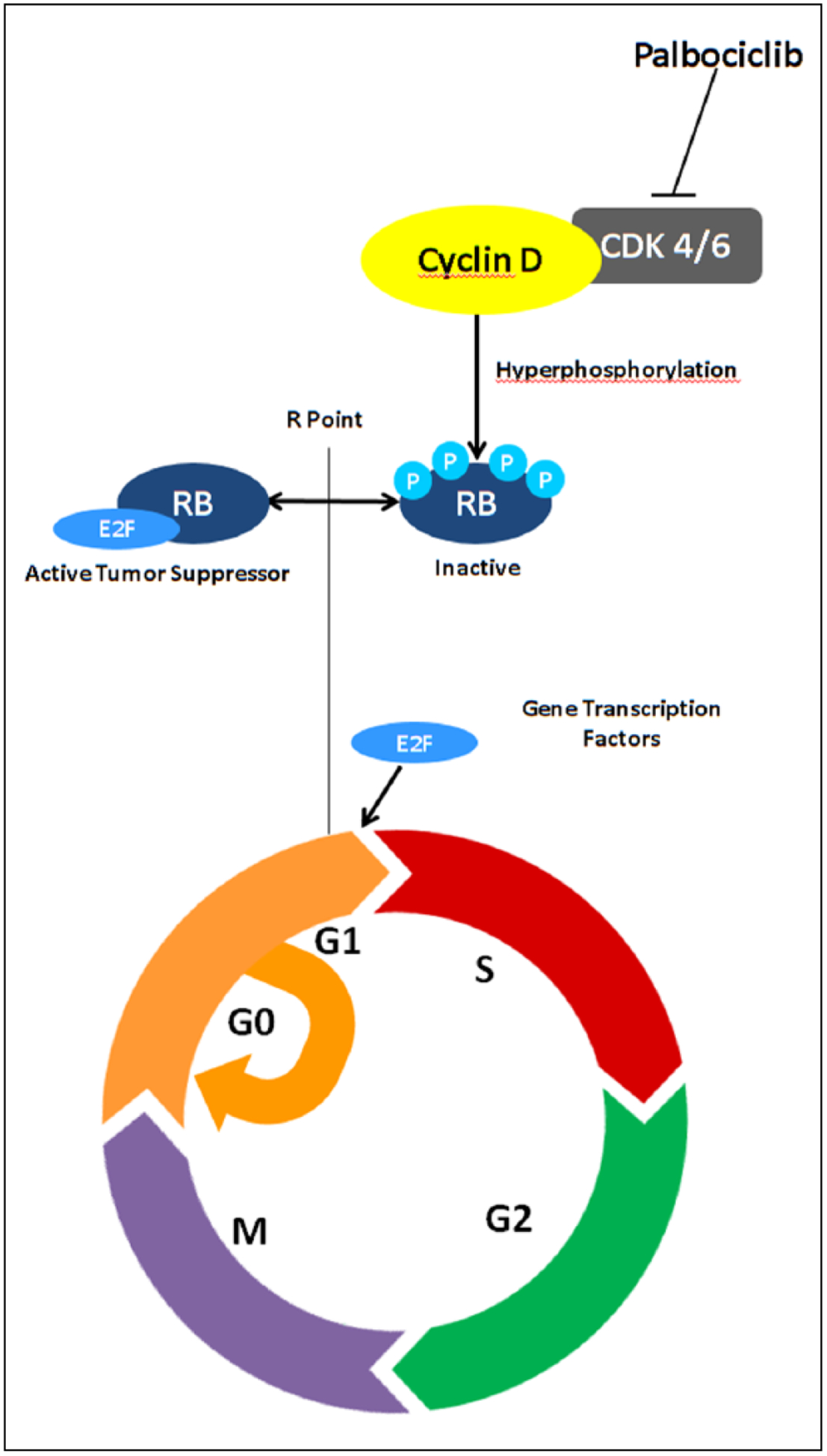
To review palbociclib, a novel small-molecule inhibitor of cyclin-dependent kinases 4 and 6, and its current place in therapy for the treatment of hormone receptor (HMR)-positive, human epidermal growth factor receptor 2 (Her2)-negative advanced breast cancer.
Four phase I trials, 2 phase II trials, and 1 phase III trial were identified from May 2004 to May 2015 using PubMed, American Society of Clinical Oncology (ASCO) abstracts, and European Society of Medical Oncology (ESMO) abstracts.
In the first-line setting, the phase II PALbociclib: Ongoing trials in the Management of breast cAncer (PALOMA)-1 trial randomized patients to receive letrozole alone or letrozole plus palbociclib 125 mg daily for 3 weeks, followed by 1 week off, as initial therapy for advanced breast cancer. The investigator-assessed median progression-free survival (PFS) was 20. 2 months for the combination versus 10.2 months for letrozole alone (hazard ratio [HR] = 0.488; 95% CI = 0.319-0.748; 1-sided P = 0.0004). The ensuing Food and Drug Administration approval of palbociclib was given a "breakthrough therapy" designation, where preliminary evidence suggests substantial improvement over existing therapies for a serious or life-threatening disease. A confirmatory phase III trial, PALOMA-2, is under way. In patients who were previously treated with endocrine therapy for advanced breast cancer, the phase III PALOMA-3 trial randomized patients to fulvestrant plus palbociclib versus fulvestrant plus placebo. The investigator-assessed median PFS at the time of a preplanned analysis was 9.2 months with palbociclib-fulvestrant compared with 3.8 months with placebo-fulvestrant (HR = 0.42; 95% CI = 0.32-0.56; P < 0.001).
Palbociclib, the first-in-class CDK4/6 inhibitor, significantly extended PFS in combination with endocrine therapy in the first and subsequent lines of treatment for HMR-positive, Her2-negative advanced breast cancer.
综述哌柏西利(一种细胞周期蛋白依赖性激酶4和6的新型小分子抑制剂)及其在激素受体(HR)阳性、人表皮生长因子受体2(Her2)阴性晚期乳腺癌治疗中的当前治疗地位。
2004年5月至2015年5月期间,通过PubMed、美国临床肿瘤学会(ASCO)摘要和欧洲医学肿瘤学会(ESMO)摘要,确定了4项I期试验、2项II期试验和1项III期试验。
在一线治疗中,II期哌柏西利:乳腺癌管理中的正在进行试验(PALOMA)-1试验将患者随机分为单独接受来曲唑或来曲唑加哌柏西利125mg每日服用3周,随后休息1周,作为晚期乳腺癌的初始治疗。研究者评估的联合治疗组中位无进展生存期(PFS)为20.2个月,而来曲唑单药组为10.2个月(风险比[HR]=0.488;95%CI=0.319-0.748;单侧P=0.0004)。随后美国食品药品监督管理局对哌柏西利的批准被授予“突破性疗法”称号,即初步证据表明其在治疗严重或危及生命的疾病方面比现有疗法有显著改善。一项确证性III期试验PALOMA-2正在进行中。在先前接受过晚期乳腺癌内分泌治疗的患者中,III期PALOMA-3试验将患者随机分为氟维司群加哌柏西利组与氟维司群加安慰剂组。在预先计划的分析时,研究者评估的哌柏西利-氟维司群组中位PFS为9.2个月,而安慰剂-氟维司群组为3.8个月(HR=0.42;95%CI=0.32-0.56;P<0.001)。
哌柏西利作为首个CDK4/6抑制剂,在HR阳性、Her2阴性晚期乳腺癌的一线及后续治疗中与内分泌治疗联合使用时显著延长了PFS。