Knops Reinoud E, Brouwer Tom F, Barr Craig S, Theuns Dominic A, Boersma Lucas, Weiss Raul, Neuzil Petr, Scholten Marcoen, Lambiase Pier D, Leon Angel R, Hood Margaret, Jones Paul W, Wold Nicholas, Grace Andrew A, Olde Nordkamp Louise R A, Burke Martin C
Academic Medical Center, Amsterdam, The Netherlands.
Academic Medical Center, Amsterdam, The Netherlands
Europace. 2016 Jul;18(7):1010-5. doi: 10.1093/europace/euv299. Epub 2015 Aug 31.
The subcutaneous implantable cardioverter defibrillator (S-ICD) was introduced to overcome complications related to transvenous leads. Adoption of the S-ICD requires implanters to learn a new implantation technique. The aim of this study was to assess the learning curve for S-ICD implanters with respect to implant-related complications, procedure time, and inappropriate shocks (IASs).
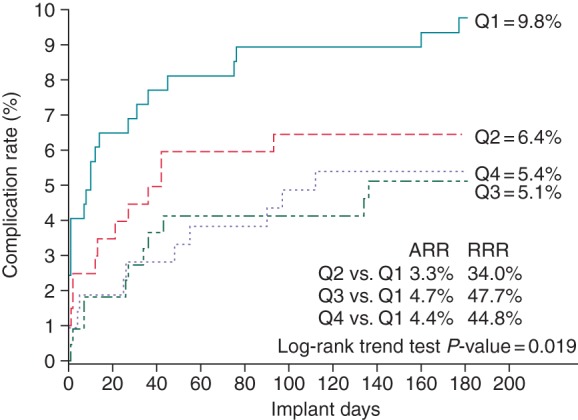
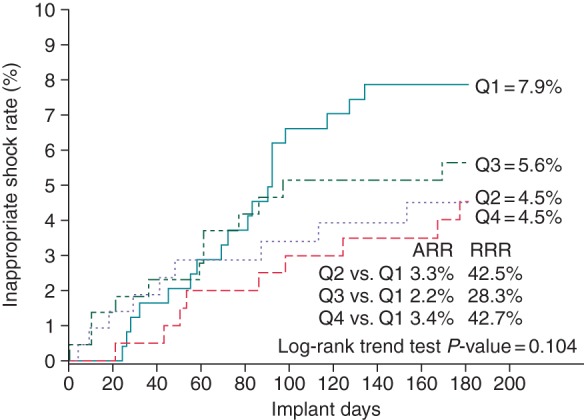
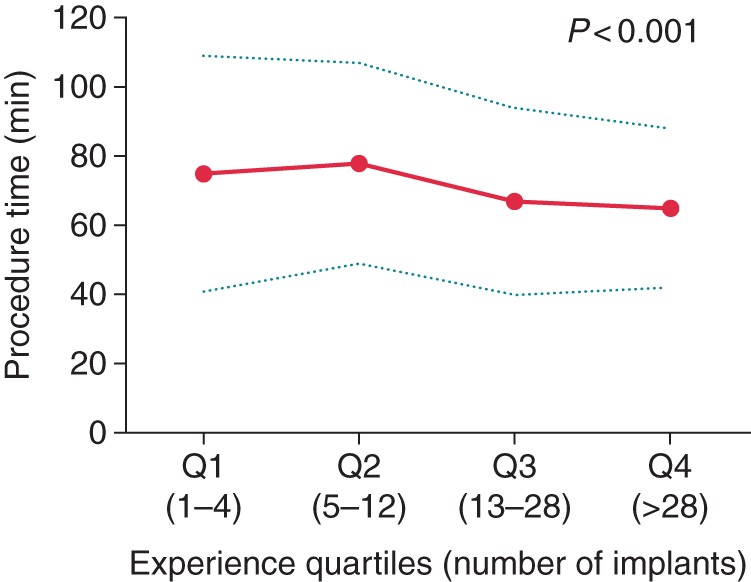
In a pooled cohort from two clinical S-ICD databases, the IDE Trial and the EFFORTLESS Registry, complications, IASs at 180 days follow-up and implant procedure duration were assessed. Patients were grouped in quartiles based on experience of the implanter and Kaplan-Meier estimates of complication and IAS rates were calculated. A total of 882 patients implanted in 61 centres by 107 implanters with a median of 4 implants (IQR 1,8) were analysed. There were a total of 59 patients with complications and 48 patients with IAS. The complication rate decreased significantly from 9.8% in Quartile 1 (least experience) to 5.4% in Quartile 4 (most experience) (P = 0.02) and non-significantly for IAS from 7.9 to 4.8% (P = 0.10). Multivariable analysis demonstrated a hazard ratio of 0.78 (P = 0.045) for complications and 1.01 (P = 0.958) for IAS. Dual-zone programming increased with experience of the individual implanter (P < 0.001), which reduced IAS significantly in the multivariable model (HR 0.44, P = 0.01). Procedure time decreased from 75 to 65 min (P < 0.001). The complication rate and procedure time stabilized after Quartile 2 (>13 implants).
There is a short and significant learning curve associated with physicians adopting the S-ICD. Performance stabilizes after 13 implants.
皮下植入式心律转复除颤器(S-ICD)的引入是为了克服与经静脉导线相关的并发症。采用S-ICD要求植入者学习一种新的植入技术。本研究的目的是评估S-ICD植入者在植入相关并发症、手术时间和不适当电击(IAS)方面的学习曲线。
在来自两个临床S-ICD数据库(IDE试验和EFFORTLESS注册研究)的汇总队列中,评估了并发症、180天随访时的IAS以及植入手术持续时间。根据植入者的经验将患者分为四分位数,并计算并发症和IAS发生率的Kaplan-Meier估计值。对107名植入者在61个中心植入的882例患者进行了分析,植入者的植入中位数为4例(四分位间距1,8)。共有59例患者出现并发症,48例患者发生IAS。并发症发生率从第一四分位数(经验最少)的9.8%显著降至第四四分位数(经验最多)的5.4%(P = 0.02),而IAS发生率从7.9%降至4.8%,差异无统计学意义(P = 0.10)。多变量分析显示,并发症的风险比为0.78(P = 0.045),IAS的风险比为1.01(P = 0.958)。双区程控随着植入者个人经验的增加而增加(P < 0.001),在多变量模型中显著降低了IAS(风险比0.44,P = 0.01)。手术时间从75分钟降至65分钟(P < 0.001)。第二四分位数(>13次植入)后并发症发生率和手术时间趋于稳定。
医生采用S-ICD存在一个短暂且显著的学习曲线。植入13次后性能趋于稳定。