Sedhain Arun, Hada Rajani, Agrawal Rajendra Kumar, Bhattarai Gandhi R, Baral Anil
Department of Nephrology, National Academy of Medical Sciences (NAMS), Bir Hospital, Kathmandu, Nepal.
Advanced Analytics, Optumlnsight, Rocky Hill, CT, USA. Study location: Department of Nephrology, National Academy of Medical Sciences (NAMS), Bir Hospital, Kathmandu, Nepal.
Nutr Metab Insights. 2015 Aug 12;8:21-7. doi: 10.4137/NMi.S27640. eCollection 2015.
To assess the nutritional status of patients on maintenance hemodialysis by using modified quantitative subjective global assessment (MQSGA) and anthropometric measurements.
We Conducted a cross sectional descriptive analytical study to assess the nutritional status of fifty four patients with chronic kidney disease undergoing maintenance hemodialysis by using MQSGA and different anthropometric and laboratory measurements like body mass index (BMI), mid-arm circumference (MAC), mid-arm muscle circumference (MAMC), triceps skin fold (TSF) and biceps skin fold (BSF), serum albumin, C-reactive protein (CRP) and lipid profile in a government tertiary hospital at Kathmandu, Nepal.
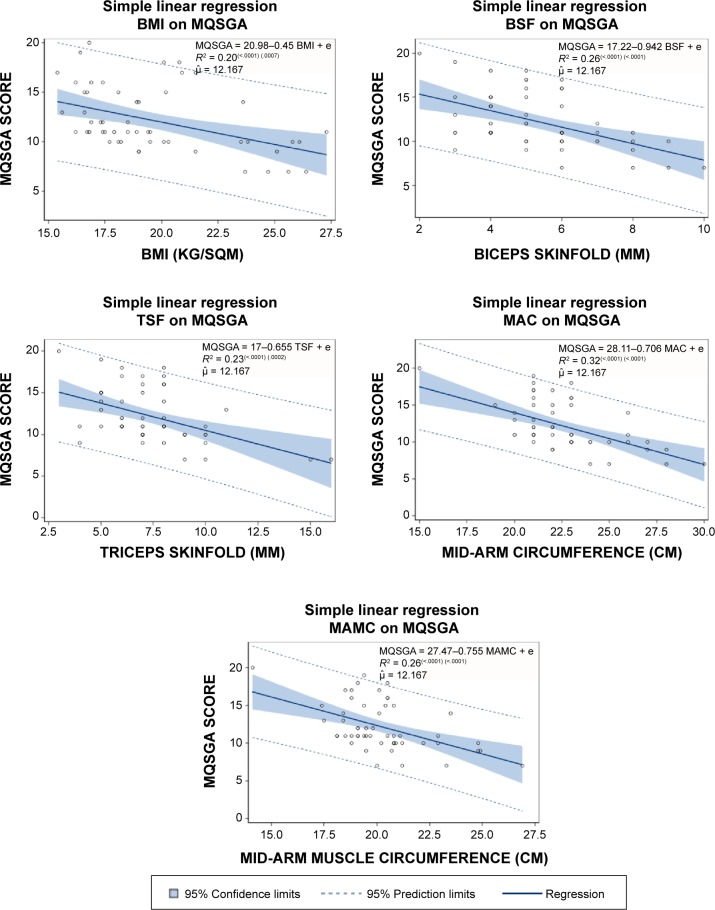
Based on MQSGA criteria, 66.7% of the patients suffered from mild to moderate malnutrition and 33.3% were well nourished. None of the patients were severely malnourished. CRP was positive in 56.3% patients. Serum albumin, MAC and BMI were (mean + SD) 4.0 + 0.3 mg/dl, 22 + 2.6 cm and 19.6 ± 3.2 kg/m(2) respectively. MQSGA showed negative correlation with MAC (r = -0.563; P = <0.001), BMI (r = -0.448; P = <0.001), MAMC (r = -0.506; P = <.0001), TSF (r = -0.483; P = <.0002), and BSF (r = -0.508; P = <0.0001). Negative correlation of MQSGA was also found with total cholesterol, triglyceride, LDL cholesterol and HDL cholesterol without any statistical significance.
Mild to moderate malnutrition was found to be present in two thirds of the patients undergoing hemodialysis. Anthropometric measurements like BMI, MAC, MAMC, BSF and TSF were negatively correlated with MQSGA. Anthropometric and laboratory assessment tools could be used for nutritional assessment as they are relatively easier, cheaper and practical markers of nutritional status.
通过使用改良定量主观全面评定法(MQSGA)和人体测量学方法评估维持性血液透析患者的营养状况。
我们在尼泊尔加德满都的一家政府三级医院开展了一项横断面描述性分析研究,通过MQSGA以及不同的人体测量学和实验室测量方法,如体重指数(BMI)、上臂围(MAC)、上臂肌肉围(MAMC)、三头肌皮褶厚度(TSF)和二头肌皮褶厚度(BSF)、血清白蛋白、C反应蛋白(CRP)和血脂谱,来评估54例接受维持性血液透析的慢性肾脏病患者的营养状况。
根据MQSGA标准,66.7%的患者存在轻度至中度营养不良,33.3%营养状况良好。无患者存在严重营养不良。56.3%的患者CRP呈阳性。血清白蛋白、MAC和BMI分别为(均值±标准差)4.0±0.3mg/dl、22±2.6cm和19.6±3.2kg/m²。MQSGA与MAC(r = -0.563;P = <0.001)、BMI(r = -0.448;P = <0.001)、MAMC(r = -0.506;P = <.0001)、TSF(r = -0.483;P = <.0002)和BSF(r = -0.508;P = <0.0001)呈负相关。MQSGA与总胆固醇、甘油三酯、低密度脂蛋白胆固醇和高密度脂蛋白胆固醇也呈负相关,但无统计学意义。
发现三分之二的血液透析患者存在轻度至中度营养不良。BMI、MAC、MAMC、BSF和TSF等人体测量学指标与MQSGA呈负相关。人体测量学和实验室评估工具可用于营养评估,因为它们是相对更简便、更便宜且实用的营养状况指标。