Gambacciani Marco, Levancini Marco
Department of Obstetrics and Gynecology, Pisa University Hospital, Italy.
Department of Obstetrics and Gynecology, Pisa University Hospital, Italy ; Department of Obstetrics and Gynecology, Clinica Alemana, Univesidad Del Desarrollo, Santiago, Chile.
Prz Menopauzalny. 2014 Sep;13(4):213-20. doi: 10.5114/pm.2014.44996. Epub 2014 Sep 9.
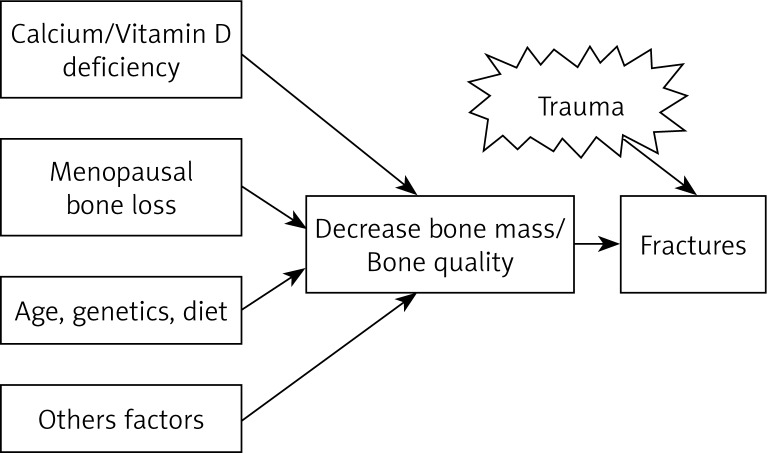
Fracture prevention is one of the public health priorities worldwide. Estrogen deficiency is the major factor in the pathogenesis of postmenopausal osteoporosis, the most common metabolic bone disease. Different effective treatments for osteoporosis are available. Hormone replacement therapy (HRT) at different doses rapidly normalizes turnover, preserves bone mineral density (BMD) at all skeletal sites, leading to a significant, reduction in vertebral and non-vertebral fractures. Tibolone, a selective tissue estrogenic activity regulator (STEAR), is effective in the treatment of vasomotor symptoms, vaginal atrophy and prevention/treatment of osteoporosis with a clinical efficacy similar to that of conventional HRT. Selective estrogen receptor modulators (SERMs) such as raloxifene and bazedoxifene reduce turnover and maintain or increase vertebral and femoral BMD and reduce the risk of osteoporotic fractures. The combination of bazedoxifene and conjugated estrogens, defined as tissue selective estrogen complex (TSEC), is able to reduce climacteric symptoms, reduce bone turnover and preserve BMD. In conclusion, osteoporosis prevention can actually be considered as a major additional benefit in climacteric women who use HRT for treatment of climacteric symptoms. The use of a standard dose of HRT for osteoporosis prevention is based on biology, epidemiology, animal and preclinical data, observational studies and randomized, clinical trials. The antifracture effect of a lower dose HRT or TSEC is supported by the data on BMD and turnover, with compelling scientific evidence.
预防骨折是全球公共卫生的重点之一。雌激素缺乏是绝经后骨质疏松症发病机制中的主要因素,绝经后骨质疏松症是最常见的代谢性骨病。目前有多种有效的骨质疏松症治疗方法。不同剂量的激素替代疗法(HRT)能迅速使骨转换正常化,维持所有骨骼部位的骨矿物质密度(BMD),从而显著降低椎体和非椎体骨折的发生率。替勃龙,一种选择性组织雌激素活性调节剂(STEAR),在治疗血管舒缩症状、阴道萎缩以及预防/治疗骨质疏松症方面有效,其临床疗效与传统HRT相似。选择性雌激素受体调节剂(SERM)如雷洛昔芬和巴多昔芬可降低骨转换,维持或增加椎体和股骨的BMD,并降低骨质疏松性骨折的风险。巴多昔芬与结合雌激素的组合,即组织选择性雌激素复合物(TSEC),能够减轻更年期症状,降低骨转换并维持BMD。总之,对于使用HRT治疗更年期症状的更年期女性,预防骨质疏松症实际上可被视为一项重要的额外益处。使用标准剂量的HRT预防骨质疏松症是基于生物学、流行病学、动物和临床前数据、观察性研究以及随机临床试验。较低剂量HRT或TSEC的抗骨折作用得到了关于BMD和骨转换数据的支持,并有令人信服的科学证据。