Kuhlmann Beatrice G, Kornadt Anna E, Bayen Ute J, Meuser Katharina, Wulff Liliane
Department of Psychology, School of Social Sciences, University of Mannheim, Germany.
Institute of Experimental Psychology, Heinrich-Heine-Universität Düsseldorf, Germany.
J Gerontol B Psychol Sci Soc Sci. 2017 May 1;72(3):436-440. doi: 10.1093/geronb/gbv049.
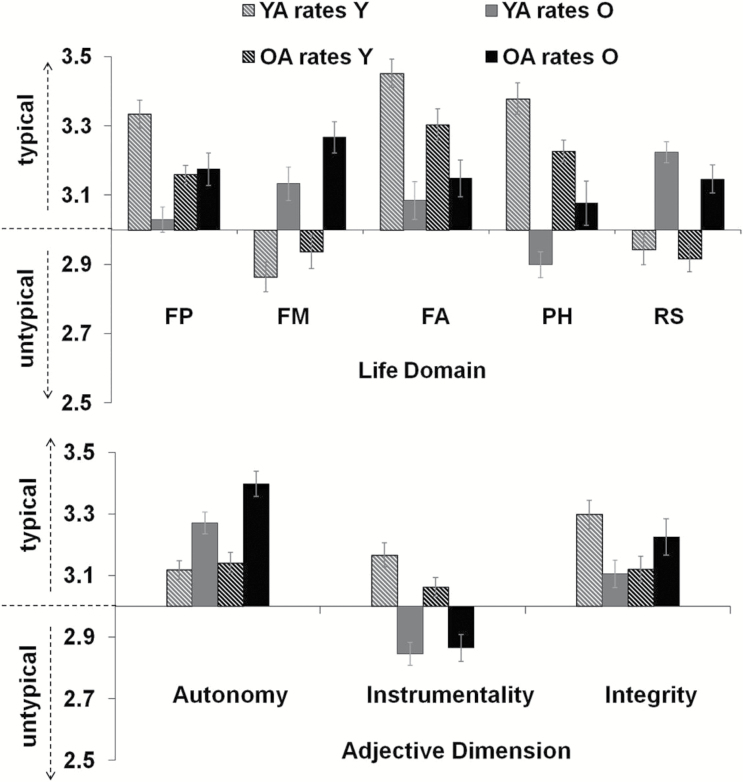
The authors investigated the sources of age-stereotype multidimensionality with the help of personal everyday statements that differed with respect to life domain (e.g., family and partnership vs financial matters) and the adjective dimension reflected in the behavior (e.g., autonomous vs instrumental behavior).
A total of 368 statements reflecting autonomy-, instrumentality-, or integrity-related behaviors in five different life domains were generated. Sixty-nine younger (18-26 years) and 74 older (60-84 years) participants rated the typicality of each statement for either a "young adult" or an "old adult."
Occurrence and direction of age stereotypes varied by life domain and adjective dimension and ultimately depended on the specific combination of both factors (i.e., a significant interaction). For example, old adults were expected to be optimistic about religious aspects but not about their health, fitness, and appearance.
The findings highlight the multidimensionality and complexity of age stereotypes based on a wide array of personal everyday statements.
作者借助在生活领域(如家庭与伴侣关系和财务问题)方面存在差异且行为中体现的形容词维度(如自主行为与工具性行为)的个人日常陈述,探究年龄刻板印象多维性的来源。
共生成了368条反映五个不同生活领域中与自主性、工具性或正直性相关行为的陈述。69名年轻参与者(18 - 26岁)和74名年长参与者(60 - 84岁)对每条陈述对于“年轻人”或“老年人”的典型性进行评分。
年龄刻板印象的出现和方向因生活领域和形容词维度而异,最终取决于这两个因素的具体组合(即显著的交互作用)。例如,人们预计老年人在宗教方面持乐观态度,但在健康、体能和外貌方面并非如此。
研究结果凸显了基于大量个人日常陈述所形成的年龄刻板印象的多维性和复杂性。