Rybarczyk Agnieszka, Szostak Natalia, Antczak Maciej, Zok Tomasz, Popenda Mariusz, Adamiak Ryszard, Blazewicz Jacek, Szachniuk Marta
Institute of Computing Science, Poznan University of Technology, Piotrowo 2, 60-965, Poznan, Poland.
Institute of Bioorganic Chemistry, Polish Academy of Sciences, Noskowskiego 12/14, 61-704, Poznan, Poland.
BMC Bioinformatics. 2015 Sep 2;16(1):276. doi: 10.1186/s12859-015-0718-6.
The function of RNA is strongly dependent on its structure, so an appropriate recognition of this structure, on every level of organization, is of great importance. One particular concern is the assessment of base-base interactions, described as the secondary structure, the knowledge of which greatly facilitates an interpretation of RNA function and allows for structure analysis on the tertiary level. The RNA secondary structure can be predicted from a sequence using in silico methods often adjusted with experimental data, or assessed from 3D structure atom coordinates. Computational approaches typically consider only canonical, Watson-Crick and wobble base pairs. Handling of non-canonical interactions, important for a full description of RNA structure, is still very difficult.
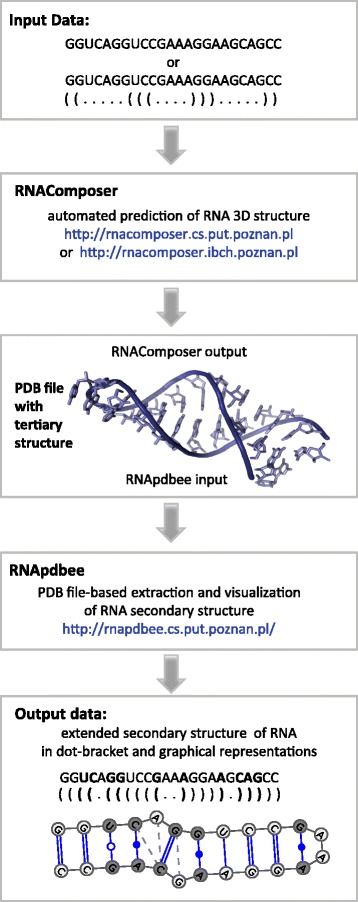
We introduce our novel approach to assessing an extended RNA secondary structure, which characterizes both canonical and non-canonical base pairs, along with their type classification. It is based on predicting the RNA 3D structure from a user-provided sequence or a secondary structure that only describes canonical base pairs, and then deriving the extended secondary structure from atom coordinates. In our example implementation, this was achieved by integrating the functionality of two fully automated, high fidelity methods in a computational pipeline: RNAComposer for the 3D RNA structure prediction and RNApdbee for base-pair annotation.
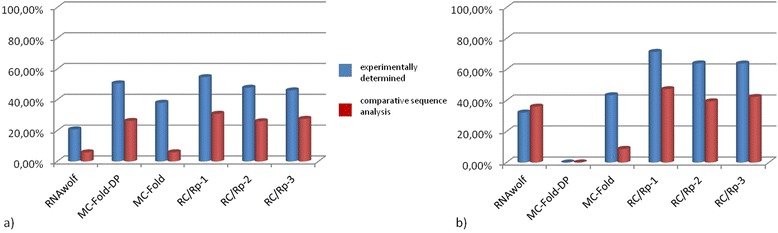
The presented methodology ties together existing applications for RNA 3D structure prediction and base-pair annotation. The example performance, applying RNAComposer and RNApdbee, reveals better accuracy in non-canonical base pair assessment than the compared methods that directly predict RNA secondary structure.
RNA的功能强烈依赖于其结构,因此在每个组织层面上对这种结构进行适当识别非常重要。一个特别需要关注的是对碱基相互作用的评估,即二级结构,了解二级结构极大地有助于解释RNA功能,并允许在三级水平上进行结构分析。RNA二级结构可以使用通常根据实验数据进行调整的计算机方法从序列中预测,或者从三维结构原子坐标中评估。计算方法通常只考虑经典的沃森-克里克碱基对和摆动碱基对。处理对于完整描述RNA结构很重要的非经典相互作用仍然非常困难。
我们介绍了一种评估扩展RNA二级结构的新方法,该方法对经典和非经典碱基对及其类型分类进行了表征。它基于从用户提供的序列或仅描述经典碱基对的二级结构预测RNA三维结构,然后从原子坐标中推导扩展二级结构。在我们的示例实现中,这是通过在计算流程中集成两种全自动、高保真方法的功能来实现的:用于三维RNA结构预测的RNAComposer和用于碱基对注释的RNApdbee。
所提出的方法将现有的RNA三维结构预测和碱基对注释应用联系在一起。应用RNAComposer和RNApdbee的示例性能表明,与直接预测RNA二级结构的比较方法相比,在非经典碱基对评估方面具有更高的准确性。