Hug Shaun M, Gaut Brandon S
Department of Ecology and Evolutionary Biology, UC Irvine, 321 Steinhaus Hall, Irvine, CA, 92697, USA.
BMC Evol Biol. 2015 Sep 2;15:177. doi: 10.1186/s12862-015-0457-3.
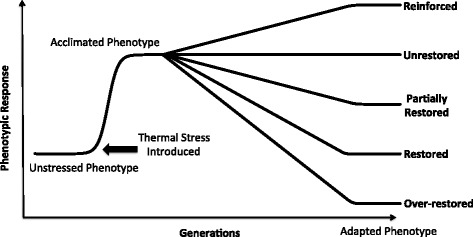
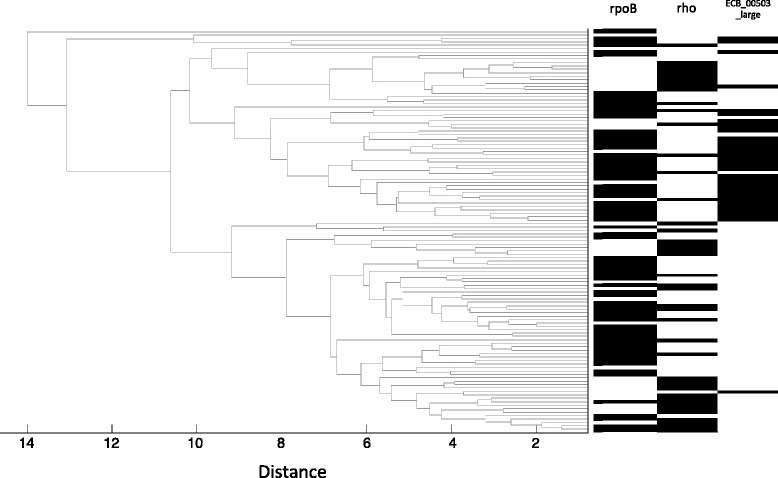
In the short-term, organisms acclimate to stress through phenotypic plasticity, but in the longer term they adapt to stress genetically. The mutations that accrue during adaptation may contribute to completely novel phenotypes, or they may instead act to restore the phenotype from a stressed to a pre-stress condition. To better understand the influence of evolution on the diversity and direction of phenotypic change, we used Biolog microarrays to assay 94 phenotypes of 115 Escherichia coli clones that had adapted to high temperature (42.2 °C). We also assayed these same phenotypes in the clones' ancestor under non-stress (37.0 °C) and stress (42.2 °C) conditions. We explored associations between Biolog phenotypes and genotypes, and we also investigated phenotypic differences between clones that have one of two adaptive genetic trajectories: one that is typified by mutations in the RNA polymerase β-subunit (rpoB) and another that is defined by mutations in the rho termination factor.
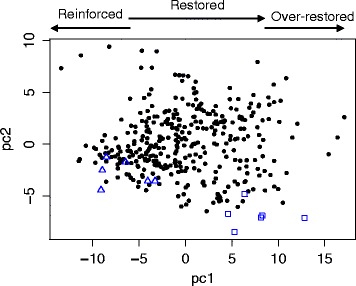
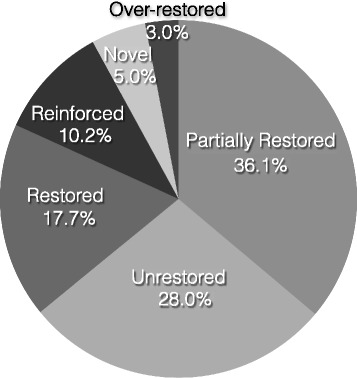
Most (54 %) phenotypic variation was restorative, shifting the phenotype from the acclimated state back toward the unstressed state. Novel phenotypes were more rare, comprising between 5 and 18 % of informative phenotypic variation. Phenotypic variation associated statistically with genetic variation, demonstrating a genetic basis for phenotypic change. Finally, clones with rpoB mutations differed in phenotype from those with rho mutations, largely due to differences in chemical sensitivity.
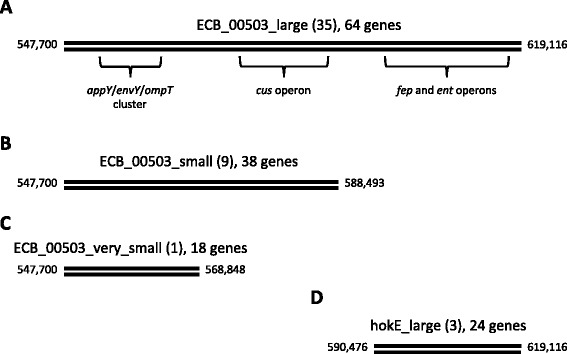
Our results contribute to previous observations showing that a major component of adaptation in microbial evolution experiments is toward restoration to the unstressed state. In addition, we found that a large deletion strongly affected phenotypic variation. Finally, we demonstrated that the two genetic trajectories leading to thermal adaptation encompass different phenotypes.
短期内,生物体通过表型可塑性适应压力,但从长期来看,它们会通过基因适应压力。适应过程中积累的突变可能导致全新的表型,或者相反,可能起到将表型从应激状态恢复到应激前状态的作用。为了更好地理解进化对表型变化的多样性和方向的影响,我们使用Biolog微阵列分析了115个适应高温(42.2°C)的大肠杆菌克隆的94种表型。我们还在克隆的祖先处于非应激(37.0°C)和应激(42.2°C)条件下分析了这些相同的表型。我们探索了Biolog表型与基因型之间的关联,还研究了具有两种适应性遗传轨迹之一的克隆之间的表型差异:一种以RNA聚合酶β亚基(rpoB)中的突变为典型,另一种由rho终止因子中的突变定义。
大多数(54%)表型变异是恢复性的,将表型从适应状态转变回非应激状态。新表型更为罕见,占信息性表型变异的5%至18%。表型变异与遗传变异在统计学上相关,证明了表型变化的遗传基础。最后,具有rpoB突变的克隆与具有rho突变的克隆在表型上存在差异,这主要是由于化学敏感性的差异。
我们的结果支持了先前的观察结果,即微生物进化实验中适应的一个主要组成部分是恢复到非应激状态。此外,我们发现一个大的缺失强烈影响表型变异。最后,我们证明了导致热适应的两种遗传轨迹包含不同的表型。