Penn Marion L, Kennedy Anne P, Vassilev Ivaylo I, Chew-Graham Carolyn A, Protheroe Joanne, Rogers Anne, Monks Tom
Southampton General Hospital, Mailpoint 11, AA72, South Academic Block, Tremona Road, Southampton, SO16 6YD, UK.
NIHR Collaboration for Leadership in Applied Health Research (CLAHRC) Wessex, Faculty of Health Sciences, University of Southampton, Highfield, Southampton, SO17 1BJ, UK.
BMC Fam Pract. 2015 Sep 2;16:112. doi: 10.1186/s12875-015-0325-7.
Self-management support to facilitate people with type 2 diabetes to effectively manage their condition is complex to implement. Organisational and system elements operating in relation to providing optimal self-management support in primary care are poorly understood. We have applied operational research techniques to model pathways in primary care to explore and illuminate the processes and points where people struggle to find self-management support.
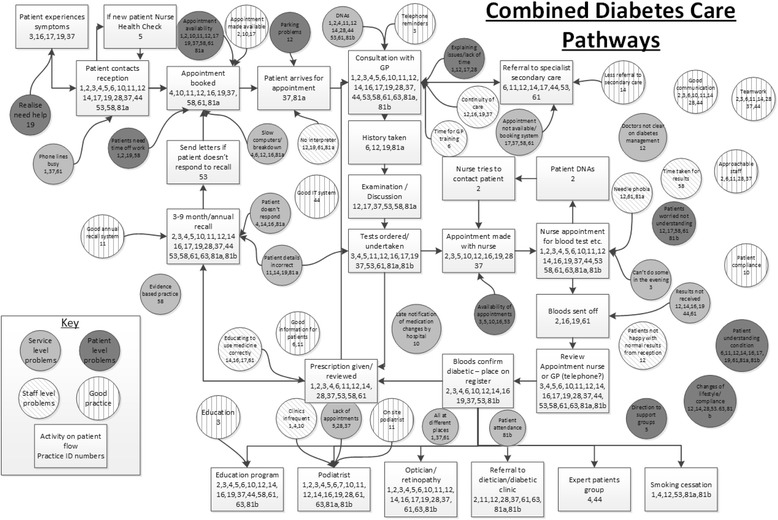
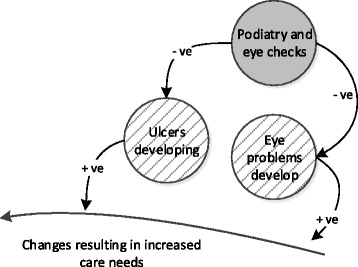
Primary care clinicians and support staff in 21 NHS general practices created maps to represent their experience of patients' progress through the system following diagnosis. These were collated into a combined pathway. Following consideration of how patients reduce dependency on the system to become enhanced self-managers, a model was created to show the influences on patients' pathways to self-management.
Following establishment of diagnosis and treatment, appointment frequency decreases and patient self-management is expected to increase. However, capacity to consistently assess self-management capabilities; provide self-management support; or enhance patient-led self-care activities is missing from the pathways. Appointment frequencies are orientated to bio-medical monitoring rather than increasing the ability to mobilise resources or undertake self-management activities.
The model provides a clear visual picture of the complexities implicated in achieving optimal self-management support. Self-management is quickly hidden from view in a system orientated to treatment delivery rather than to enhancing patient self-management. The model created highlights the limited self-management support currently provided and illuminates points where service change might impact on providing support for self-management. Ensuring professionals are aware of locally available support and people's existing network support has potential to provide appropriate and timely direction to community facilities and the mobilisation of resources.
促进2型糖尿病患者有效管理自身病情的自我管理支持实施起来很复杂。对于在初级保健中提供最佳自我管理支持所涉及的组织和系统要素,人们了解甚少。我们运用运筹学技术对初级保健中的路径进行建模,以探索和阐明人们在寻求自我管理支持时遇到困难的过程和关键点。
21家国民保健服务(NHS)普通诊所的初级保健临床医生和支持人员绘制了地图,以展示他们对患者诊断后在系统中进展情况的经验。这些地图被整理成一条综合路径。在考虑患者如何减少对系统的依赖以成为更强的自我管理者之后,创建了一个模型来展示对患者自我管理路径的影响。
在确立诊断和治疗之后,预约频率降低,患者的自我管理预期会增加。然而,路径中缺少持续评估自我管理能力、提供自我管理支持或加强患者主导的自我护理活动的能力。预约频率以生物医学监测为导向,而非提高调动资源或开展自我管理活动的能力。
该模型清晰直观地呈现了实现最佳自我管理支持所涉及的复杂性。在一个以治疗提供而非增强患者自我管理为导向的系统中,自我管理很快就被忽视了。所创建的模型凸显了目前提供的自我管理支持有限,并阐明了服务变革可能对提供自我管理支持产生影响的关键点。确保专业人员了解当地可用的支持以及人们现有的网络支持,有可能为社区设施和资源调动提供适当且及时的指导。