Xu Yixiao, Wang Dexuan, Zhuang Zhizhi, Jin Keke, Zheng Lvzhen, Yang Qing, Guo Kunyuan
Department of Hematology, Zhujiang Hospital, Southern Medical University, Guangzhou, Guangdong 510282, P.R. China.
Department of Pediatrics, The Second Affiliated and Yuying Children's Hospital of Wenzhou Medical University, Wenzhou, Zhejiang 325000, P.R. China.
Mol Med Rep. 2015 Nov;12(5):6475-82. doi: 10.3892/mmr.2015.4258. Epub 2015 Aug 27.
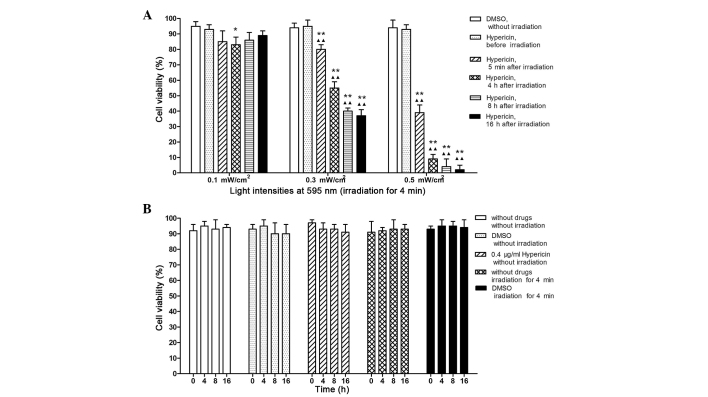
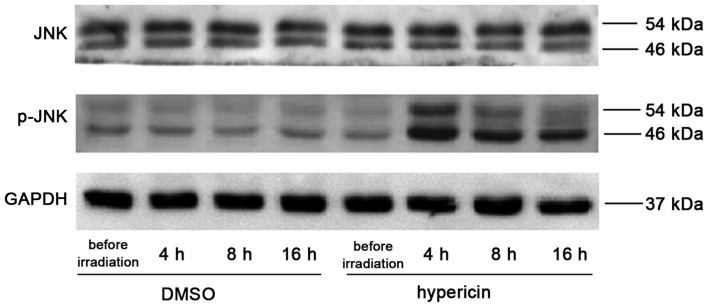
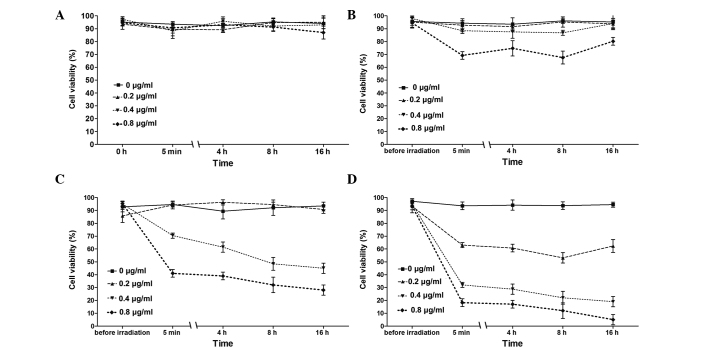
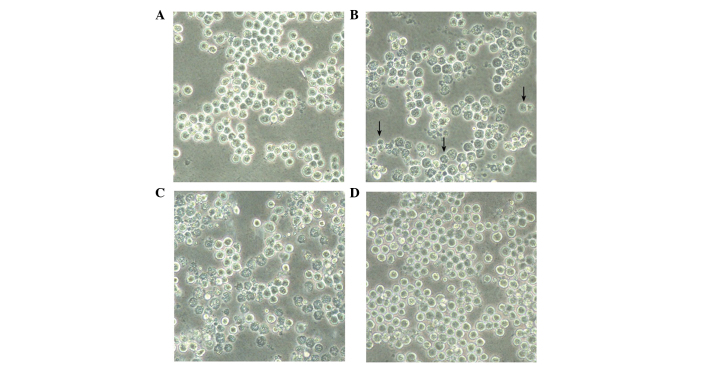
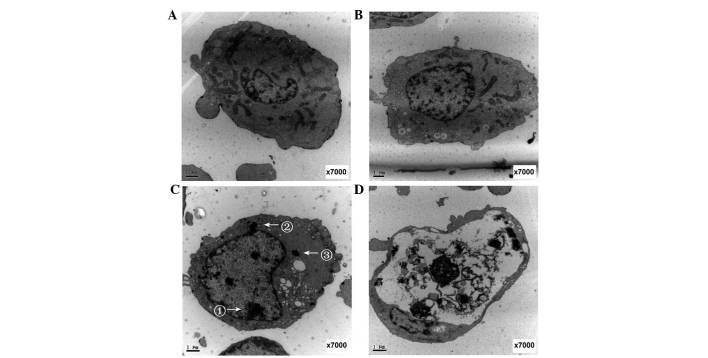
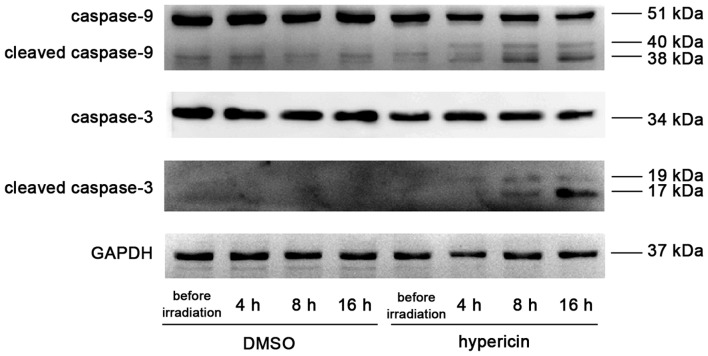
Hypericin (Hyp) is traditionally used as an antidepressant and antiviral agent. It selectively accumulates in spheroids and is also used as a photosensitizer in the photodynamic therapy of cancer. The present study aimed to investigate the cytotoxic effect of Hyp‑mediated photodynamic therapy (Hyp‑PDT) on cell growth and apoptosis of K562 leukemia cells, and to examine the underlying mechanisms. Hyp‑PDT was performed with different light intensities (0.1, 0.3 and 0.5 mW/cm2), different concentrations of Hyp (0, 0.2, 0.4 and 0.8 µg/ml) and different durations of irradiation (0, 2, 4 and 8 min) in order to select the optimal conditions for subsequent experiments. A concentration of 0.4 µg/ml Hyp with a 5 h drug‑light interval and 4 min irradiation at 0.3 mW/cm2 light intensity was selected as the optimal conditions. The effects of Hyp‑PDT on apoptosis were determined by detecting morphological changes under microscopy and by performing western blot analysis. The results revealed that Hyp‑PDT suppressed cell viability in a light intensity‑, dose‑ and irradiation duration‑dependent manner. The expression levels of cleaved caspase‑9, cleaved caspase‑3 and phosphorylated‑C‑Jun N terminal kinase (JNK)l were significantly upregulated following Hyp‑PDT. These results indicated that Hyp‑PDT decreased cell viability and induced mitochondria‑caspase‑dependent apoptosis in the K562 cells through regulation of the JNK pathway. These findings suggest that Hyp-PDT may be developed as an effective treatment for leukemia.
金丝桃素(Hyp)传统上用作抗抑郁药和抗病毒剂。它选择性地积聚在球体中,也用作癌症光动力疗法中的光敏剂。本研究旨在探讨Hyp介导的光动力疗法(Hyp-PDT)对K562白血病细胞生长和凋亡的细胞毒性作用,并研究其潜在机制。为了选择后续实验的最佳条件,采用不同的光照强度(0.1、0.3和0.5 mW/cm2)、不同浓度的Hyp(0、0.2、0.4和0.8 μg/ml)和不同的照射时间(0、2、4和8分钟)进行Hyp-PDT。选择0.4 μg/ml的Hyp浓度、5小时的药物-光照间隔和0.3 mW/cm2光照强度下照射4分钟作为最佳条件。通过显微镜下检测形态变化和进行蛋白质免疫印迹分析来确定Hyp-PDT对凋亡的影响。结果显示,Hyp-PDT以光照强度、剂量和照射时间依赖性方式抑制细胞活力。Hyp-PDT后,裂解的半胱天冬酶-9、裂解的半胱天冬酶-3和磷酸化的C-Jun氨基末端激酶(JNK)1的表达水平显著上调。这些结果表明,Hyp-PDT通过调节JNK途径降低K562细胞的活力并诱导线粒体-半胱天冬酶依赖性凋亡。这些发现表明,Hyp-PDT可能被开发为一种有效的白血病治疗方法。