Department of Anatomy and K.K. Leung Brain Research Centre, Preclinical School of Medicine, Fourth Military Medical University, Xi'an, Shaanxi 710032, P.R. China.
Department of Anatomy, Histology and Embryology, Liaoning Medical University, Jinzhou, Liaoning 121000, P.R. China.
Mol Med Rep. 2018 Feb;17(2):2803-2810. doi: 10.3892/mmr.2017.8245. Epub 2017 Dec 11.
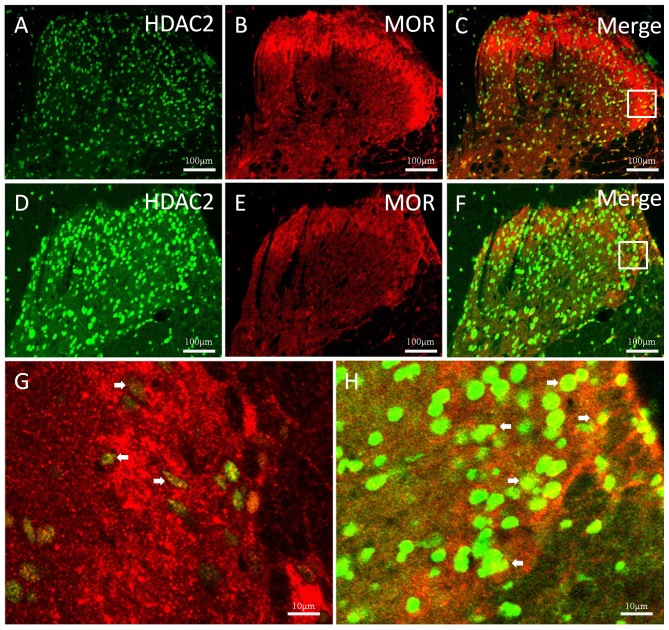
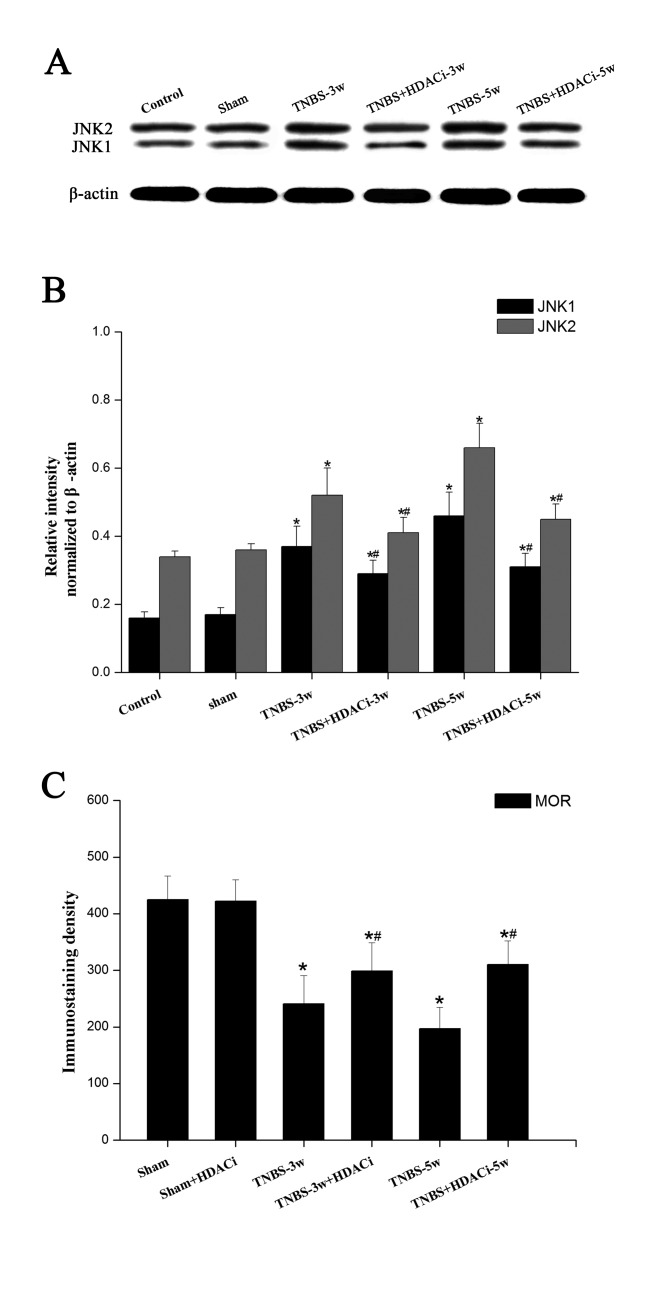
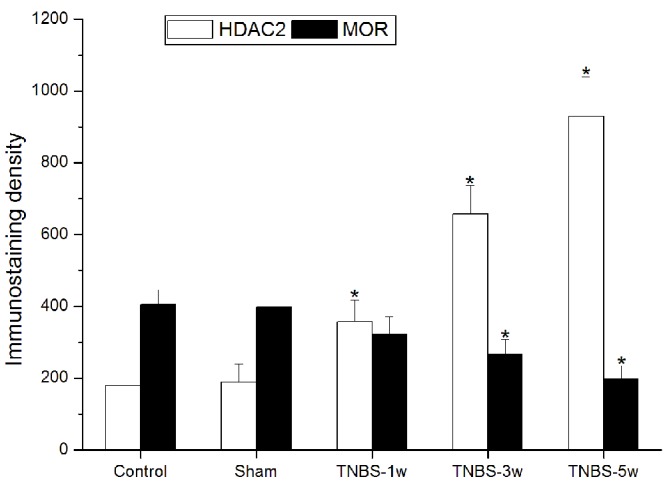
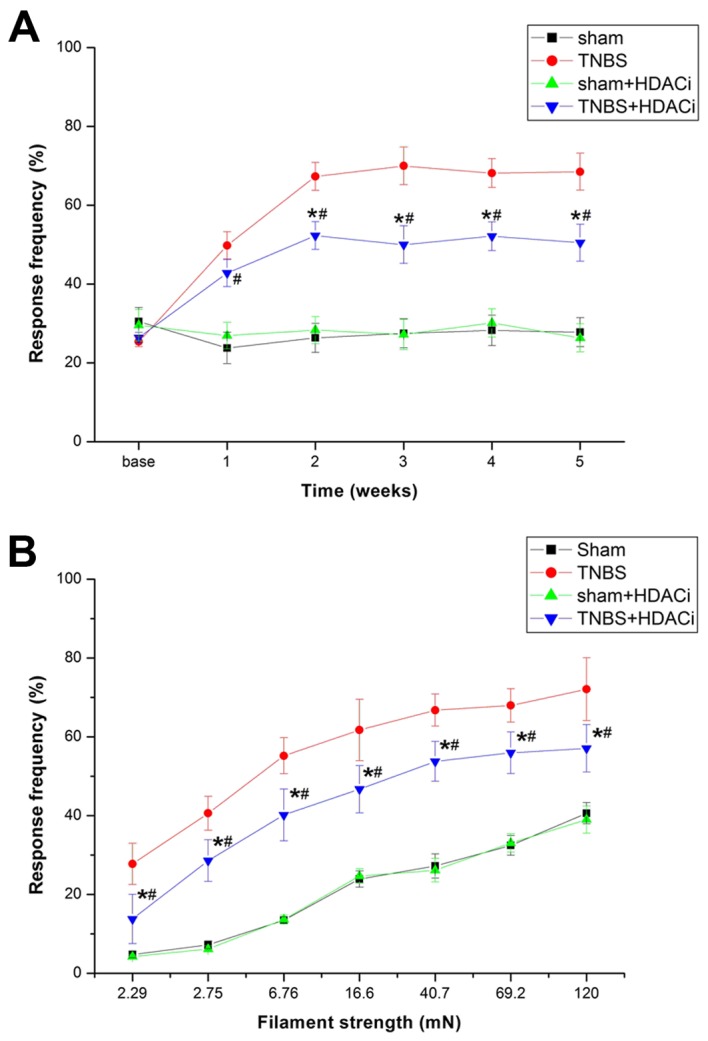
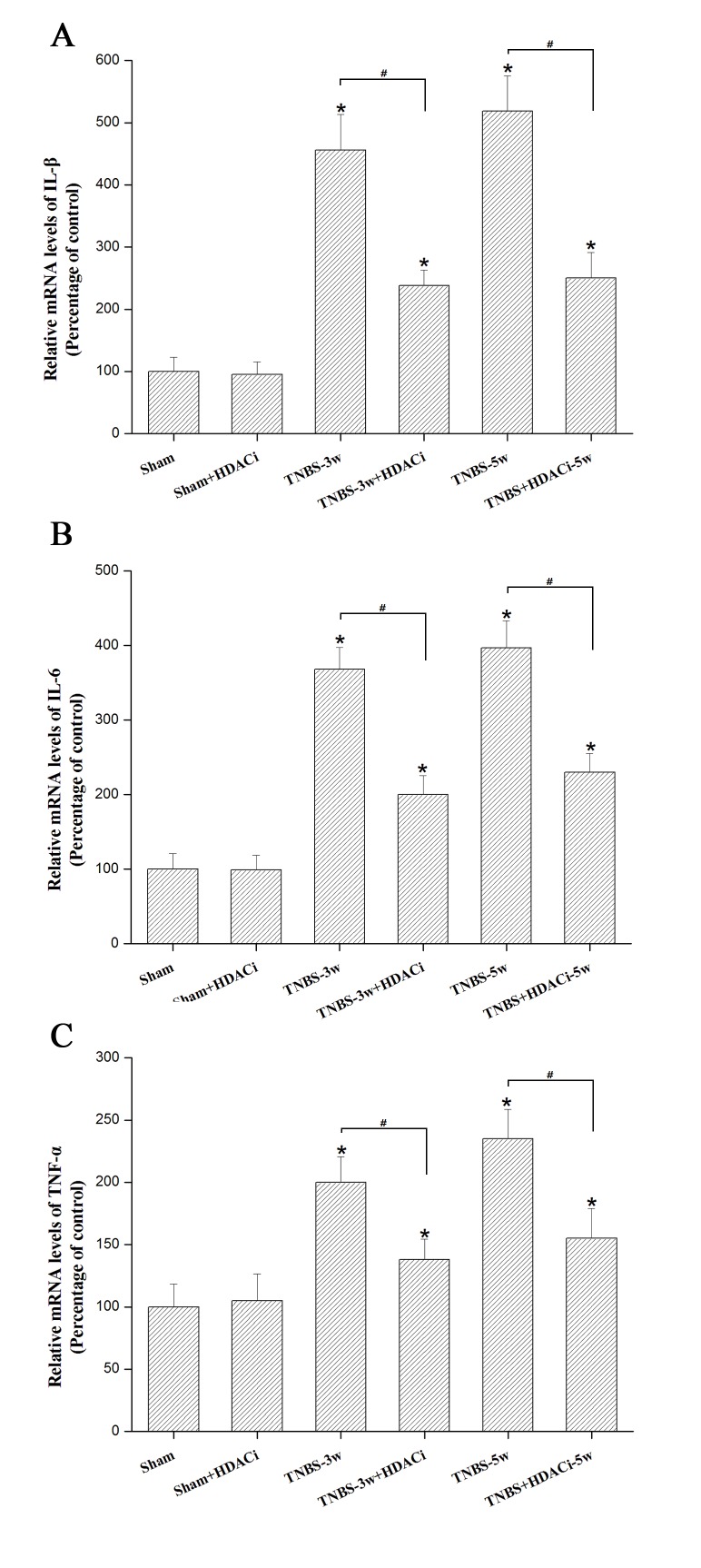
Chronic pain occurs in ~85-90% of chronic pancreatitis (CP) patients. However, as the pathogenesis of CP pain remains to be fully understood, the current therapies for CP pain remain inadequate. Emerging evidence has suggested that the epigenetic modulations of genes are involved in chronic pain. In the present study, intrapancreatic trinitrobenzene sulfonic acid infusions were used to establish a CP model in rats. Mechanical allodynia was measured with von Frey filaments. Immunofluorescent staining analysis was used to observe the expression changes of histone deacetylase 2 (HDAC2) and µ‑opioid receptor (MOR), and intrathecal administration of the selective HDAC2 inhibitor AR‑42 was used to assess the underlying mechanisms. The expression levels of c‑Jun N‑terminal kinase (JNK) in the thoracic spinal cord were detected by western blotting, and the mRNA expression levels of interleukin (IL)1‑β, IL‑6 and tumor necrosis factor (TNF)‑α were detected by reverse transcription‑quantitative polymerase chain reaction. The results demonstrated that HDAC2 expression was upregulated during the course of CP induction, while MOR activity in the thoracic spinal dorsal horn was significantly suppressed. Intrathecal infusion of AR‑42 significantly attenuated CP‑induced mechanical allodynia, with rescued MOR activity. Additionally, HDAC2 facilitated the release of inflammatory cytokines, including IL‑1β, IL‑6 and TNF‑α. These results suggested that the underlying mechanisms of HDAC2 regulating MOR activity under CP induction may occur via promoting the release of inflammatory cytokines, thus activating the JNK signaling pathway. The present study suggested that the epigenetic‑regulated disturbance of MOR is dependent on the endogenous analgesia system in CP, which may a provide novel therapeutic strategy for treating pain in CP.
慢性疼痛发生在~85-90%的慢性胰腺炎(CP)患者中。然而,由于 CP 疼痛的发病机制尚未完全阐明,目前针对 CP 疼痛的治疗方法仍然不够充分。新出现的证据表明,基因的表观遗传调控参与了慢性疼痛。在本研究中,使用胰腺内三硝基苯磺酸输注来建立大鼠 CP 模型。使用 von Frey 纤维测量机械性痛觉过敏。免疫荧光染色分析用于观察组蛋白去乙酰化酶 2(HDAC2)和μ阿片受体(MOR)的表达变化,并鞘内给予选择性 HDAC2 抑制剂 AR-42 以评估潜在机制。通过 Western blot 检测胸段脊髓中 c-Jun N-末端激酶(JNK)的表达水平,并通过逆转录-定量聚合酶链反应检测白细胞介素(IL)1-β、IL-6 和肿瘤坏死因子(TNF)-α的 mRNA 表达水平。结果表明,在 CP 诱导过程中 HDAC2 表达上调,而胸段脊髓背角的 MOR 活性显著受到抑制。鞘内输注 AR-42 可显著减轻 CP 诱导的机械性痛觉过敏,同时挽救了 MOR 活性。此外,HDAC2 促进了包括 IL-1β、IL-6 和 TNF-α在内的炎症细胞因子的释放。这些结果表明,HDAC2 在 CP 诱导下调节 MOR 活性的潜在机制可能是通过促进炎症细胞因子的释放,从而激活 JNK 信号通路。本研究表明,MOR 的表观遗传调控紊乱依赖于 CP 中的内源性镇痛系统,这可能为 CP 疼痛的治疗提供新的治疗策略。