Matsushima Akira, Yoshida Kunihiro, Genno Hirokazu, Murata Asuka, Matsuzawa Setsuko, Nakamura Katsuya, Nakamura Akinori, Ikeda Shu-Ichi
Department of Neurology and Rheumatology, Shinshu University School of Medicine, 3-1-1 Asahi, Matsumoto, 390-8621 Japan.
Division of Neurogenetics, Department of Brain Disease Research, Shinshu University School of Medicine, 3-1-1 Asahi, Matsumoto, 390-8621 Japan.
Cerebellum Ataxias. 2015 Aug 6;2:9. doi: 10.1186/s40673-015-0028-9. eCollection 2015.
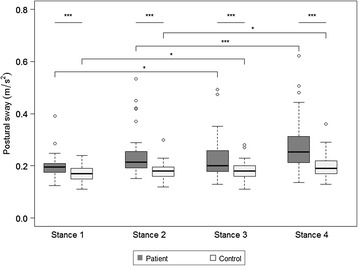
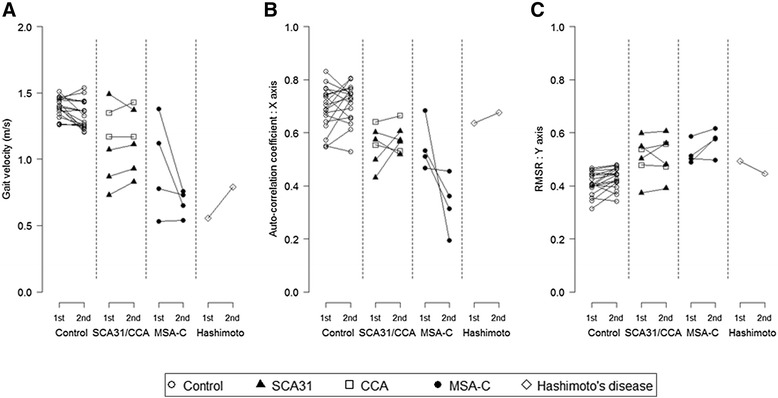
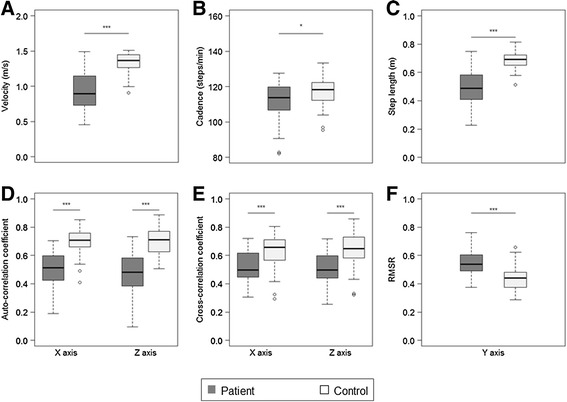
The aim of this study was to investigate the usefulness of a triaxial accelerometer for the clinical assessment of standing and gait impairment in ataxic patients quantitatively. Fifty-one patients with spinocerebellar ataxia (SCA) or multiple system atrophy with predominant cerebellar ataxia (MSA-C) and 56 healthy control subjects were enrolled. The subjects, with a triaxial accelerometer on their back, were indicated to stand for 30 s in four different conditions (eyes opened or closed, and feet apart or together) and then to walk 10 m for a total of 12 times on a flat floor at their usual walking speed. In standing analysis, the degree of body sway was assessed. In gait analysis, gait velocity, cadence, step length, step regularity (auto-correlation coefficient: AC), step repeatability (cross-correlation coefficient) and the degree of body sway (The ratio of root mean square in each direction to the root mean square vector magnitude: RMSR) were evaluated.
The degree of body sway in each standing condition and all parameters in gait showed a significant difference between the patients and control subjects. The AC and RMSR values, as well as the Scale for the Assessment and Rating of Ataxia score, showed a strong correlation with disease duration.
Various parameters obtained by a triaxial accelerometer can be sensitive and objective markers for the assessment and follow-up of standing and gait impairment in ataxic patients.
本研究旨在定量调查三轴加速度计对共济失调患者站立和步态障碍临床评估的有用性。纳入了51例脊髓小脑共济失调(SCA)或以小脑性共济失调为主的多系统萎缩(MSA-C)患者以及56名健康对照者。受试者背部佩戴三轴加速度计,被要求在四种不同条件下(睁眼或闭眼,双脚分开或并拢)站立30秒,然后以其平常的步行速度在平坦地面上行走10米,共走12次。在站立分析中,评估身体摆动程度。在步态分析中,评估步态速度、步频、步长、步幅规律性(自相关系数:AC)、步幅重复性(互相关系数)以及身体摆动程度(每个方向的均方根与均方根向量大小的比值:RMSR)。
患者与对照者在每种站立条件下的身体摆动程度以及步态的所有参数均存在显著差异。AC和RMSR值以及共济失调评估与评分量表得分与疾病持续时间呈强相关。
通过三轴加速度计获得的各种参数可作为共济失调患者站立和步态障碍评估及随访的敏感且客观的指标。