Donthamsetti Prashant, Quejada Jose Rafael, Javitch Jonathan A, Gurevich Vsevolod V, Lambert Nevin A
Departments of Psychiatry and Pharmacology, Columbia University College of Physicians and Surgeons, New York, New York.
Division of Molecular Therapeutics, New York State Psychiatric Institute, New York, New York.
Curr Protoc Pharmacol. 2015 Sep 1;70:2.14.1-2.14.14. doi: 10.1002/0471141755.ph0214s70.
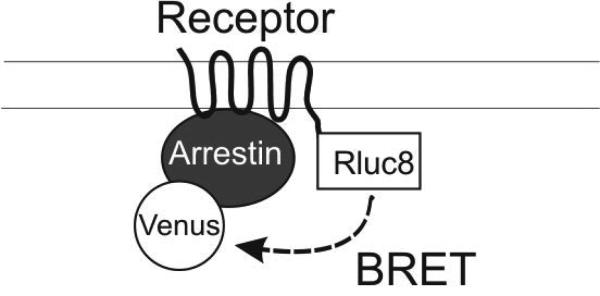
G protein-coupled receptors (GPCRs) represent ∼25% of current drug targets. Ligand binding to these receptors activates G proteins and arrestins, which are involved in differential signaling pathways. Because functionally selective or biased ligands activate one of these two pathways, they may be superior medications for certain diseases states. The identification of such ligands requires robust drug screening assays for both G protein and arrestin activity. This unit describes protocols for two bioluminescence resonance energy transfer (BRET)-based assays used to monitor arrestin recruitment to GPCRs. One assay requires modification of GPCRs by fusion to a BRET donor or acceptor moiety, whereas the other can detect arrestin recruitment to unmodified GPCRs.
G蛋白偶联受体(GPCRs)约占目前药物靶点的25%。配体与这些受体结合会激活G蛋白和抑制蛋白,它们参与不同的信号通路。由于功能选择性或偏向性配体激活这两条通路之一,它们可能是某些疾病状态下的优质药物。识别此类配体需要针对G蛋白和抑制蛋白活性进行可靠的药物筛选测定。本单元介绍了两种基于生物发光共振能量转移(BRET)的测定方法的方案,用于监测抑制蛋白募集到GPCRs。一种测定方法需要通过与BRET供体或受体部分融合来修饰GPCRs,而另一种可以检测抑制蛋白募集到未修饰的GPCRs。