Zhang Min, Gao Xiang, Chen Yuanhan, Zhi Min, Chen Huangwei, Tang Jian, Su Minli, Yao Jiayin, Yang Qingfan, Chen Junrong, Hu Pinjin, Liu Huanliang
From the Department of Gastroenterology, The Sixth Affiliated Hospital of Sun Yat-Sen University, Guangzhou (MZ, XG, MZ, HC, JT, MS, JY, QY, JC, PH, HL); Division of Nephrology, Guangdong General Hospital, Guangdong Academy of Medical Sciences, Guangzhou, China; 3Guangdong Gastrointestinal Institute, the Sixth Affiliated Hospital of Sun Yat-sen University, Guangzhou (YC), China.
Medicine (Baltimore). 2015 Sep;94(35):1. doi: 10.1097/MD.0000000000001455.
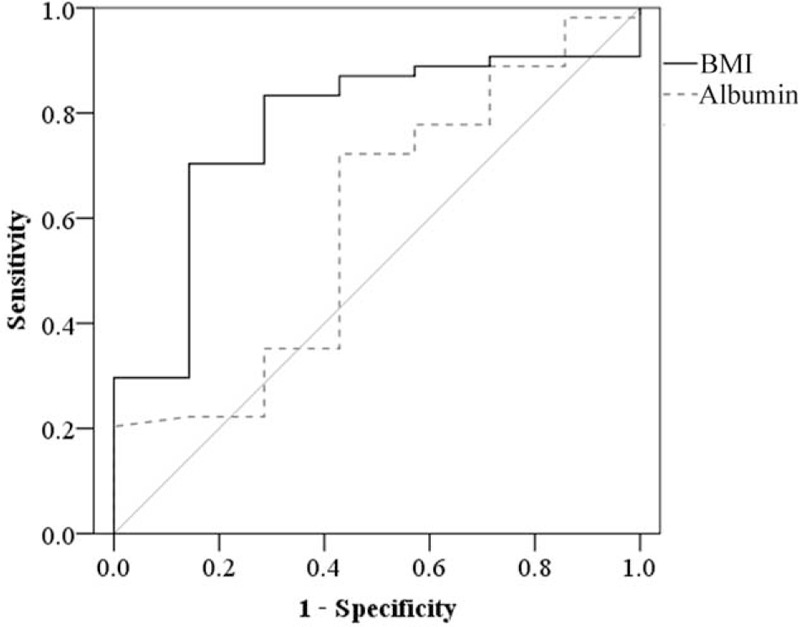
Poor preoperative nutritional status for individuals with Crohn's disease (CD) is associated with intra-abdominal septic complications (IASCs). The present study aimed to investigate the association of the common nutrition indices serum albumin and body mass index (BMI) with IASCs. Sixty-four CD patients who had received elective intestinal operations were retrospectively investigated. Among these patients, 32 had received individualized fortified nutrition support. IASCs occurred in 7 patients (10.9%). Compared with non-IASC patients, IASC patients had a lower BMI (17.6 ± 2.7 vs 15.6 ± 1.3 kg/m, P = 0.048). The area under the receiver operating characteristic curve according to the BMI-based IASC prediction was 0.772 (95% confidence interval [CI], 0.601-0.944; P = 0.020) with an optimum diagnostic cutoff value of 16.2 kg/m. A BMI < 16.2 kg/m significantly increased the risk of developing an IASC (odds ratio [OR], 10.286; 95% CI, 1.158-91.386). Even after correction with the simplified CD activity index (CDAI), a low BMI level remained associated with IASCs (OR, 7.650; 95% CI, 0.808-72.427; P = 0.076). Serum albumin was not associated with IASCs. Although the fortified nutrition support group had an albumin level comparable to the control group, this group had a higher simplified CDAI score, a lower BMI level, and a comparable incidence rate of IASCs. Thus, BMI more accurately reflects the basic preoperative nutritional status of CD patients than serum albumin. BMI can aid in guiding preoperative nutrition support and judging the appropriate operation time for CD.
克罗恩病(CD)患者术前营养状况较差与腹腔内感染并发症(IASC)相关。本研究旨在调查常见营养指标血清白蛋白和体重指数(BMI)与IASC之间的关联。对64例接受择期肠道手术的CD患者进行了回顾性研究。在这些患者中,32例接受了个体化强化营养支持。7例患者(10.9%)发生了IASC。与非IASC患者相比,IASC患者的BMI较低(17.6±2.7 vs 15.6±1.3kg/m²,P=0.048)。基于BMI的IASC预测的受试者工作特征曲线下面积为0.772(95%置信区间[CI],0.601 - 0.944;P=0.020),最佳诊断临界值为16.2kg/m²。BMI<16.2kg/m²显著增加了发生IASC的风险(比值比[OR],10.286;95%CI,1.158 - 91.386)。即使在用简化的CD活动指数(CDAI)校正后,低BMI水平仍与IASC相关(OR,7.650;95%CI,0.808 - 72.427;P=0.076)。血清白蛋白与IASC无关。尽管强化营养支持组的白蛋白水平与对照组相当,但该组的简化CDAI评分更高、BMI水平更低且IASC发生率相当。因此,BMI比血清白蛋白更准确地反映CD患者术前的基本营养状况。BMI有助于指导术前营养支持并判断CD患者的合适手术时机。