Zeng Ailiang, Hu Qi, Liu Yanwei, Wang Zheng, Cui Xiaoming, Li Rui, Yan Wei, You Yongping
Department of Neurosurgery, The First Affiliated Hospital of Nanjing Medical University, Nanjing 210029, PR China.
Beijing Neurosurgical Institute, Capital Medical University, Beijing 100050, PR China.
Oncotarget. 2015 Oct 6;6(30):30232-8. doi: 10.18632/oncotarget.4920.
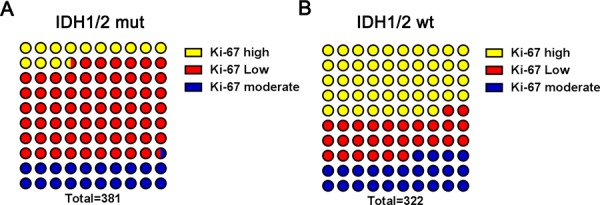
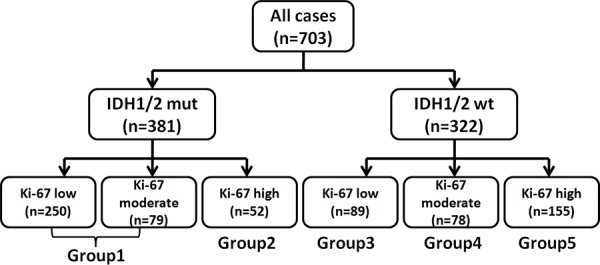
The current World Health Organization (WHO) classification of human gliomas is mainly based on morphology. However, it has limitations in prognostic prediction. We examined whether combining isocitrate dehydrogenase (IDH) 1/2 mutation status with the Ki-67 labeling index would improve the definition of prognostically distinct entities. We investigated the correlation of Ki-67 expression with IDH1/2 mutation status and their impact on clinical outcome in 703 gliomas. Low Ki-67 expression closely overlapped with IDH1/2 mutation in our cohort (P < 0.0001). Patients with IDH1/2 mutation survived significantly longer than patients with wild-type IDH1/2 did (P < 0.0001); higher Ki-67 expression was associated with shorter progression-free survival and overall survival (OS) (P < 0.0001). IDH1/2 combined with Ki-67 was used to re-classify glioma patients into five groups. IDH1/2 mutant patients with low and moderate Ki-67 expression (Group1) had the best prognosis, whereas patients with wild-type IDH1/2 and high Ki-67 expression (Group5) had the worst prognosis (Median OS = 1527 vs. 355 days, P < 0.0001). To summarize, our new classification model distinguishes biologically distinct subgroups and provides prognostic information regardless of the conventional WHO grade. Classification based on IDH1/2 mutation status and Ki-67 expression level could be more convenient for clinical application and guide personalized treatment in malignant gliomas.
世界卫生组织(WHO)目前对人类胶质瘤的分类主要基于形态学。然而,其在预后预测方面存在局限性。我们研究了将异柠檬酸脱氢酶(IDH)1/2突变状态与Ki-67标记指数相结合是否能更好地定义预后不同的实体。我们调查了703例胶质瘤中Ki-67表达与IDH1/2突变状态的相关性及其对临床结局的影响。在我们的队列中,低Ki-67表达与IDH1/2突变密切相关(P<0.0001)。IDH1/2突变的患者比野生型IDH1/2的患者存活时间显著更长(P<0.0001);较高的Ki-67表达与无进展生存期和总生存期(OS)较短相关(P<0.0001)。IDH1/2与Ki-67联合用于将胶质瘤患者重新分为五组。IDH1/2突变且Ki-67低表达和中等表达的患者(第1组)预后最佳,而IDH1/2野生型且Ki-67高表达的患者(第5组)预后最差(中位OS=1527天对355天,P<0.0001)。总之,我们的新分类模型区分了生物学上不同的亚组,且无论WHO传统分级如何都能提供预后信息。基于IDH1/2突变状态和Ki-67表达水平的分类在临床应用中可能更方便,并可指导恶性胶质瘤的个体化治疗。