Rocha Eduardo Arrais, Pereira Francisca Tatiana Moreira, Abreu José Sebastião, Lima José Wellington O, Monteiro Marcelo de Paula M, Rocha Neto Almino Cavalcante, Quidute Ana Rosa Pinto, Goés Camilla Viana A, Rodrigues Sobrinho Carlos Roberto Martins, Scanavacca Maurício Ibrahim
Universidade de São Paulo, São Paulo, SP, Brazil.
Universidade Federal do Ceará, Fortaleza, CE, Brazil.
Arq Bras Cardiol. 2015 Dec;105(6):552-9. doi: 10.5935/abc.20150108. Epub 2015 Sep 4.
Cardiac resynchronization therapy (CRT) is the recommended treatment by leading global guidelines. However, 30%-40% of selected patients are non-responders.
To develop an echocardiographic model to predict cardiac death or transplantation (Tx) 1 year after CRT.
Observational, prospective study, with the inclusion of 116 patients, aged 64.89 ± 11.18 years, 69.8% male, 68,1% in NYHA FC III and 31,9% in FC IV, 71.55% with left bundle-branch block, and median ejection fraction (EF) of 29%. Evaluations were made in the pre‑implantation period and 6-12 months after that, and correlated with cardiac mortality/Tx at the end of follow-up. Cox and logistic regression analyses were performed with ROC and Kaplan-Meier curves. The model was internally validated by bootstrapping.
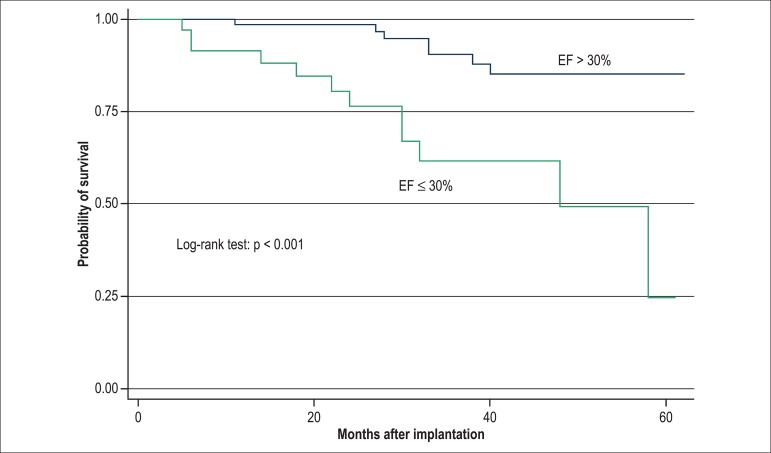
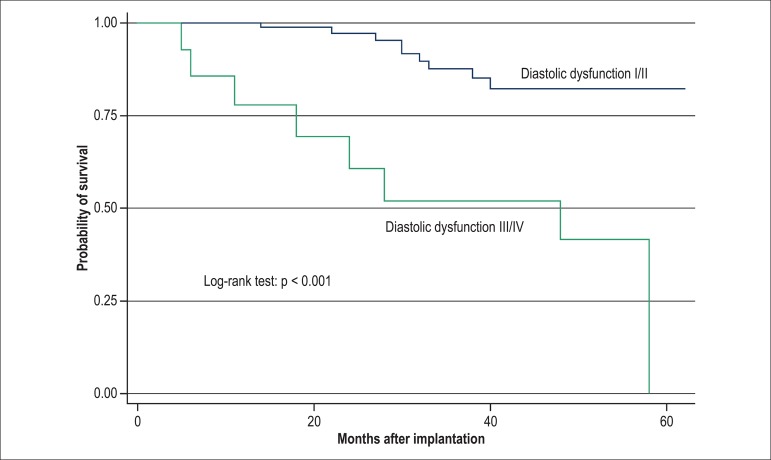
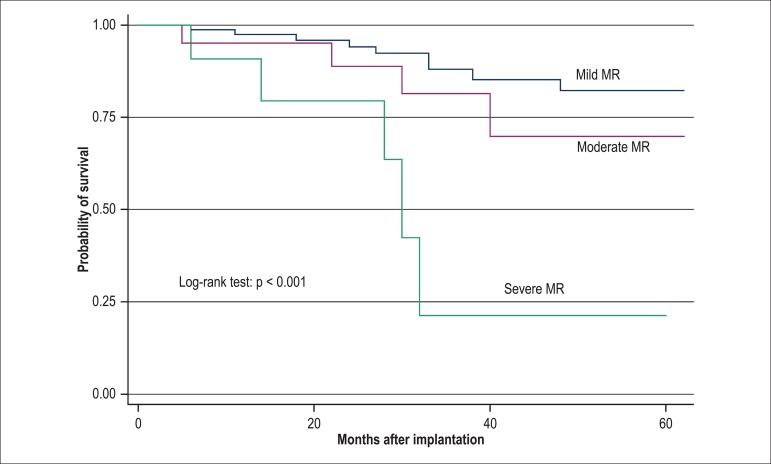
There were 29 (25%) deaths/Tx during follow-up of 34.09 ± 17.9 months. Cardiac mortality/Tx was 16.3%. In the multivariate Cox model, EF < 30%, grade III/IV diastolic dysfunction and grade III mitral regurgitation at 6‑12 months were independently related to increased cardiac mortality or Tx, with hazard ratios of 3.1, 4.63 and 7.11, respectively. The area under the ROC curve was 0.78.
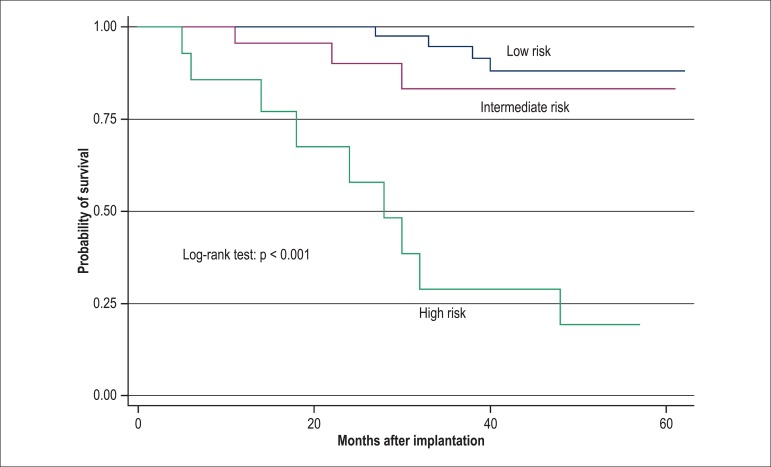
EF lower than 30%, severe diastolic dysfunction and severe mitral regurgitation indicate poor prognosis 1 year after CRT. The combination of two of those variables indicate the need for other treatment options.
心脏再同步治疗(CRT)是全球主要指南推荐的治疗方法。然而,30%-40%的选定患者无反应。
建立一种超声心动图模型,以预测CRT术后1年的心源性死亡或移植情况。
进行观察性前瞻性研究,纳入116例患者,年龄64.89±11.18岁,男性占69.8%,纽约心脏协会(NYHA)心功能分级III级者占68.1%,IV级者占31.9%,左束支传导阻滞者占71.55%,中位射血分数(EF)为29%。在植入前及植入后6-12个月进行评估,并与随访结束时的心源性死亡率/移植情况相关联。使用ROC曲线和Kaplan-Meier曲线进行Cox和逻辑回归分析。通过自举法对模型进行内部验证。
在34.09±17.9个月的随访期间,有29例(25%)死亡/移植。心源性死亡率/移植率为16.3%。在多变量Cox模型中,6-12个月时EF<30%、III/IV级舒张功能障碍和III级二尖瓣反流与心源性死亡或移植风险增加独立相关,风险比分别为3.1、4.63和7.11。ROC曲线下面积为0.78。
EF低于30%、严重舒张功能障碍和严重二尖瓣反流表明CRT术后1年预后不良。其中两个变量的组合表明需要其他治疗选择。