Alsharari Shakir D, King Justin R, Nordman Jacob C, Muldoon Pretal P, Jackson Asti, Zhu Andy Z X, Tyndale Rachel F, Kabbani Nadine, Damaj M Imad
Department of Pharmacology and Toxicology, College of Pharmacy, King Saud University, Riyadh, Kingdom of Saudi Arabia; Department of Pharmacology and Toxicology, Medical College of Virginia, Virginia Commonwealth University, Richmond, Virginia, United States of America.
Department of Molecular Neuroscience, Krasnow Institute for Advanced Study, George Mason University, Fairfax, Virginia, United States of America.
PLoS One. 2015 Sep 10;10(9):e0137070. doi: 10.1371/journal.pone.0137070. eCollection 2015.
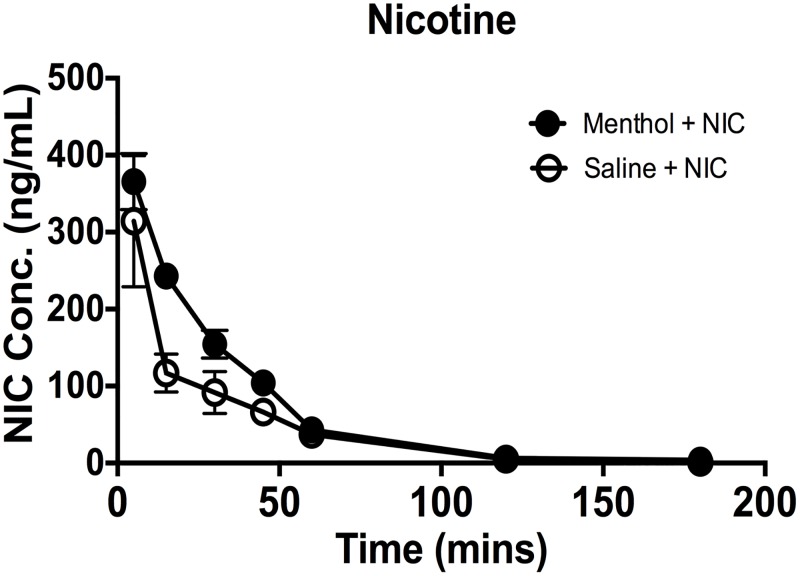
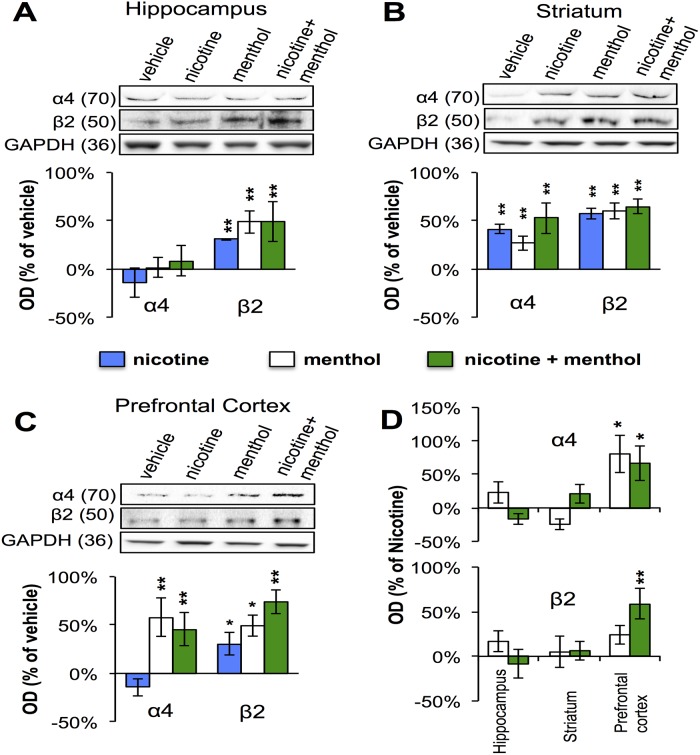
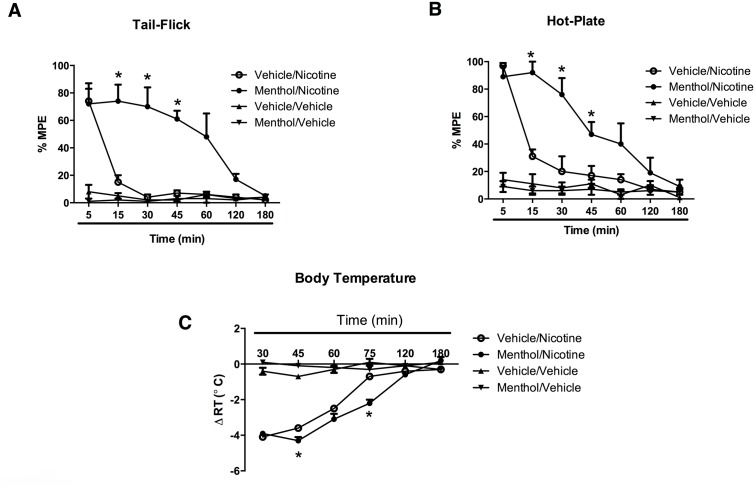
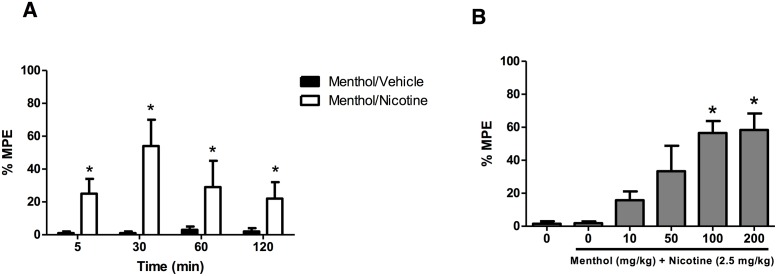
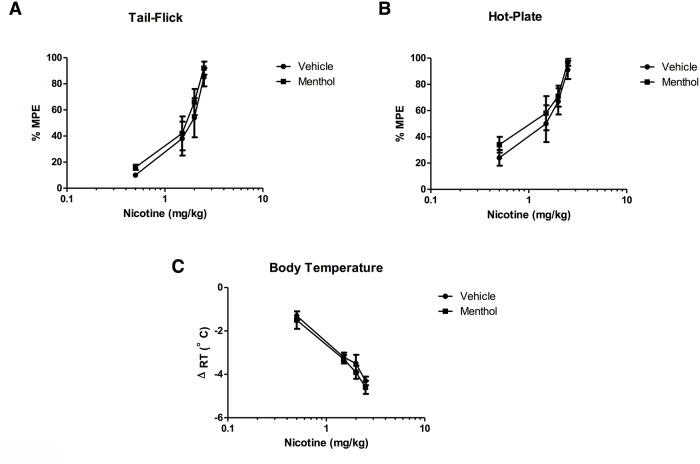
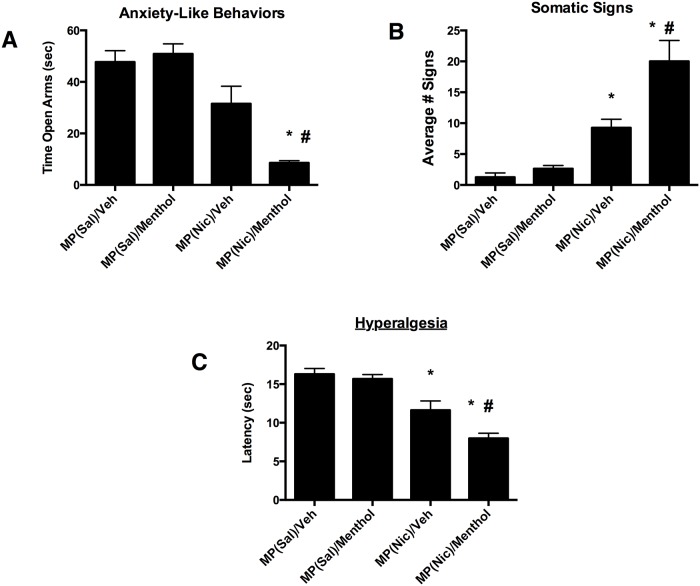
Although menthol, a common flavoring additive to cigarettes, has been found to impact the addictive properties of nicotine cigarettes in smokers little is known about its pharmacological and molecular actions in the brain. Studies were undertaken to examine whether the systemic administration of menthol would modulate nicotine pharmacokinetics, acute pharmacological effects (antinociception and hypothermia) and withdrawal in male ICR mice. In addition, we examined changes in the brain levels of nicotinic receptors of rodents exposed to nicotine and menthol. Administration of i.p. menthol significantly decreased nicotine's clearance (2-fold decrease) and increased its AUC compared to i.p. vehicle treatment. In addition, menthol pretreatment prolonged the duration of nicotine-induced antinociception and hypothermia (2.5 mg/kg, s.c.) for periods up to 180 min post-nicotine administration. Repeated administration of menthol with nicotine increased the intensity of mecamylamine-precipitated withdrawal signs in mice exposed chronically to nicotine. The potentiation of withdrawal intensity by menthol was accompanied by a significant increase in nicotine plasma levels in these mice. Western blot analyses of α4 and β2 nAChR subunit expression suggests that chronic menthol impacts the levels and distribution of these nicotinic subunits in various brain regions. In particular, co-administration of menthol and nicotine appears to promote significant increase in β2 and α4 nAChR subunit expression in the hippocampus, prefrontal cortex and striatum of mice. Surprisingly, chronic injections of menthol alone to mice caused an upregulation of β2 and α4 nAChR subunit levels in these brain regions. Because the addition of menthol to tobacco products has been suggested to augment their addictive potential, the current findings reveal several new pharmacological molecular adaptations that may contribute to its unique addictive profile.
尽管薄荷醇作为香烟中一种常见的调味添加剂,已被发现会影响吸烟者对尼古丁香烟的成瘾特性,但人们对其在大脑中的药理作用和分子作用知之甚少。本研究旨在探讨薄荷醇全身给药是否会调节雄性ICR小鼠的尼古丁药代动力学、急性药理作用(抗伤害感受和体温过低)以及戒断反应。此外,我们还研究了暴露于尼古丁和薄荷醇的啮齿动物大脑中烟碱受体水平的变化。与腹腔注射赋形剂相比,腹腔注射薄荷醇显著降低了尼古丁的清除率(降低了2倍)并增加了其曲线下面积。此外,薄荷醇预处理延长了尼古丁诱导的抗伤害感受和体温过低(2.5mg/kg,皮下注射)的持续时间,在尼古丁给药后长达180分钟。薄荷醇与尼古丁重复给药增加了长期暴露于尼古丁的小鼠中美加明诱发的戒断症状的强度。薄荷醇对戒断强度的增强伴随着这些小鼠尼古丁血浆水平的显著增加。α4和β2 nAChR亚基表达的蛋白质印迹分析表明,长期使用薄荷醇会影响这些烟碱亚基在不同脑区的水平和分布。特别是,薄荷醇与尼古丁共同给药似乎促进了小鼠海马体、前额叶皮质和纹状体中β2和α4 nAChR亚基表达的显著增加。令人惊讶的是,单独给小鼠长期注射薄荷醇会导致这些脑区中β2和α4 nAChR亚基水平上调。由于在烟草产品中添加薄荷醇被认为会增强其成瘾潜力,目前的研究结果揭示了几种新的药理分子适应性变化,这可能有助于其独特的成瘾特征。