Lv Tangfeng, Wang Qian, Cromie Meghan, Liu Hongbing, Tang Song, Song Yong, Gao Weimin
Department of Environmental Toxicology, The Institute of Environmental and Human Health, Texas Tech University, Lubbock, Texas 79416, United States of America.
Department of Respiratory Medicine, Jinling Hospital, Nanjing, Jiangsu 210002, China.
Oncotarget. 2015 Oct 20;6(32):33006-18. doi: 10.18632/oncotarget.5026.
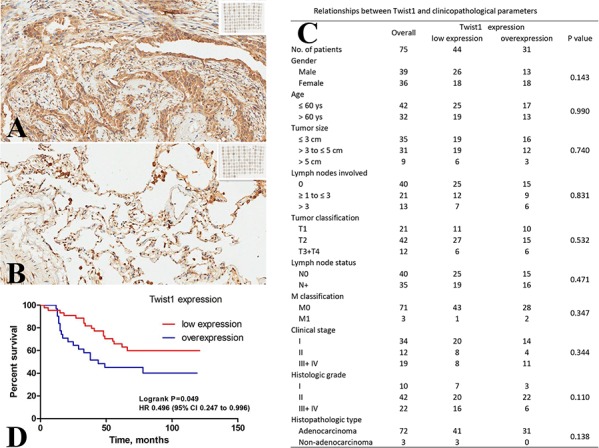
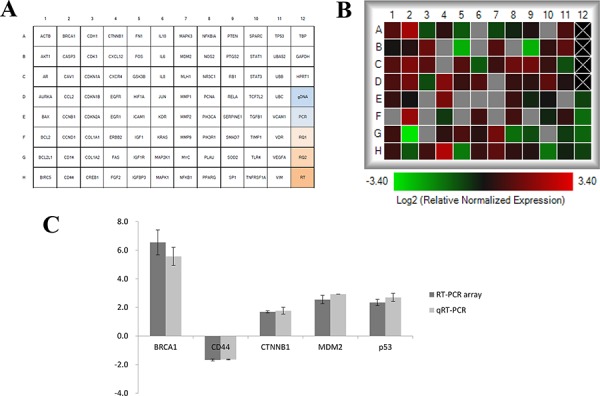
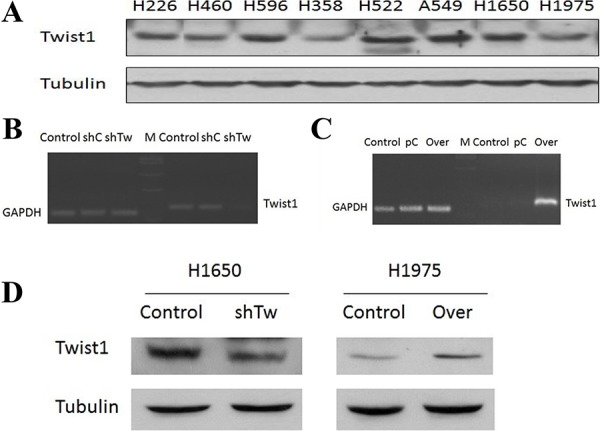
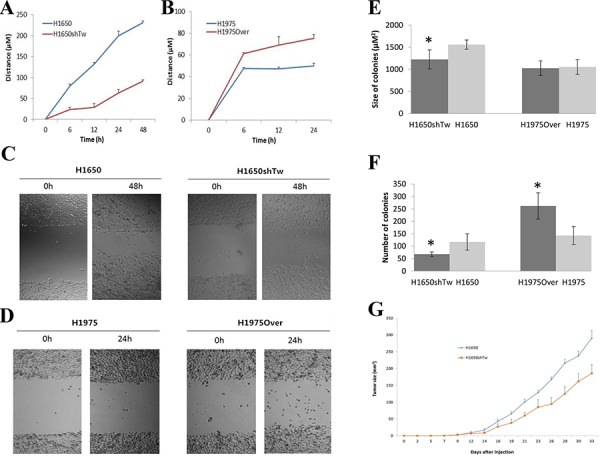
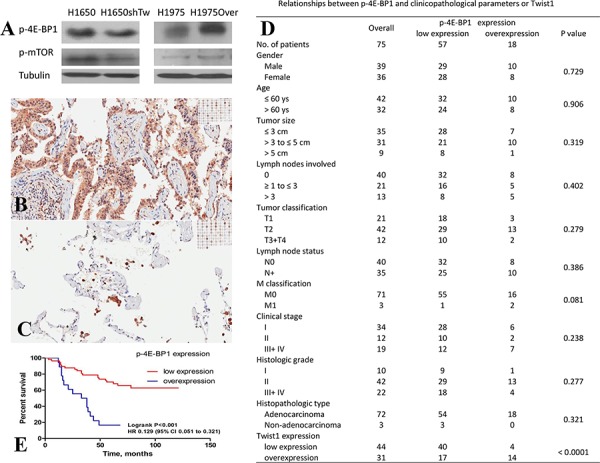
Twist1 overexpression corresponds with poor survival in non-small cell lung cancer (NSCLC), but the underlining mechanism is not clear. The objective of the present study was to investigate the tumorigenic role of Twist1 and its related molecular mechanisms in NSCLC. Twist1 was overexpressed in 34.7% of NSCLC patients. The survival rate was significantly lower in patients with high Twist1 expression than low expression (P < 0.05). Twist1 expression levels were higher in H1650 cells, but relatively lower in H1975 cells. H1650 with stable Twist1 knockdown, H1650shTw, demonstrated a significantly slower rate of wound closure; however, H1975 with stable Twist1 overexpression, H1975Over, had an increased motility velocity. A significant decrease in colony number and size was observed in H1650shTw, but a significant increase in colony number was found in H1975Over (P < 0.05). Tumor growth significantly decreased in mice implanted with H1650shTw compared to H1650 (P < 0.05). 4E-BP1 and p53 gene expressions were increased, but p-4E-BP1 and p-mTOR protein expressions were decreased in H1650shTw. However, 4E-BP1 gene expression was decreased, while p-4E-BP1 and p-mTOR protein expressions were increased in H1975Over. p-4E-BP1 was overexpressed in 24.0% of NSCLC patients. Survival rate was significantly lower in patients with high p-4E-BP1 expression than low p-4E-BP1 (P < 0.01). A significant correlation was found between Twist1 and p-4E-BP1 (P < 0.01). A total of 13 genes in RT-PCR array showed significant changes in H1650shTw. Altogether, Twist1 is correlated with p-4E-BP1 in predicting the prognostic outcome of NSCLC. Inhibition of Twist1 decreases p-4E-BP1 expression possibly through downregulating p-mTOR and increasing p53 expression in NSCLC.
Twist1过表达与非小细胞肺癌(NSCLC)患者的不良生存相关,但潜在机制尚不清楚。本研究的目的是探讨Twist1在NSCLC中的致瘤作用及其相关分子机制。34.7%的NSCLC患者中Twist1过表达。Twist1高表达患者的生存率显著低于低表达患者(P<0.05)。H1650细胞中Twist1表达水平较高,而H1975细胞中相对较低。稳定敲低Twist1的H1650细胞(H1650shTw)显示伤口愈合速度明显减慢;然而,稳定过表达Twist1的H1975细胞(H1975Over)运动速度增加。H1650shTw中集落数量和大小显著减少,但H1975Over中集落数量显著增加(P<0.05)。与H1650相比,植入H1650shTw的小鼠肿瘤生长显著减少(P<0.05)。H1650shTw中4E-BP1和p53基因表达增加,但p-4E-BP1和p-mTOR蛋白表达减少。然而,H1975Over中4E-BP1基因表达减少,而p-4E-BP1和p-mTOR蛋白表达增加。24.0%的NSCLC患者中p-4E-BP1过表达。p-4E-BP1高表达患者的生存率显著低于低表达患者(P<0.01)。Twist1与p-4E-BP1之间存在显著相关性(P<0.01)。RT-PCR阵列中的总共13个基因在H1650shTw中显示出显著变化。总之,在预测NSCLC的预后结果方面,Twist1与p-4E-BP1相关。在NSCLC中,抑制Twist1可能通过下调p-mTOR和增加p53表达来降低p-4E-BP1表达。