Kaiser Laure, Le Ru Bruno Pierre, Kaoula Ferial, Paillusson Corentin, Capdevielle-Dulac Claire, Obonyo Julius Ochieng, Herniou Elisabeth A, Jancek Severine, Branca Antoine, Calatayud Paul-André, Silvain Jean-François, Dupas Stephane
Laboratoire Evolution, Génomes, Comportement et Ecologie, UMR CNRS-Univ. Paris-Sud-IRD, Univ. Paris-Saclay Gif-sur-Yvette Cedex, France ; INRA, UMR 1392, Institut d'Ecologie et des Sciences de l'Environnement de Paris Paris, France.
Laboratoire Evolution, Génomes, Comportement et Ecologie, UMR CNRS-Univ. Paris-Sud-IRD, Univ. Paris-Saclay Gif-sur-Yvette Cedex, France ; icipe: African Insect Science for Food and Health Nairobi, Kenya.
Evol Appl. 2015 Sep;8(8):807-20. doi: 10.1111/eva.12260. Epub 2015 Jul 7.
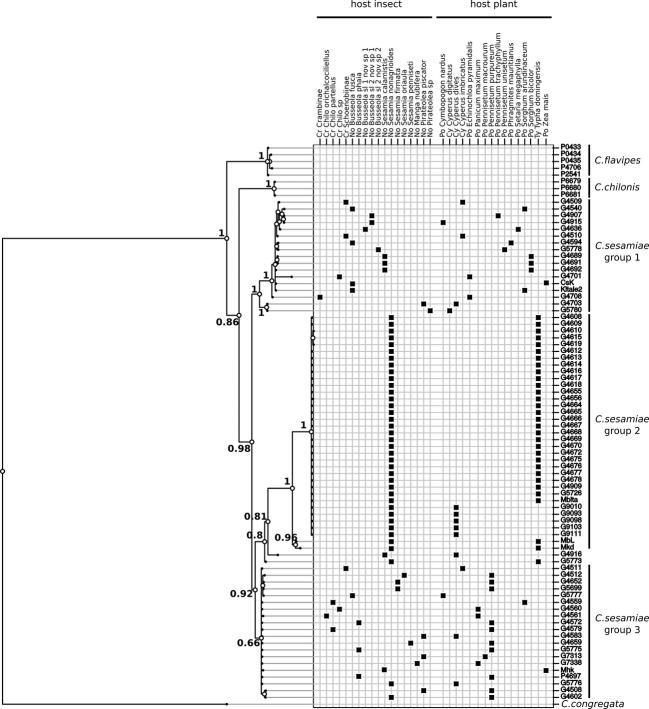
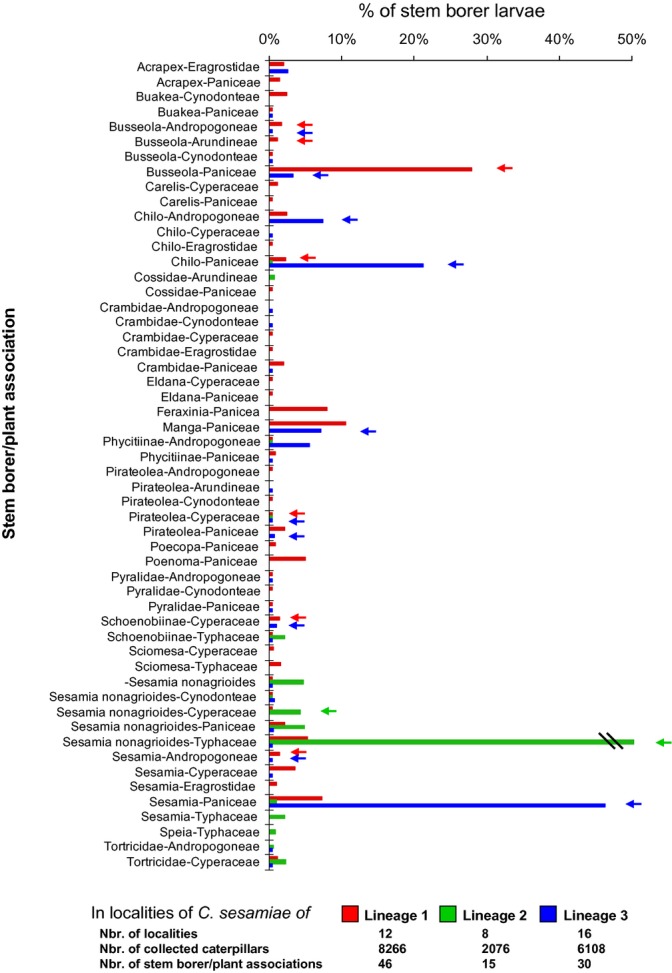
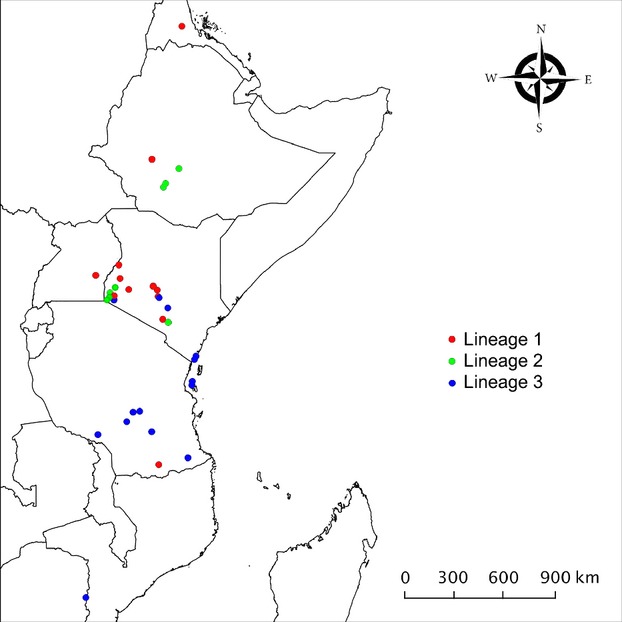
To develop efficient and safe biological control, we need to reliably identify natural enemy species, determine their host range, and understand the mechanisms that drive host range evolution. We investigated these points in Cotesia sesamiae, an African parasitic wasp of cereal stem borers. Phylogenetic analyses of 74 individual wasps, based on six mitochondrial and nuclear genes, revealed three lineages. We then investigated the ecological status (host plant and host insect ranges in the field, and host insect suitability tests) and the biological status (cross-mating tests) of the three lineages. We found that one highly supported lineage showed all the hallmarks of a cryptic species. It is associated with one host insect, Sesamia nonagrioides, and is reproductively isolated from the other two lineages by pre- and postmating barriers. The other two lineages had a more variable phylogenetic support, depending on the set of genes; they exhibited an overlapping and diversified range of host species and are not reproductively isolated from one another. We discuss the ecological conditions and mechanisms that likely generated this ongoing speciation and the relevance of this new specialist taxon in the genus Cotesia for biological control.
为了开发高效且安全的生物防治方法,我们需要可靠地识别天敌物种,确定其寄主范围,并了解驱动寄主范围进化的机制。我们以谷物螟虫的非洲寄生蜂——塞氏茧蜂(Cotesia sesamiae)为研究对象,对这些要点进行了研究。基于六个线粒体基因和核基因,对74只个体黄蜂进行的系统发育分析揭示了三个谱系。然后,我们研究了这三个谱系的生态状况(田间的寄主植物和寄主昆虫范围,以及寄主昆虫适宜性测试)和生物学状况(杂交交配测试)。我们发现,一个得到高度支持的谱系具有隐存种的所有特征。它与一种寄主昆虫——非洲高粱条螟(Sesamia nonagrioides)相关联,并且通过交配前和交配后的障碍与其他两个谱系生殖隔离。另外两个谱系的系统发育支持度则根据基因组合的不同而更具变异性;它们表现出寄主物种范围重叠且多样化,并且彼此之间没有生殖隔离。我们讨论了可能导致这种正在进行的物种形成的生态条件和机制,以及塞氏茧蜂属中这个新的专化类群在生物防治中的相关性。