Université Paris-Saclay, CNRS, IRD, UMR Évolution, Génomes, Comportement, et Écologie, Gif-sur-Yvette, France.
UMR 7261 CNRS, Institut de Recherche sur la Biologie de l'Insecte, Faculté des Sciences et Techniques, Université de Tours, Tours, France.
J Virol. 2021 Oct 27;95(22):e0068421. doi: 10.1128/JVI.00684-21. Epub 2021 Jul 28.
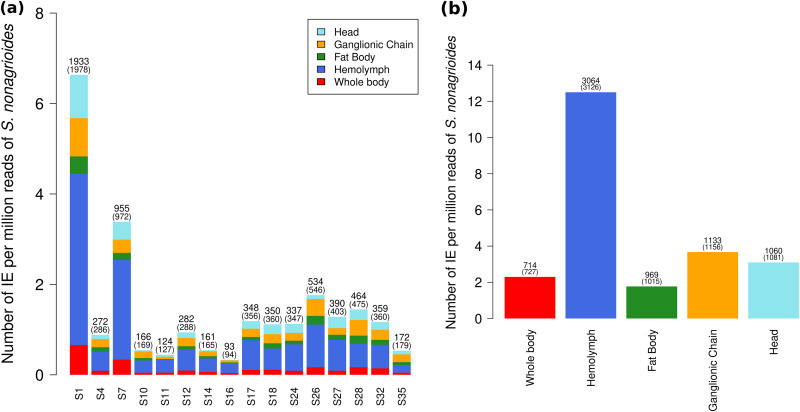
Bracoviruses are domesticated viruses found in parasitic wasp genomes. They are composed of genes of nudiviral origin that are involved in particle production and proviral segments containing virulence genes that are necessary for parasitism success. During particle production, proviral segments are amplified and individually packaged as DNA circles in nucleocapsids. These particles are injected by parasitic wasps into host larvae together with their eggs. Bracovirus circles of two wasp species were reported to undergo chromosomal integration in parasitized host hemocytes, through a conserved sequence named the host integration motif (HIM). Here, we used bulk Illumina sequencing to survey integrations of Cotesia typhae bracovirus circles in the DNA of its host, the maize corn borer (Sesamia nonagrioides), 7 days after parasitism. First, assembly and annotation of a high-quality genome for C. typhae enabled us to characterize 27 proviral segments clustered in proviral loci. Using these data, we characterized large numbers of chromosomal integrations (from 12 to 85 events per host haploid genome) for all 16 bracovirus circles containing a HIM. Integrations were found in four S. nonagrioides tissues and in the body of a caterpillar in which parasitism had failed. The 12 remaining circles do not integrate but are maintained at high levels in host tissues. Surprisingly, we found that HIM-mediated chromosomal integration in the wasp germ line has occurred accidentally at least six times during evolution. Overall, our study furthers our understanding of wasp-host genome interactions and supports HIM-mediated chromosomal integration as a possible mechanism of horizontal transfer from wasps to their hosts. Bracoviruses are endogenous domesticated viruses of parasitoid wasps that are injected together with wasp eggs into wasp host larvae during parasitism. Several studies have shown that some DNA circles packaged into bracovirus particles become integrated into host somatic genomes during parasitism, but the phenomenon has never been studied using nontargeted approaches. Here, we use bulk Illumina sequencing to systematically characterize and quantify bracovirus circle integrations that occur in four tissues of the Mediterranean corn borer (Sesamia nonagrioides) during parasitism by the Cotesia typhae wasp. Our analysis reveals that all circles containing a HIM integrate at substantial levels (from 12 to 85 integrations per host cell, in total) in all tissues, while other circles do not integrate. In addition to shedding new light on wasp-bracovirus-host interactions, our study supports HIM-mediated chromosomal integration of bracovirus as a possible source of wasp-to-host horizontal transfer, with long-term evolutionary consequences.
β 病毒是在寄生蜂基因组中发现的驯化病毒。它们由起源于 nudivirus 的基因组成,这些基因参与颗粒产生和前病毒片段,前病毒片段包含寄生成功所必需的毒力基因。在颗粒产生过程中,前病毒片段被扩增并单独包装为核衣壳中的 DNA 环。这些颗粒与寄生蜂的卵一起被寄生蜂注射到宿主幼虫体内。据报道,两种寄生蜂的β 病毒环通过一个名为宿主整合基序(HIM)的保守序列在被寄生的宿主血细胞中发生染色体整合。在这里,我们使用大量的 Illumina 测序来调查玉米螟(Sesamia nonagrioides)被玉米螟(Cotesia typhae)寄生 7 天后,其β 病毒环的 DNA 中 C. typhae 病毒环的整合情况。首先,高质量的 C. typhae 基因组组装和注释使我们能够对聚集在前病毒基因座中的 27 个前病毒片段进行特征描述。利用这些数据,我们对所有包含 HIM 的 16 个β 病毒环的大量染色体整合(每个宿主单倍体基因组 12 到 85 个事件)进行了特征描述。整合发生在四个 S. nonagrioides 组织和一个寄生失败的毛毛虫体内。其余 12 个环不整合,但在宿主组织中维持高水平。令人惊讶的是,我们发现 HIM 介导的寄生蜂生殖系中的染色体整合在进化过程中至少偶然发生了六次。总的来说,我们的研究增进了我们对寄生蜂与宿主基因组相互作用的理解,并支持 HIM 介导的染色体整合作为从寄生蜂到宿主的水平转移的一种可能机制。β 病毒是寄生蜂的内源性驯化病毒,在寄生过程中与蜂卵一起注入蜂宿主幼虫体内。几项研究表明,一些包装在β 病毒颗粒中的 DNA 环在寄生过程中整合到宿主的体细胞基因组中,但这一现象从未使用非靶向方法进行过研究。在这里,我们使用大量的 Illumina 测序来系统地描述和量化地中海玉米螟(Sesamia nonagrioides)在被 Cotesia typhae 寄生时,四个组织中β 病毒环的整合。我们的分析表明,所有含有 HIM 的环都以相当高的水平(每个宿主细胞 12 到 85 个整合,总共)整合到所有组织中,而其他环则不整合。除了揭示寄生蜂-病毒-宿主相互作用的新现象外,我们的研究还支持 HIM 介导的β 病毒染色体整合作为寄生蜂到宿主水平转移的一个可能来源,具有长期的进化后果。