Li You, Simmons David Rabern, Bateman Craig C, Short Dylan P G, Kasson Matthew T, Rabaglia Robert J, Hulcr Jiri
School of Forest Resources and Conservation, Institute of Food and Agricultural Sciences, University of Florida, Gainesville, Florida, United States of America.
Department of Entomology and Nematology, Institute of Food and Agricultural Sciences, University of Florida, Gainesville, Florida, United States of America.
PLoS One. 2015 Sep 14;10(9):e0137689. doi: 10.1371/journal.pone.0137689. eCollection 2015.
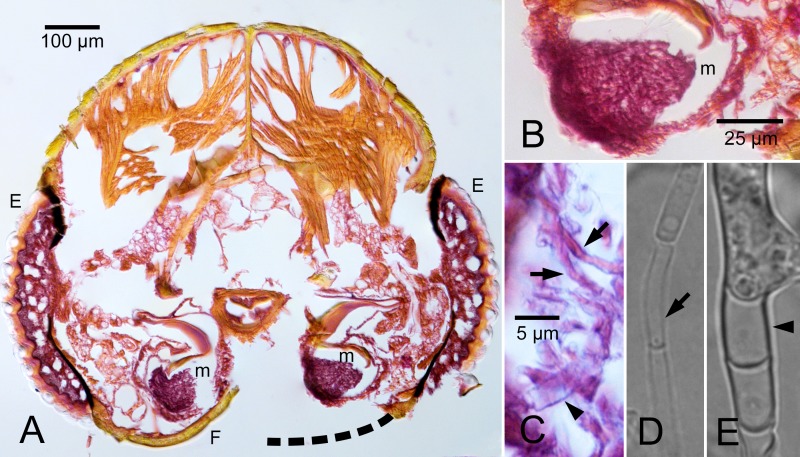
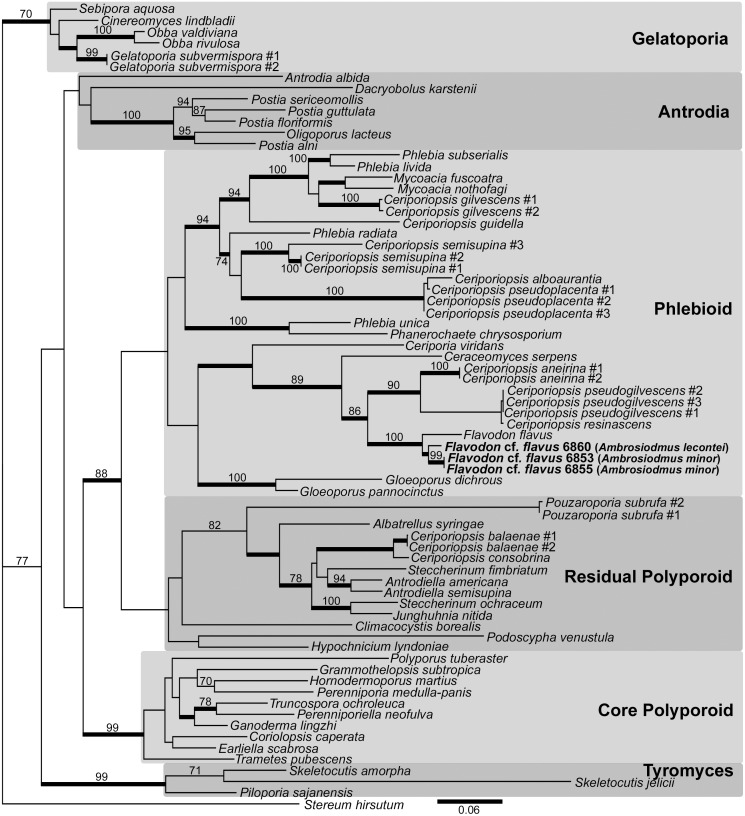
Ambrosia symbiosis is an obligate, farming-like mutualism between wood-boring beetles and fungi. It evolved at least 11 times and includes many notorious invasive pests. All ambrosia beetles studied to date cultivate ascomycotan fungi: early colonizers of recently killed trees with poor wood digestion. Beetles in the widespread genus Ambrosiodmus, however, colonize decayed wood. We characterized the mycosymbionts of three Ambrosiodmus species using quantitative culturing, high-throughput metabarcoding, and histology. We determined the fungi to be within the Polyporales, closely related to Flavodon flavus. Culture-independent sequencing of Ambrosiodmus minor mycangia revealed a single operational taxonomic unit identical to the sequences from the cultured Flavodon. Histological sectioning confirmed that Ambrosiodmus possessed preoral mycangia containing dimitic hyphae similar to cultured F. cf. flavus. The Ambrosiodmus-Flavodon symbiosis is unique in several aspects: it is the first reported association between an ambrosia beetle and a basidiomycotan fungus; the mycosymbiont grows as hyphae in the mycangia, not as budding pseudo-mycelium; and the mycosymbiont is a white-rot saprophyte rather than an early colonizer: a previously undocumented wood borer niche. Few fungi are capable of turning rotten wood into complete animal nutrition. Several thousand beetle-fungus symbioses remain unstudied and promise unknown and unexpected mycological diversity and enzymatic innovations.
共生菌共生是一种钻木甲虫与真菌之间的专性、类似农耕的互利共生关系。它至少进化了11次,包括许多臭名昭著的入侵害虫。迄今为止研究的所有共生菌甲虫都培育子囊菌真菌:这些真菌是近期死亡树木的早期定植者,木材消化能力较差。然而,广泛分布的Ambrosiodmus属中的甲虫会在腐朽的木材中定植。我们使用定量培养、高通量宏条形码技术和组织学方法对三种Ambrosiodmus物种的真菌共生体进行了表征。我们确定这些真菌属于多孔菌目,与黄多孔菌密切相关。对小Ambrosiodmus菌囊的非培养测序揭示了一个单一的可操作分类单元,与培养的黄多孔菌的序列相同。组织切片证实,Ambrosiodmus拥有口前菌囊,其中含有与培养的拟黄多孔菌相似的二型菌丝。Ambrosiodmus - 黄多孔菌共生在几个方面是独特的:它是首次报道的共生菌甲虫与担子菌真菌之间的关联;真菌共生体在菌囊中以菌丝形式生长,而不是以出芽的假菌丝形式生长;并且真菌共生体是一种白腐腐生菌,而不是早期定植者:这是一个以前未记录的蛀木虫生态位。很少有真菌能够将腐烂的木材转化为完整的动物营养物质。数千种甲虫 - 真菌共生关系仍未得到研究,有望发现未知和意想不到的真菌多样性及酶创新。