Dey Sanjukta, Corina Vlot A
Helmholtz Zentrum Muenchen, Department of Environmental Sciences, Institute of Biochemical Plant Pathology , Neuherberg, Germany.
Front Plant Sci. 2015 Aug 28;6:640. doi: 10.3389/fpls.2015.00640. eCollection 2015.
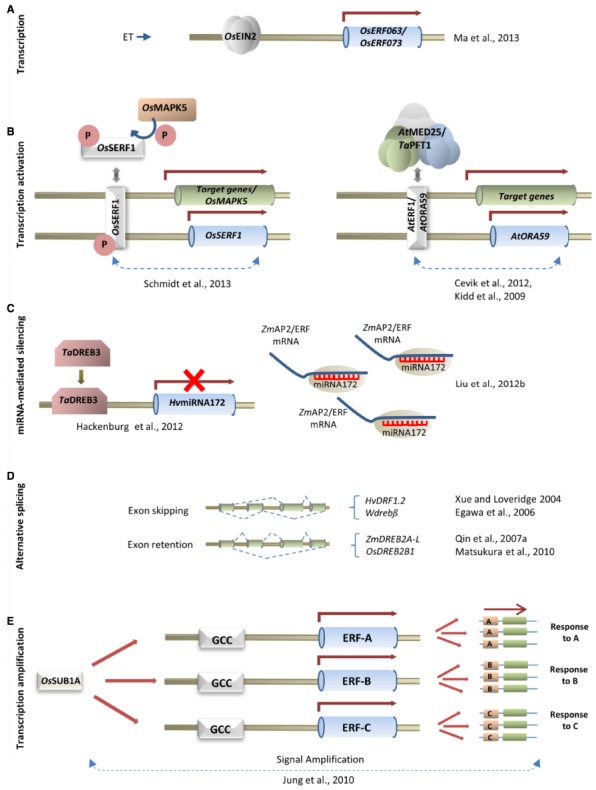
The APETALA2/Ethylene-Responsive Factor (AP2/ERF) superfamily of transcription factors (TFs) regulates physiological, developmental and stress responses. Most of the AP2/ERF TFs belong to the ERF family in both dicotyledonous and monocotyledonous plants. ERFs are implicated in the responses to both biotic and abiotic stress and occasionally impart multiple stress tolerance. Studies have revealed that ERF gene function is conserved in dicots and monocots. Moreover, successful stress tolerance phenotypes are observed on expression in heterologous systems, making ERFs promising candidates for engineering stress tolerance in plants. In this review, we summarize the role of ERFs in general stress tolerance, including responses to biotic and abiotic stress factors, and endeavor to understand the cascade of ERF regulation resulting in successful signal-to-response translation in monocotyledonous plants.
转录因子(TFs)的APETALA2/乙烯响应因子(AP2/ERF)超家族调控生理、发育和应激反应。在双子叶植物和单子叶植物中,大多数AP2/ERF转录因子都属于ERF家族。ERF参与生物和非生物胁迫反应,偶尔赋予多重胁迫耐受性。研究表明,ERF基因功能在双子叶植物和单子叶植物中是保守的。此外,在异源系统中表达时可观察到成功的胁迫耐受性表型,这使得ERF成为植物工程胁迫耐受性的有前景的候选者。在本综述中,我们总结了ERF在一般胁迫耐受性中的作用,包括对生物和非生物胁迫因子的反应,并试图了解导致单子叶植物成功实现信号到反应转化的ERF调控级联。