Bloome Deirdre
Soc Forces. 2015 Mar;93(3):1047-1080. doi: 10.1093/sf/sou092.
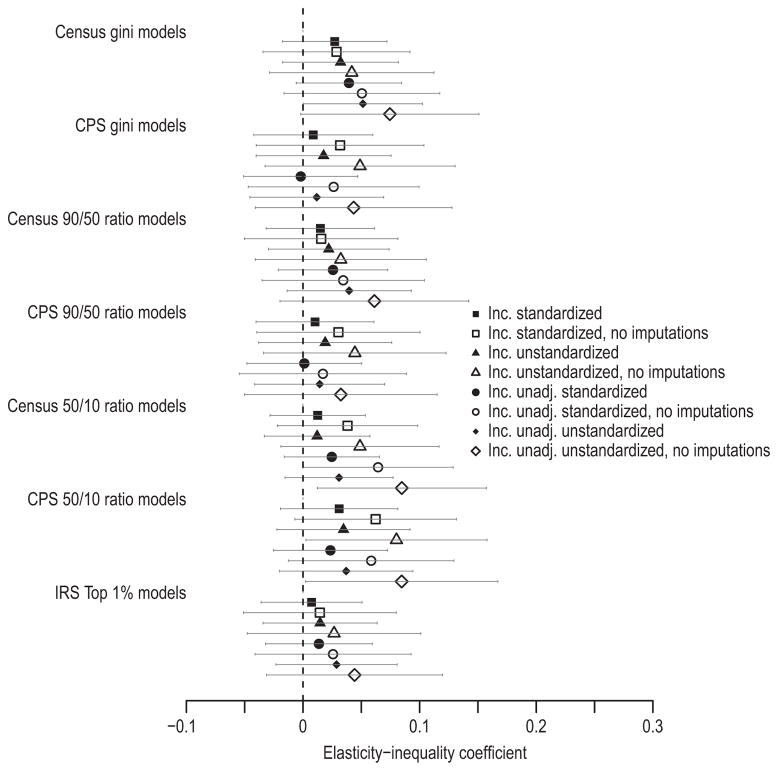
Is there a relationship between family income inequality and income mobility across generations in the United States? As family income inequality rose in the United States, parental resources available for improving children's health, education, and care diverged. The amount and rate of divergence also varied across US states. Researchers and policy analysts have expressed concern that relatively high inequality might be accompanied by relatively low mobility, tightening the connection between individuals' incomes during childhood and adulthood. Using data from the Panel Study of Income Dynamics, the National Longitudinal Survey of Youth, and various government sources, this paper exploits state and cohort variation to estimate the relationship between inequality and mobility. Results provide very little support for the hypothesis that inequality shapes mobility in the United States. The inequality children experienced during youth had no robust association with their economic mobility as adults. Formal analysis reveals that offsetting effects could underlie this result. In theory, mobility-enhancing forces may counterbalance mobility-reducing effects. In practice, the results suggest that in the US context, the intergenerational transmission of income may not be very responsive to changes in inequality.
美国的家庭收入不平等与代际收入流动性之间存在关联吗?随着美国国内家庭收入不平等加剧,可用于改善子女健康、教育和照料的父母资源出现了分化。分化的程度和速度在美国各州也存在差异。研究人员和政策分析师担心,相对较高的不平等可能伴随着相对较低的流动性,从而强化童年与成年时期个人收入之间的联系。本文利用收入动态面板研究、全国青年纵向调查以及各种政府来源的数据,通过州和队列的差异来估计不平等与流动性之间的关系。结果几乎没有支持不平等影响美国流动性这一假设。儿童在青少年时期经历的不平等与他们成年后的经济流动性没有显著关联。正式分析表明,抵消效应可能是这一结果的潜在原因。理论上,促进流动性的力量可能会抵消降低流动性的影响。实际上,结果表明在美国的背景下,收入的代际传递可能对不平等的变化不太敏感。