
杨树中转化酶基因家族的全基因组鉴定
Genome-Wide Identification of the Invertase Gene Family in Populus.
作者信息
Chen Zhong, Gao Kai, Su Xiaoxing, Rao Pian, An Xinmin
机构信息
National Engineering Laboratory for Tree Breeding, College of Biological Sciences and Biotechnology, Beijing Forestry University, Beijing, China; Key Laboratory of Genetics and Breeding in Forest Trees and Ornamental Plants of the Ministry of Education, College of Biological Sciences and Biotechnology, Beijing Forestry University, Beijing, China.
Beijing Berry Genomics Company Limited, Beijing, China.
出版信息
PLoS One. 2015 Sep 22;10(9):e0138540. doi: 10.1371/journal.pone.0138540. eCollection 2015.
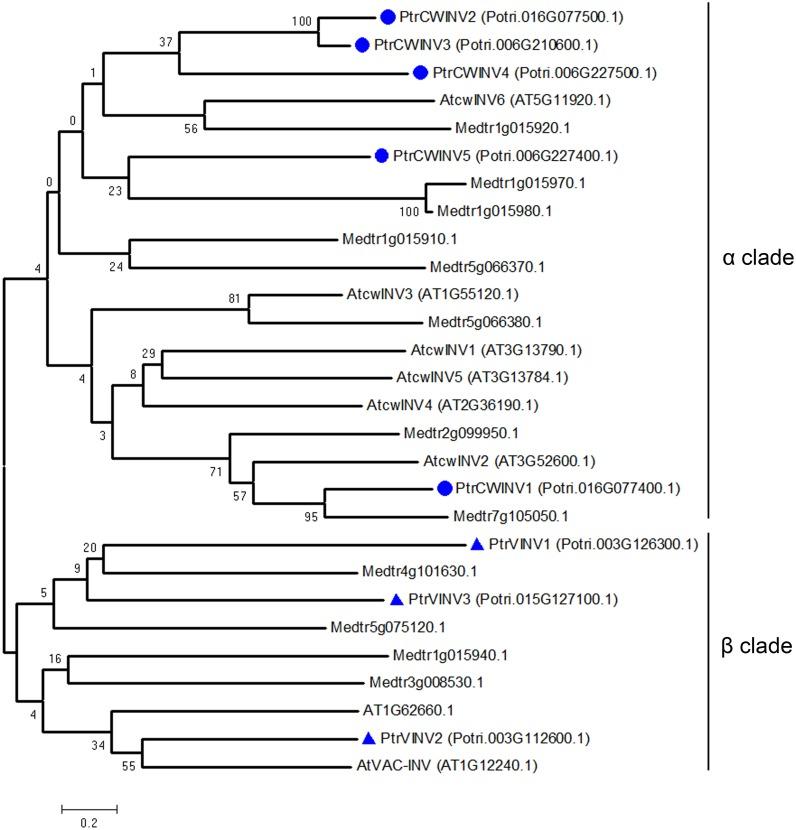
Invertase plays a crucial role in carbohydrate partitioning and plant development as it catalyses the irreversible hydrolysis of sucrose into glucose and fructose. The invertase family in plants is composed of two sub-families: acid invertases, which are targeted to the cell wall and vacuole; and neutral/alkaline invertases, which function in the cytosol. In this study, 5 cell wall invertase genes (PtCWINV1-5), 3 vacuolar invertase genes (PtVINV1-3) and 16 neutral/alkaline invertase genes (PtNINV1-16) were identified in the Populus genome and found to be distributed on 14 chromosomes. A comprehensive analysis of poplar invertase genes was performed, including structures, chromosome location, phylogeny, evolutionary pattern and expression profiles. Phylogenetic analysis indicated that the two sub-families were both divided into two clades. Segmental duplication is contributed to neutral/alkaline sub-family expansion. Furthermore, the Populus invertase genes displayed differential expression in roots, stems, leaves, leaf buds and in response to salt/cold stress and pathogen infection. In addition, the analysis of enzyme activity and sugar content revealed that invertase genes play key roles in the sucrose metabolism of various tissues and organs in poplar. This work lays the foundation for future functional analysis of the invertase genes in Populus and other woody perennials.
转化酶在碳水化合物分配和植物发育中起着关键作用,因为它催化蔗糖不可逆地水解为葡萄糖和果糖。植物中的转化酶家族由两个亚家族组成:定位于细胞壁和液泡的酸性转化酶;以及在细胞质中起作用的中性/碱性转化酶。在本研究中,在杨树基因组中鉴定出5个细胞壁转化酶基因(PtCWINV1 - 5)、3个液泡转化酶基因(PtVINV1 - 3)和16个中性/碱性转化酶基因(PtNINV1 - 16),并发现它们分布在14条染色体上。对杨树转化酶基因进行了全面分析,包括结构、染色体定位、系统发育、进化模式和表达谱。系统发育分析表明,这两个亚家族都分为两个进化枝。片段重复有助于中性/碱性亚家族的扩展。此外,杨树转化酶基因在根、茎、叶、叶芽中以及对盐/冷胁迫和病原体感染有不同的表达。此外,酶活性和糖含量分析表明,转化酶基因在杨树各组织器官的蔗糖代谢中起关键作用。这项工作为未来杨树和其他木本多年生植物转化酶基因的功能分析奠定了基础。




 Zotero 插件