Goldmann Tobias, Blank Thomas, Prinz Marco
Institute of Neuropathology, University of Freiburg, Germany.
Institute of Neuropathology, University of Freiburg, Germany; BIOSS Centre for Biological Signalling Studies, University of Freiburg, Germany.
Curr Opin Neurobiol. 2016 Feb;36:38-42. doi: 10.1016/j.conb.2015.09.003. Epub 2015 Sep 20.
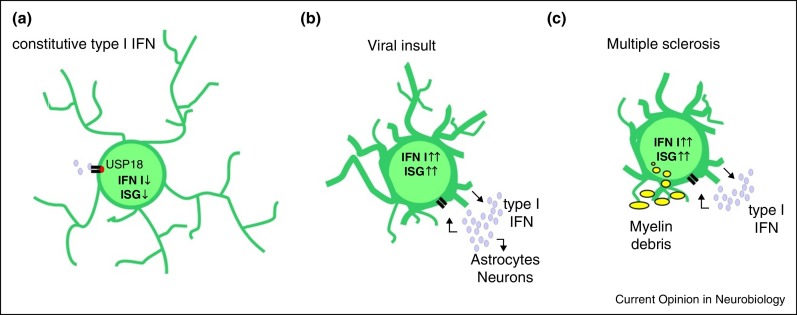
Type I interferons (IFN) are pleiotropic cytokines originally described as molecules used for communication between cells to trigger the protective defenses against viral infections. Upon activation, type I IFN can be produced locally in the central nervous system (CNS) from a number of different cell types including microglia, the CNS-resident macrophages. Increased type I IFN production and signaling in microglia are critically important to limit viral infection and disease progression in multiple sclerosis. However, recent findings suggest that even baseline levels of constitutive IFN expression and secretion are important for homeostasis of the CNS. In fact, in the absence of viral particles chronic elevation of IFN I may be tremendously harmful for the CNS, as assumed for patients suffering from Aicardi-Goutières syndrome, Cree encephalitis or other type I interferonopathies. The highly diverse nature of type I IFN for brain homeostasis during health and disease will be discussed in this report.
I型干扰素(IFN)是多效性细胞因子,最初被描述为细胞间用于触发抗病毒感染保护性防御的分子。激活后,I型干扰素可由包括小胶质细胞(中枢神经系统驻留巨噬细胞)在内的多种不同细胞类型在中枢神经系统(CNS)中局部产生。小胶质细胞中I型干扰素产生和信号传导的增加对于限制多发性硬化症中的病毒感染和疾病进展至关重要。然而,最近的研究结果表明,即使是组成型干扰素表达和分泌的基线水平对于中枢神经系统的稳态也很重要。事实上,正如患有Aicardi-Goutières综合征、克里脑炎或其他I型干扰素病的患者所推测的那样,在没有病毒颗粒的情况下,IFN I的慢性升高可能对中枢神经系统造成极大危害。本报告将讨论I型干扰素在健康和疾病期间对脑稳态的高度多样性。