Sanford Sophie A I, McEwan William A
Department of Clinical Neurosciences at the University of Cambridge, Cambridge, United Kingdom.
UK Dementia Research Institute at the University of Cambridge, Cambridge, United Kingdom.
Front Cell Neurosci. 2022 Jul 15;16:949340. doi: 10.3389/fncel.2022.949340. eCollection 2022.
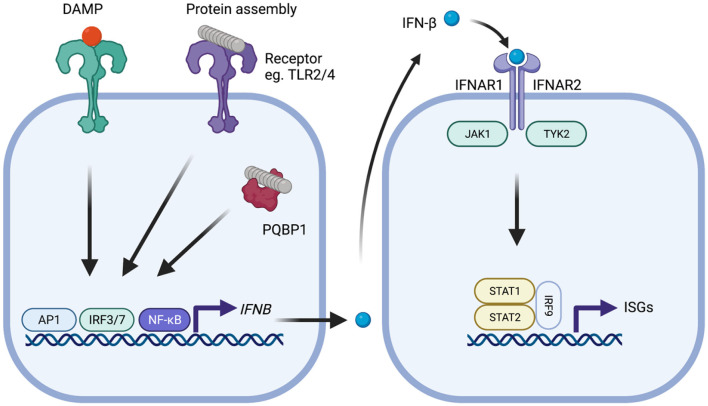
The detection of pathogen-associated molecular patterns can elicit the production of type-I interferons (IFNs), soluble cytokines that induce a transcriptional state inhibitory to viral replication. Signatures of type-I IFN-driven gene expression, and type-I IFNs themselves, are observed in the central nervous system during neurodegenerative diseases including Alzheimer's disease and other tauopathies, the umbrella term for diseases that feature aggregation of the cytosolic protein tau. The contribution of the type-I IFN response to pathological progression of these diseases, however, is not well-understood. The wholesale transcriptional changes that ensue from type-I IFN production can both promote protective effects and lead to damage dependent on the context and duration of the response. The type-I IFN system therefore represents a signaling pathway with a potential disease-modifying role in the progression of neurodegenerative disease. In this review we summarize the evidence for a type-I IFN signature in AD and other tauopathies and examine the role of aggregated proteins as inflammatory stimuli. We explore both the protective role of IFN against protein pathologies as well as their downstream toxic consequences, which include the exacerbation of protein pathology as a potentially destructive feed-forward loop. Given the involvement of type-I IFNs in other neurogenerative diseases, we draw comparisons with other categories of homotypic protein aggregation. Understanding how type-I IFN influences progression of AD and other tauopathies may yield important insight to neurodegeneration and identify new targets in an area currently lacking disease-modifying therapies.
病原体相关分子模式的检测可引发I型干扰素(IFN)的产生,I型干扰素是一种可溶性细胞因子,可诱导抑制病毒复制的转录状态。在包括阿尔茨海默病和其他tau蛋白病(以细胞溶质蛋白tau聚集为特征的疾病的统称)在内的神经退行性疾病的中枢神经系统中,可观察到I型干扰素驱动的基因表达特征以及I型干扰素本身。然而,I型干扰素反应对这些疾病病理进展的作用尚未得到充分了解。I型干扰素产生后随之而来的全面转录变化,既可以促进保护作用,也可能根据反应的背景和持续时间导致损伤。因此,I型干扰素系统代表了一种在神经退行性疾病进展中具有潜在疾病修饰作用的信号通路。在这篇综述中,我们总结了AD和其他tau蛋白病中I型干扰素特征的证据,并研究了聚集蛋白作为炎症刺激物的作用。我们探讨了干扰素对蛋白质病理的保护作用及其下游毒性后果,其中包括蛋白质病理的加剧,这可能是一个潜在的破坏性前馈循环。鉴于I型干扰素参与其他神经退行性疾病,我们将其与其他同类蛋白质聚集类别进行了比较。了解I型干扰素如何影响AD和其他tau蛋白病的进展,可能会为神经退行性变带来重要见解,并在目前缺乏疾病修饰疗法的领域中确定新的靶点。