Patlolla Jagan M R, Kopelovich Levy, Qian Li, Zhang Yuting, Kumar Gaurav, Madka Venkateshwar, Mohammed Altaf, Biddick Laura, Sadeghi Michael, Lightfoot Stan, Rao Chinthalapally V
Center for Chemoprevention and Cancer Drug Development, Department of Medicine, Hem-Onc Section, PCS Oklahoma Cancer Center, University of Oklahoma Health Sciences Center, Oklahoma City, OK 73104, USA.
Chemopreventive Agent Development Research Group, Division of Cancer Prevention, National Cancer Institute, Bethesda, MD 20892-9788, USA.
Oncol Rep. 2015 Dec;34(6):2925-34. doi: 10.3892/or.2015.4277. Epub 2015 Sep 16.
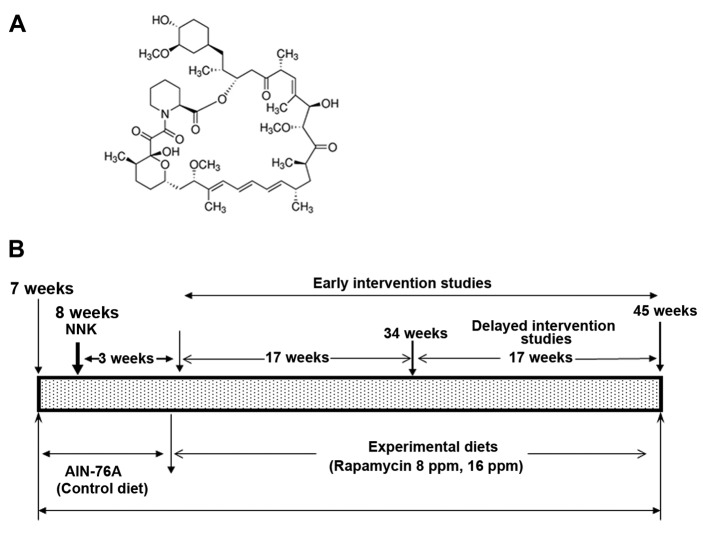
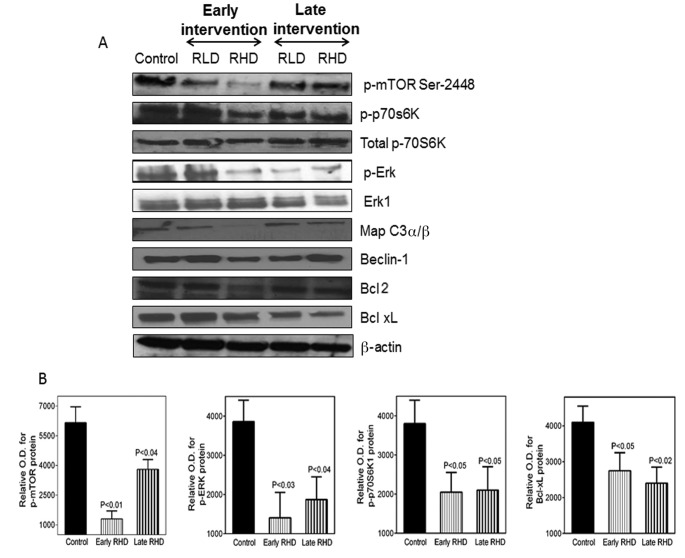
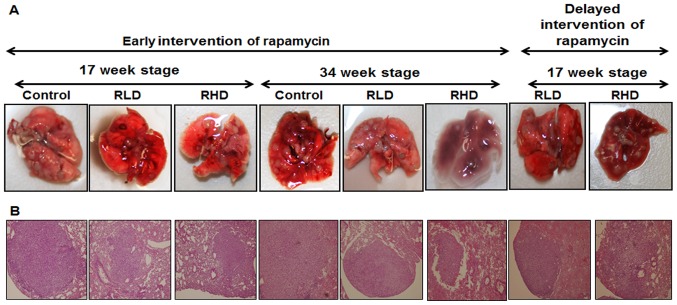
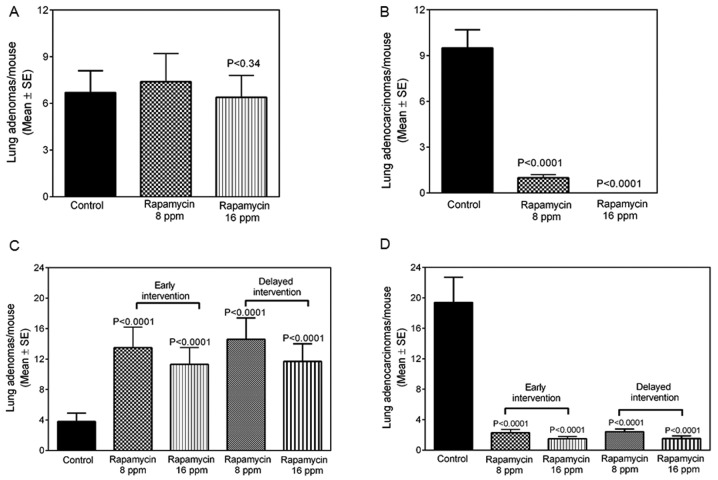
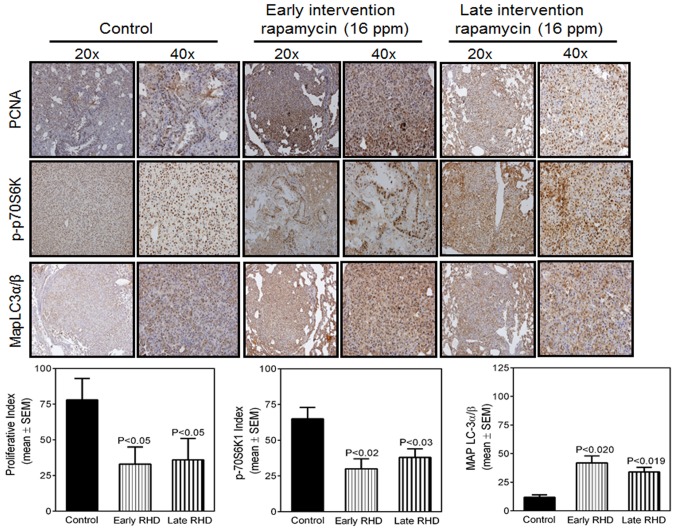
In tobacco-associated lung cancers, the protein kinase B/mammalian target of rapamycin (Akt/mTOR) pathway frequently is activated by nicotine and its metabolite 4-(methylnitrosamino)-1-(3-pyridyl)-1-butanone (NNK). The aim of the present study was to examine the effects of early or late intervention with rapamycin in NNK-induced lung adenoma and progression to adenocarcinoma in female A/J mice. At 7 weeks of age, 40 mice/each carcinogen group received one dose of 10 μmol NNK i.p. Three weeks later, the early intervention groups (25/group) were fed diets containing 0, 8 or 16 ppm rapamycin. The mice were sacrificed after 17 or 34 weeks of drug exposure and tumors were evaluated via histopathology. For late intervention (late adenoma and adenocarcinoma stage), groups of 15 mice were administered diets containing 8 or 16 ppm rapamycin starting 20 weeks after NNK treatment and continuing for 17 weeks before evaluation of tumor progression. Administration of 8 or 16 ppm rapamycin as an early or a late stage intervention significantly suppressed lung adenoma and adenocarcinoma formation (p<0.01-0.0001) after 17 or 34 weeks of exposure. The effect was more pronounced (>50‑60% tumor inihibition; p<0.0001) at the early intervention and the size of NNK-induced tumors decreased from >2.10 to <~0.75 mm3 (p=0.0056). Lung tumors harvested from mice exposed to rapamycin showed a significant decrease in p-mTOR, p-S6K1, PCNA and Bcl-xL as compared with controls in the early and late stage intervention studies. These observations suggest that rapamycin is highly effective even with administration after dysplastic adenoma or early adenocarcinoma stages and is useful for high-risk lung cancer patients.
在烟草相关肺癌中,蛋白激酶B/雷帕霉素哺乳动物靶点(Akt/mTOR)通路常被尼古丁及其代谢物4-(甲基亚硝胺基)-1-(3-吡啶基)-1-丁酮(NNK)激活。本研究的目的是检测雷帕霉素早期或晚期干预对NNK诱导的雌性A/J小鼠肺腺瘤及向腺癌进展的影响。7周龄时,每个致癌物组的40只小鼠腹腔注射一剂10 μmol NNK。3周后,早期干预组(每组25只)喂食含0、8或16 ppm雷帕霉素的饲料。药物暴露17或34周后处死小鼠,通过组织病理学评估肿瘤。对于晚期干预(晚期腺瘤和腺癌阶段),15只小鼠组成的组在NNK治疗后20周开始喂食含8或16 ppm雷帕霉素的饲料,并持续17周,然后评估肿瘤进展。在暴露17或34周后,作为早期或晚期干预给予8或16 ppm雷帕霉素可显著抑制肺腺瘤和腺癌的形成(p<0.01 - 0.0001)。早期干预时效果更显著(肿瘤抑制>50 - 60%;p<0.0001),且NNK诱导肿瘤的大小从>2.10减小至<~0.75 mm³(p = 0.0056)。在早期和晚期干预研究中,与对照组相比,从暴露于雷帕霉素的小鼠收获的肺肿瘤中p-mTOR、p-S6K1、PCNA和Bcl-xL显著降低。这些观察结果表明,即使在发育异常腺瘤或早期腺癌阶段后给药,雷帕霉素也非常有效,对高危肺癌患者有用。