Santos S V, Margarido M R R A, Caires I S, Santos R A N, Souza S G, Souza J M A, Martimiano R R, Dutra C S K, Palha P, Zanetti A C G, Pazin-Filho A
Programa de Educação Tutorial, Faculdade de Medicina de Ribeirão Preto, Universidade de São Paulo, Ribeirão Preto, SP, Brasil.
Programa de Educação Tutorial, Escola de Enfermagem de Ribeirão Preto, Universidade de São Paulo, Ribeirão Preto, SP, Brasil.
Braz J Med Biol Res. 2015 Dec;48(12):1151-5. doi: 10.1590/1414-431X20154667. Epub 2015 Sep 18.
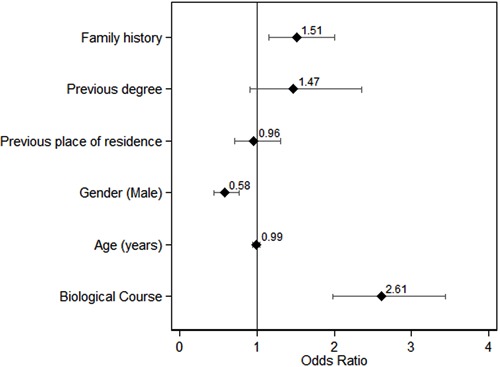
We aimed to evaluate knowledge of first aid among new undergraduates and whether it is affected by their chosen course. A questionnaire was developed to assess knowledge of how to activate the Mobile Emergency Attendance Service - MEAS (Serviço de Atendimento Móvel de Urgência; SAMU), recognize a pre-hospital emergency situation and the first aid required for cardiac arrest. The students were also asked about enrolling in a first aid course. Responses were received from 1038 of 1365 (76.04%) new undergraduates. The questionnaires were completed in a 2-week period 1 month after the beginning of classes. Of the 1038 respondents (59.5% studying biological sciences, 11.6% physical sciences, and 28.6% humanities), 58.5% knew how to activate the MEAS/SAMU (54.3% non-biological vs 61.4% biological, P=0.02), with an odds ratio (OR)=1.39 (95%CI=1.07-1.81) regardless of age, sex, origin, having a previous degree or having a relative with cardiac disease. The majority could distinguish emergency from non-emergency situations. When faced with a possible cardiac arrest, 17.7% of the students would perform chest compressions (15.5% non-biological vs 19.1% biological first-year university students, P=0.16) and 65.2% would enroll in a first aid course (51.1% non-biological vs 74.7% biological, P<0.01), with an OR=2.61 (95%CI=1.98-3.44) adjusted for the same confounders. Even though a high percentage of the students recognized emergency situations, a significant proportion did not know the MEAS/SAMU number and only a minority had sufficient basic life support skills to help with cardiac arrest. A significant proportion would not enroll in a first aid course. Biological first-year university students were more prone to enroll in a basic life support course.
我们旨在评估新入学本科生的急救知识,以及其是否受到所选课程的影响。我们设计了一份问卷,以评估学生对于如何启动移动紧急出勤服务(MEAS,即紧急医疗移动服务;SAMU)、识别院前紧急情况以及心脏骤停所需急救措施的了解程度。我们还询问了学生是否参加过急救课程。在1365名新入学本科生中,有1038人(76.04%)回复了问卷。问卷在课程开始1个月后的2周内完成。在1038名受访者中(59.5%学习生物科学,11.6%学习物理科学,28.6%学习人文科学),58.5%的人知道如何启动MEAS/SAMU(非生物专业学生为54.3%,生物专业学生为61.4%,P = 0.02),无论年龄、性别、出身、是否拥有先前学位或是否有心脏病亲属,其优势比(OR)= 1.39(95%置信区间= 1.07 - 1.81)。大多数人能够区分紧急情况和非紧急情况。当面对可能的心脏骤停时,17.7%的学生会进行胸外按压(非生物专业一年级大学生为15.5%,生物专业一年级大学生为19.1%,P = 0.16),65.2%的学生会参加急救课程(非生物专业学生为51.1%,生物专业学生为74.7%,P < 0.01),在对相同混杂因素进行调整后,OR = 2.61(95%置信区间= 1.98 - 3.44)。尽管有很高比例的学生能够识别紧急情况,但仍有相当一部分人不知道MEAS/SAMU号码,只有少数人具备足够的基本生命支持技能来应对心脏骤停。有相当一部分人不会参加急救课程。生物专业一年级大学生更倾向于参加基本生命支持课程。