• 文献检索
  • 文档翻译
  • 深度研究
  • 学术资讯
  • Suppr Zotero 插件Zotero 插件
  • 邀请有礼
  • 套餐&价格
  • 历史记录
应用&插件
Suppr Zotero 插件Zotero 插件浏览器插件Mac 客户端Windows 客户端微信小程序
定价
高级版会员购买积分包购买API积分包
服务
文献检索文档翻译深度研究API 文档MCP 服务
关于我们
关于 Suppr公司介绍联系我们用户协议隐私条款
关注我们

Suppr 超能文献

核心技术专利:CN118964589B侵权必究
粤ICP备2023148730 号-1Suppr @ 2026

文献检索

告别复杂PubMed语法,用中文像聊天一样搜索,搜遍4000万医学文献。AI智能推荐,让科研检索更轻松。

立即免费搜索

文件翻译

保留排版,准确专业,支持PDF/Word/PPT等文件格式,支持 12+语言互译。

免费翻译文档

深度研究

AI帮你快速写综述,25分钟生成高质量综述,智能提取关键信息,辅助科研写作。

立即免费体验

人类蛋白质、功能和疾病网络的综合分析。

Integrative analysis of human protein, function and disease networks.

作者信息

Liu Wei, Wu Aiping, Pellegrini Matteo, Wang Xiaofan

机构信息

Department of Automation, Shanghai Jiao Tong University, Shanghai, 200240, China.

Institute of Biophysics, Chinese Academy of Sciences, Beijing, 100080.

出版信息

Sci Rep. 2015 Sep 24;5:14344. doi: 10.1038/srep14344.

DOI:10.1038/srep14344
PMID:26399914
原文链接:https://pmc.ncbi.nlm.nih.gov/articles/PMC4585831/
Abstract

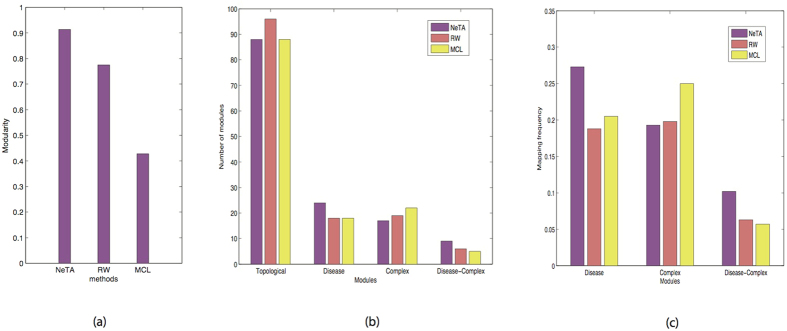
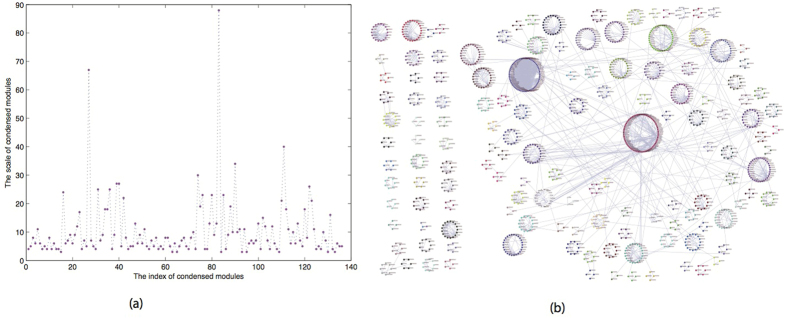
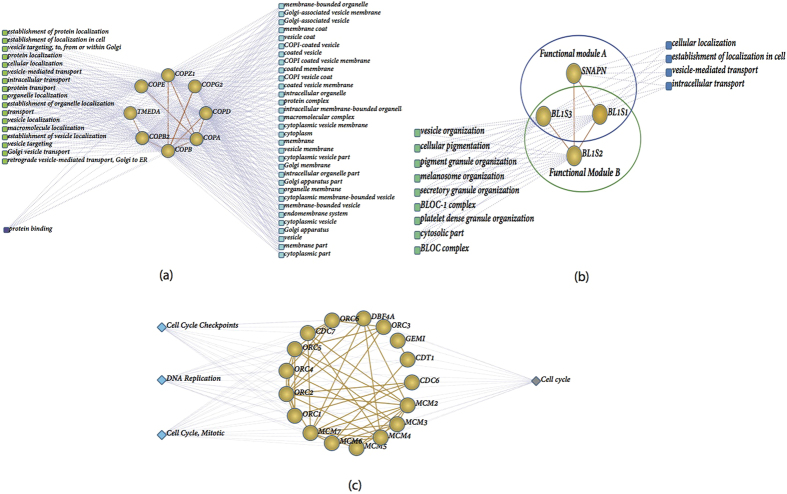
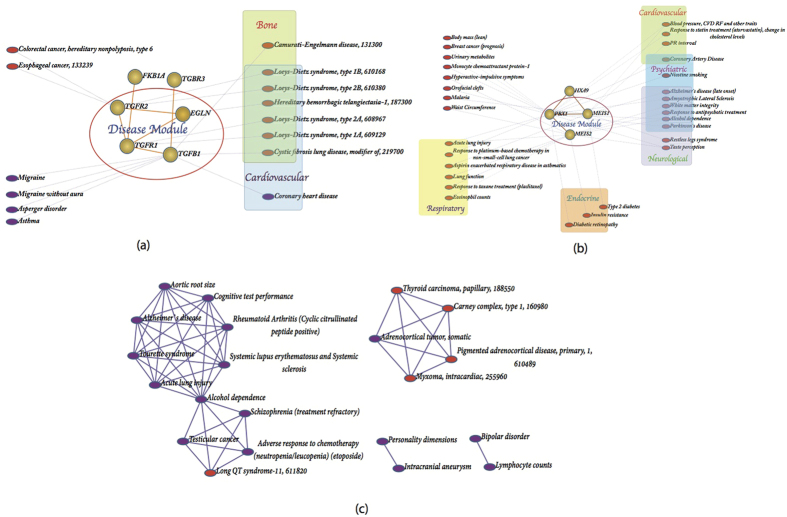
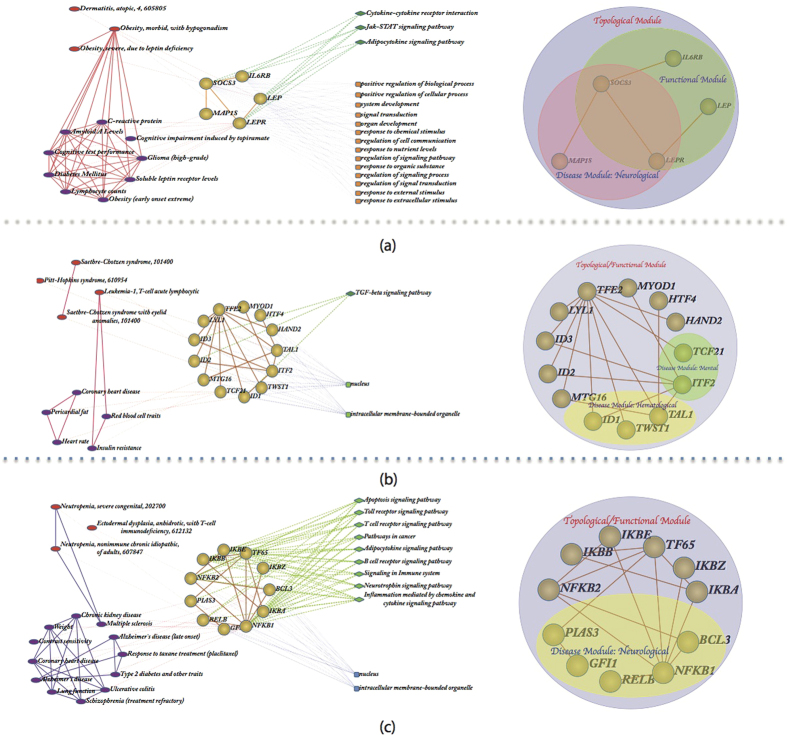
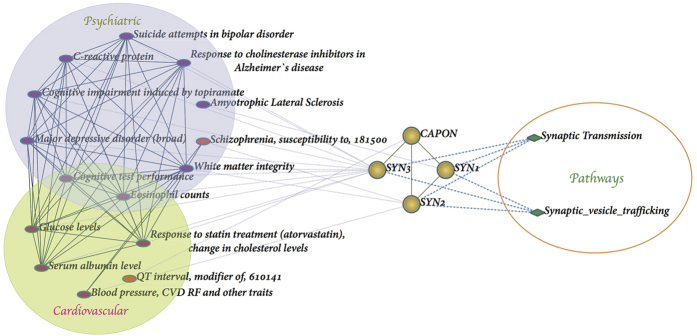
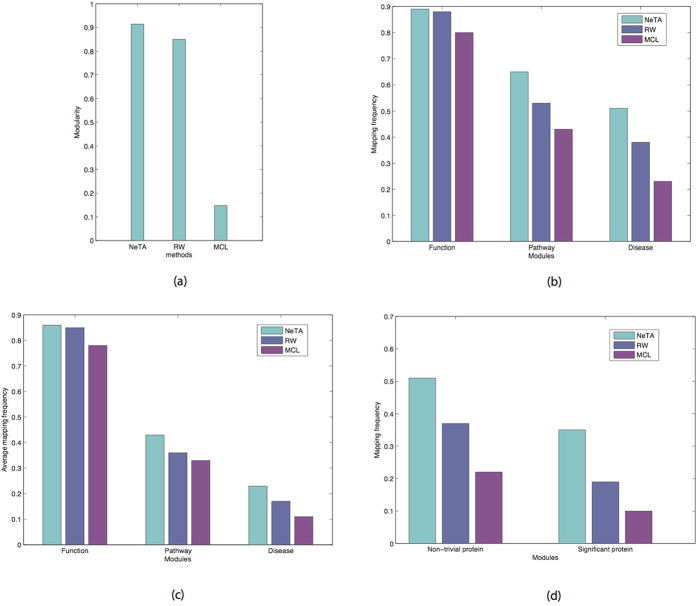
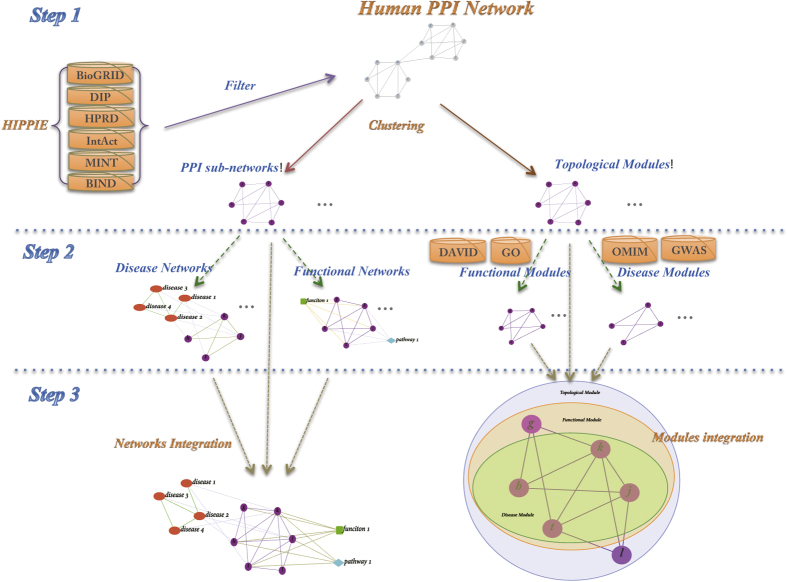
Protein-protein interaction (PPI) networks serve as a powerful tool for unraveling protein functions, disease-gene and disease-disease associations. However, a direct strategy for integrating protein interaction, protein function and diseases is still absent. Moreover, the interrelated relationships among these three levels are poorly understood. Here we present a novel systematic method to integrate protein interaction, function, and disease networks. We first identified topological modules in human protein interaction data using the network topological algorithm (NeTA) we previously developed. The resulting modules were then associated with functional terms using Gene Ontology to obtain functional modules. Finally, disease modules were constructed by associating the modules with OMIM and GWAS. We found that most topological modules have cohesive structure, significant pathway annotations and good modularity. Most functional modules (70.6%) fully cover corresponding topological modules, and most disease modules (88.5%) are fully covered by the corresponding functional modules. Furthermore, we identified several protein modules of interest that we describe in detail, which demonstrate the power of our integrative approach. This approach allows us to link genes, and pathways with their corresponding disorders, which may ultimately help us to improve the prevention, diagnosis and treatment of disease.

摘要

蛋白质-蛋白质相互作用(PPI)网络是揭示蛋白质功能、疾病基因和疾病-疾病关联的有力工具。然而,整合蛋白质相互作用、蛋白质功能和疾病的直接策略仍然缺乏。此外,这三个层面之间的相互关系还知之甚少。在此,我们提出一种整合蛋白质相互作用、功能和疾病网络的新型系统方法。我们首先使用先前开发的网络拓扑算法(NeTA)在人类蛋白质相互作用数据中识别拓扑模块。然后使用基因本体论将所得模块与功能术语相关联,以获得功能模块。最后,通过将这些模块与OMIM和全基因组关联研究(GWAS)相关联来构建疾病模块。我们发现大多数拓扑模块具有凝聚结构、显著的通路注释和良好的模块性。大多数功能模块(70.6%)完全覆盖相应的拓扑模块,并且大多数疾病模块(88.5%)被相应的功能模块完全覆盖。此外,我们鉴定了几个感兴趣的蛋白质模块并进行了详细描述,这证明了我们整合方法的强大功能。这种方法使我们能够将基因、通路与其相应的疾病联系起来,这最终可能有助于我们改善疾病的预防、诊断和治疗。
https://cdn.ncbi.nlm.nih.gov/pmc/blobs/7bb4/4585831/96013c915f52/srep14344-f8.jpg
https://cdn.ncbi.nlm.nih.gov/pmc/blobs/7bb4/4585831/38555fdf5cbf/srep14344-f1.jpg
https://cdn.ncbi.nlm.nih.gov/pmc/blobs/7bb4/4585831/fe8897eaac62/srep14344-f2.jpg
https://cdn.ncbi.nlm.nih.gov/pmc/blobs/7bb4/4585831/e6e2f615e2df/srep14344-f3.jpg
https://cdn.ncbi.nlm.nih.gov/pmc/blobs/7bb4/4585831/35a1e9a04250/srep14344-f4.jpg
https://cdn.ncbi.nlm.nih.gov/pmc/blobs/7bb4/4585831/dab94d2ae596/srep14344-f5.jpg
https://cdn.ncbi.nlm.nih.gov/pmc/blobs/7bb4/4585831/dbf46a810113/srep14344-f6.jpg
https://cdn.ncbi.nlm.nih.gov/pmc/blobs/7bb4/4585831/ce068f423198/srep14344-f7.jpg
https://cdn.ncbi.nlm.nih.gov/pmc/blobs/7bb4/4585831/96013c915f52/srep14344-f8.jpg
https://cdn.ncbi.nlm.nih.gov/pmc/blobs/7bb4/4585831/38555fdf5cbf/srep14344-f1.jpg
https://cdn.ncbi.nlm.nih.gov/pmc/blobs/7bb4/4585831/fe8897eaac62/srep14344-f2.jpg
https://cdn.ncbi.nlm.nih.gov/pmc/blobs/7bb4/4585831/e6e2f615e2df/srep14344-f3.jpg
https://cdn.ncbi.nlm.nih.gov/pmc/blobs/7bb4/4585831/35a1e9a04250/srep14344-f4.jpg
https://cdn.ncbi.nlm.nih.gov/pmc/blobs/7bb4/4585831/dab94d2ae596/srep14344-f5.jpg
https://cdn.ncbi.nlm.nih.gov/pmc/blobs/7bb4/4585831/dbf46a810113/srep14344-f6.jpg
https://cdn.ncbi.nlm.nih.gov/pmc/blobs/7bb4/4585831/ce068f423198/srep14344-f7.jpg
https://cdn.ncbi.nlm.nih.gov/pmc/blobs/7bb4/4585831/96013c915f52/srep14344-f8.jpg

相似文献

1
Integrative analysis of human protein, function and disease networks.人类蛋白质、功能和疾病网络的综合分析。
Sci Rep. 2015 Sep 24;5:14344. doi: 10.1038/srep14344.
2
Functional diversity of topological modules in human protein-protein interaction networks.人类蛋白质 - 蛋白质相互作用网络中拓扑模块的功能多样性。
Sci Rep. 2017 Nov 23;7(1):16199. doi: 10.1038/s41598-017-16270-z.
3
Detection of functional modules from protein interaction networks with an enhanced random walk based algorithm.基于增强随机游走算法从蛋白质相互作用网络中检测功能模块
Int J Comput Biol Drug Des. 2011;4(3):290-306. doi: 10.1504/IJCBDD.2011.041416. Epub 2011 Jul 21.
4
Discerning molecular interactions: A comprehensive review on biomolecular interaction databases and network analysis tools.识别分子相互作用:关于生物分子相互作用数据库和网络分析工具的全面综述
Gene. 2018 Feb 5;642:84-94. doi: 10.1016/j.gene.2017.11.028. Epub 2017 Nov 10.
5
Detecting Functional Modules Based on a Multiple-Grain Model in Large-Scale Protein-Protein Interaction Networks.基于多粒度模型在大规模蛋白质-蛋白质相互作用网络中检测功能模块
IEEE/ACM Trans Comput Biol Bioinform. 2016 Jul-Aug;13(4):610-22. doi: 10.1109/TCBB.2015.2480066. Epub 2015 Sep 18.
6
Incorporating topological information for predicting robust cancer subnetwork markers in human protein-protein interaction network.整合拓扑信息以预测人类蛋白质-蛋白质相互作用网络中稳健的癌症子网标志物。
BMC Bioinformatics. 2016 Oct 6;17(Suppl 13):351. doi: 10.1186/s12859-016-1224-1.
7
A fast hierarchical clustering algorithm for functional modules discovery in protein interaction networks.一种用于蛋白质相互作用网络中功能模块发现的快速层次聚类算法。
IEEE/ACM Trans Comput Biol Bioinform. 2011 May-Jun;8(3):607-20. doi: 10.1109/TCBB.2010.75.
8
Identifying protein complexes and functional modules--from static PPI networks to dynamic PPI networks.识别蛋白质复合物和功能模块——从静态蛋白质-蛋白质相互作用网络到动态蛋白质-蛋白质相互作用网络。
Brief Bioinform. 2014 Mar;15(2):177-94. doi: 10.1093/bib/bbt039. Epub 2013 Jun 18.
9
IIIDB: a database for isoform-isoform interactions and isoform network modules.IIIDB:一个用于异构体-异构体相互作用和异构体网络模块的数据库。
BMC Genomics. 2015;16 Suppl 2(Suppl 2):S10. doi: 10.1186/1471-2164-16-S2-S10. Epub 2015 Jan 21.
10
Towards the identification of protein complexes and functional modules by integrating PPI network and gene expression data.通过整合 PPI 网络和基因表达数据来鉴定蛋白质复合物和功能模块。
BMC Bioinformatics. 2012 May 23;13:109. doi: 10.1186/1471-2105-13-109.

引用本文的文献

1
Predicting protein functions using positive-unlabeled ranking with ontology-based priors.基于本体论先验的正无标记排序预测蛋白质功能。
Bioinformatics. 2024 Jun 28;40(Suppl 1):i401-i409. doi: 10.1093/bioinformatics/btae237.
2
Protein-protein interaction (PPI) network analysis reveals important hub proteins and sub-network modules for root development in rice (Oryza sativa).蛋白质-蛋白质相互作用(PPI)网络分析揭示了水稻(Oryza sativa)根系发育过程中的重要枢纽蛋白和子网模块。
J Genet Eng Biotechnol. 2023 May 29;21(1):69. doi: 10.1186/s43141-023-00515-8.
3
Comparative analysis between highgrade serous ovarian cancer and healthy ovarian tissues using single-cell RNA sequencing.

本文引用的文献

1
Modules, networks and systems medicine for understanding disease and aiding diagnosis.模块、网络和系统医学,用于理解疾病和辅助诊断。
Genome Med. 2014 Oct 17;6(10):82. doi: 10.1186/s13073-014-0082-6. eCollection 2014.
2
Detecting communities based on network topology.基于网络拓扑检测群落。
Sci Rep. 2014 Jul 18;4:5739. doi: 10.1038/srep05739.
3
Human symptoms-disease network.人类症状-疾病网络。
使用单细胞RNA测序对高级别浆液性卵巢癌与健康卵巢组织进行比较分析。
Front Oncol. 2023 Apr 14;13:1148628. doi: 10.3389/fonc.2023.1148628. eCollection 2023.
4
Whole-genome sequencing reveals novel ethnicity-specific rare variants associated with Alzheimer's disease.全基因组测序揭示与阿尔茨海默病相关的新型种族特异性罕见变异。
Mol Psychiatry. 2022 May;27(5):2554-2562. doi: 10.1038/s41380-022-01483-0. Epub 2022 Mar 10.
5
Exploring the conservation of Alzheimer-related pathways between H. sapiens and C. elegans: a network alignment approach.探讨人类和秀丽隐杆线虫之间与阿尔茨海默病相关通路的保守性:一种网络比对方法。
Sci Rep. 2021 Feb 25;11(1):4572. doi: 10.1038/s41598-021-83892-9.
6
Statistical Physics for Medical Diagnostics: Learning, Inference, and Optimization Algorithms.用于医学诊断的统计物理学:学习、推理与优化算法
Diagnostics (Basel). 2020 Nov 19;10(11):972. doi: 10.3390/diagnostics10110972.
7
Disease evolution in reaction networks: Implications for a diagnostic problem.反应网络中的疾病演变:对诊断问题的启示。
PLoS Comput Biol. 2020 Jun 4;16(6):e1007889. doi: 10.1371/journal.pcbi.1007889. eCollection 2020 Jun.
8
Genetic and Expression Analysis of COPI Genes and Alzheimer's Disease Susceptibility.COPI基因与阿尔茨海默病易感性的遗传及表达分析
Front Genet. 2019 Sep 19;10:866. doi: 10.3389/fgene.2019.00866. eCollection 2019.
9
Disease association of human tumor suppressor genes.人类肿瘤抑制基因的疾病相关性。
Mol Genet Genomics. 2019 Aug;294(4):931-940. doi: 10.1007/s00438-019-01557-9. Epub 2019 Apr 3.
10
Mapping biological process relationships and disease perturbations within a pathway network.在通路网络中映射生物学过程关系和疾病扰动。
NPJ Syst Biol Appl. 2018 Jun 11;4:22. doi: 10.1038/s41540-018-0055-2. eCollection 2018.
Nat Commun. 2014 Jun 26;5:4212. doi: 10.1038/ncomms5212.
4
Network analysis reveals functional cross-links between disease and inflammation genes.网络分析揭示了疾病基因与炎症基因之间的功能交联。
Sci Rep. 2013 Dec 5;3:3426. doi: 10.1038/srep03426.
5
GWAS Central: a comprehensive resource for the comparison and interrogation of genome-wide association studies.全基因组关联研究中心:用于全基因组关联研究比较和查询的综合资源。
Eur J Hum Genet. 2014 Jul;22(7):949-52. doi: 10.1038/ejhg.2013.274. Epub 2013 Dec 4.
6
Discovering disease-disease associations by fusing systems-level molecular data.通过融合系统水平的分子数据发现疾病-疾病关联。
Sci Rep. 2013 Nov 15;3:3202. doi: 10.1038/srep03202.
7
Navigating the global protein-protein interaction landscape using iRefWeb.使用iRefWeb浏览全球蛋白质-蛋白质相互作用图谱。
Methods Mol Biol. 2014;1091:315-31. doi: 10.1007/978-1-62703-691-7_22.
8
Improved network community structure improves function prediction.网络社区结构的改进提高了功能预测的准确性。
Sci Rep. 2013;3:2197. doi: 10.1038/srep02197.
9
MalaCards: an integrated compendium for diseases and their annotation.MalaCards:疾病及其注释的综合纲要。
Database (Oxford). 2013 Apr 12;2013:bat018. doi: 10.1093/database/bat018. Print 2013.
10
Global analysis of the human pathophenotypic similarity gene network merges disease module components.人类表型相似性基因网络的全局分析融合了疾病模块成分。
PLoS One. 2013;8(2):e56653. doi: 10.1371/journal.pone.0056653. Epub 2013 Feb 21.