Yoshida Sachiyo, Martines José, Lawn Joy E, Wall Stephen, Souza Joăo Paulo, Rudan Igor, Cousens Simon, Aaby Peter, Adam Ishag, Adhikari Ramesh Kant, Ambalavanan Namasivayam, Arifeen Shams Ei, Aryal Dhana Raj, Asiruddin Sk, Baqui Abdullah, Barros Aluisio Jd, Benn Christine S, Bhandari Vineet, Bhatnagar Shinjini, Bhattacharya Sohinee, Bhutta Zulfiqar A, Black Robert E, Blencowe Hannah, Bose Carl, Brown Justin, Bührer Christoph, Carlo Wally, Cecatti Jose Guilherme, Cheung Po-Yin, Clark Robert, Colbourn Tim, Conde-Agudelo Agustin, Corbett Erica, Czeizel Andrew E, Das Abhik, Day Louise Tina, Deal Carolyn, Deorari Ashok, Dilmen Uğur, English Mike, Engmann Cyril, Esamai Fabian, Fall Caroline, Ferriero Donna M, Gisore Peter, Hazir Tabish, Higgins Rosemary D, Homer Caroline Se, Hoque D E, Irgens Lorentz, Islam M T, de Graft-Johnson Joseph, Joshua Martias Alice, Keenan William, Khatoon Soofia, Kieler Helle, Kramer Michael S, Lackritz Eve M, Lavender Tina, Lawintono Laurensia, Luhanga Richard, Marsh David, McMillan Douglas, McNamara Patrick J, Mol Ben Willem J, Molyneux Elizabeth, Mukasa G K, Mutabazi Miriam, Nacul Luis Carlos, Nakakeeto Margaret, Narayanan Indira, Olusanya Bolajoko, Osrin David, Paul Vinod, Poets Christian, Reddy Uma M, Santosham Mathuram, Sayed Rubayet, Schlabritz-Loutsevitch Natalia E, Singhal Nalini, Smith Mary Alice, Smith Peter G, Soofi Sajid, Spong Catherine Y, Sultana Shahin, Tshefu Antoinette, van Bel Frank, Gray Lauren Vestewig, Waiswa Peter, Wang Wei, Williams Sarah LA, Wright Linda, Zaidi Anita, Zhang Yanfeng, Zhong Nanbert, Zuniga Isabel, Bahl Rajiv
Department of Maternal, Newborn, Child and Adolescent Health, World Health Organization, Geneva, Switzerland.
Centre for Intervention Science in Maternal and Child Health, Centre for International Health, University of Bergen, Norway.
J Glob Health. 2016 Jun;6(1):010508. doi: 10.7189/jogh.06.010508.
In 2013, an estimated 2.8 million newborns died and 2.7 million were stillborn. A much greater number suffer from long term impairment associated with preterm birth, intrauterine growth restriction, congenital anomalies, and perinatal or infectious causes. With the approaching deadline for the achievement of the Millennium Development Goals (MDGs) in 2015, there was a need to set the new research priorities on newborns and stillbirth with a focus not only on survival but also on health, growth and development. We therefore carried out a systematic exercise to set newborn health research priorities for 2013-2025.
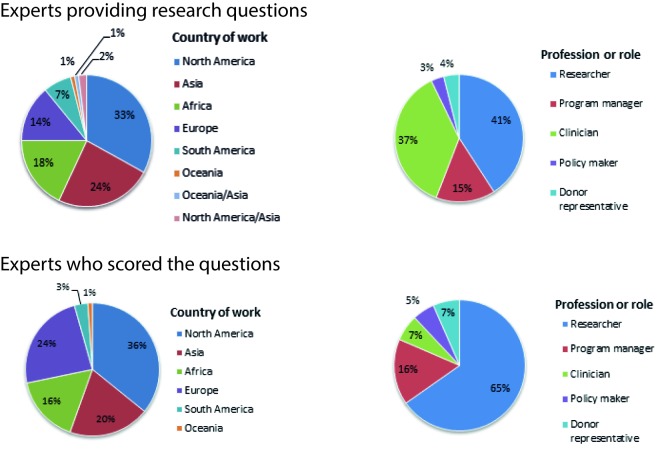
We used adapted Child Health and Nutrition Research Initiative (CHNRI) methods for this prioritization exercise. We identified and approached the 200 most productive researchers and 400 program experts, and 132 of them submitted research questions online. These were collated into a set of 205 research questions, sent for scoring to the 600 identified experts, and were assessed and scored by 91 experts.
Nine out of top ten identified priorities were in the domain of research on improving delivery of known interventions, with simplified neonatal resuscitation program and clinical algorithms and improved skills of community health workers leading the list. The top 10 priorities in the domain of development were led by ideas on improved Kangaroo Mother Care at community level, how to improve the accuracy of diagnosis by community health workers, and perinatal audits. The 10 leading priorities for discovery research focused on stable surfactant with novel modes of administration for preterm babies, ability to diagnose fetal distress and novel tocolytic agents to delay or stop preterm labour.
These findings will assist both donors and researchers in supporting and conducting research to close the knowledge gaps for reducing neonatal mortality, morbidity and long term impairment. WHO, SNL and other partners will work to generate interest among key national stakeholders, governments, NGOs, and research institutes in these priorities, while encouraging research funders to support them. We will track research funding, relevant requests for proposals and trial registers to monitor if the priorities identified by this exercise are being addressed.
2013年,估计有280万新生儿死亡,270万死产。还有更多的新生儿因早产、宫内生长受限、先天性异常以及围产期或感染性病因而遭受长期损害。随着2015年千年发展目标(MDGs)实现期限的临近,有必要确定新生儿和死产方面的新研究重点,不仅关注生存,还要关注健康、生长和发育。因此,我们开展了一项系统性工作,以确定2013 - 2025年新生儿健康研究重点。
我们采用了经过调整的儿童健康与营养研究倡议(CHNRI)方法进行此次优先排序工作。我们识别并联系了200位最具生产力的研究人员和400位项目专家,其中132人在线提交了研究问题。这些问题被整理成一组205个研究问题,发送给600位选定的专家进行评分,91位专家对其进行了评估和打分。
确定的十大优先事项中有九项属于改进已知干预措施实施方面的研究领域,其中简化新生儿复苏方案和临床算法以及提高社区卫生工作者技能位居前列。发展领域的前十大优先事项以社区层面改进袋鼠式护理的理念、如何提高社区卫生工作者诊断准确性以及围产期审计等想法为首。发现性研究的十大主要优先事项聚焦于用于早产婴儿的具有新型给药方式的稳定表面活性剂、诊断胎儿窘迫的能力以及延迟或停止早产的新型宫缩抑制剂。
这些研究结果将有助于捐助者和研究人员支持并开展研究,以填补知识空白,降低新生儿死亡率、发病率和长期损害。世界卫生组织、SNL及其他合作伙伴将努力促使国家主要利益相关者、政府、非政府组织和研究机构关注这些优先事项,同时鼓励研究资助者予以支持。我们将跟踪研究资金、相关提案请求和试验登记情况,以监测此次确定的优先事项是否得到落实。