Health System and Reproductive Health Research Directorate, Ethiopian Public Health Institute, Addis Ababa, Ethiopia.
Department of Epidemiology and Biostatistics, Institute of Public Health, College of Medicine and Health Sciences, University of Gondar, Gondar, Ethiopia.
J Glob Health. 2024 Oct 25;14:04214. doi: 10.7189/jogh.14.04214.
Despite progress in reducing maternal and child mortality worldwide, adverse birth outcomes such as preterm birth, low birth weight (LBW), small for gestational age (SGA), and stillbirth continue to be a major global health challenge. Developing a prediction model for adverse birth outcomes allows for early risk detection and prevention strategies. In this systematic review, we aimed to assess the performance of existing prediction models for adverse birth outcomes and provide a comprehensive summary of their findings.
We used the Population, Index prediction model, Comparator, Outcome, Timing, and Setting (PICOTS) approach to retrieve published studies from PubMed/MEDLINE, Scopus, CINAHL, Web of Science, African Journals Online, EMBASE, and Cochrane Library. We used WorldCat, Google, and Google Scholar to find the grey literature. We retrieved data before 1 March 2022. Data were extracted using CHecklist for Critical Appraisal and Data Extraction for Systematic Reviews of Prediction Modelling Studies. We assessed the risk of bias with the Prediction Model Risk of Bias Assessment tool. We descriptively reported the results in tables and graphs.
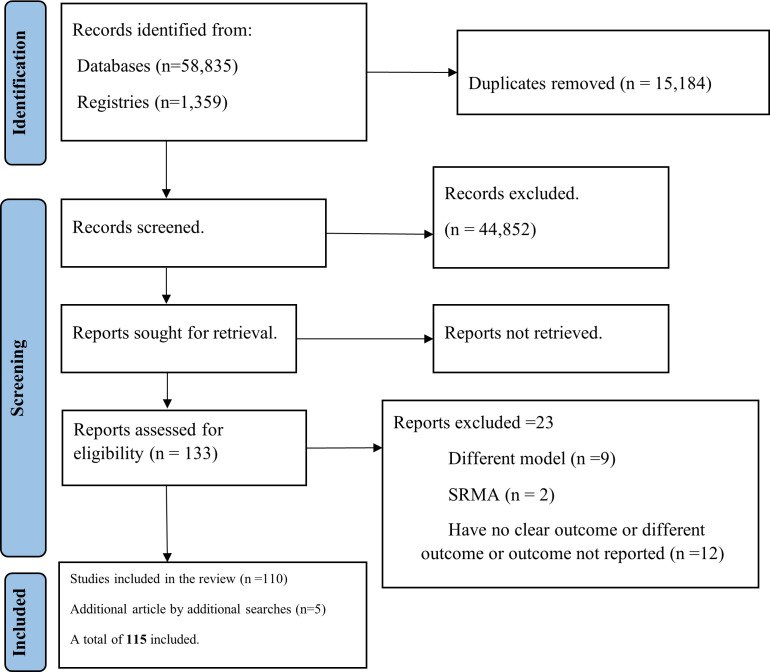
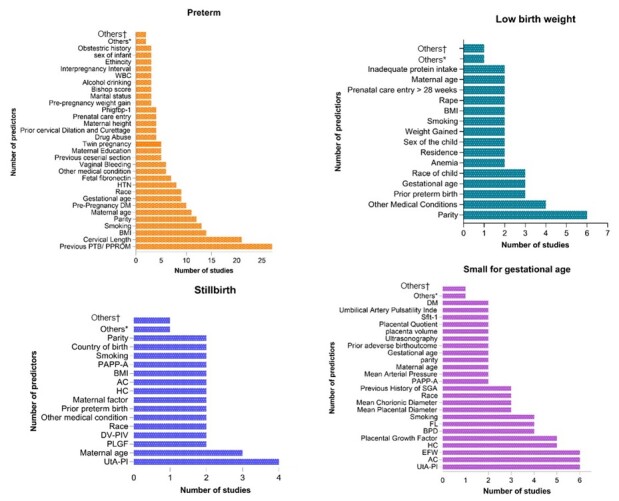
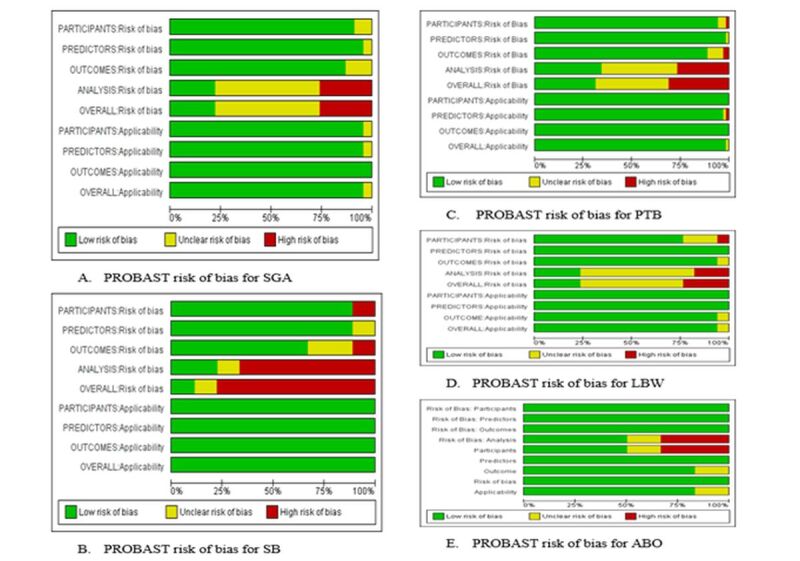
We included 115 prediction models with the following outcomes: composite adverse birth outcomes (n = 6), LBW (n = 17), SGA (n = 23), preterm birth (n = 71), and stillbirth (n = 9). The sample sizes ranged from composite adverse birth outcomes (n = 32-549), LBW (n = 97-27 233), SGA (n = 41-116 070), preterm birth (n = 31-15 883 784), and stillbirth (n = 180-76 629). Only nine studies were conducted on low- and middle-income countries. 10 studies were externally validated. Risk of bias varied across studies, in which high risk of bias was reported on prediction models for SGA (26.1%), stillbirth (77.8%), preterm birth (31%), LBW (23.5%), and composite adverse birth outcome (33.3%). The area under the receiver operating characteristics curve (AUROC) was the most used metric to describe model performance. The AUROC ranged from 0.51 to 0.83 in studies that reported predictive performance for preterm birth. The AUROC for predicting SGA, LBW, and stillbirth varied from 0.54 to 0.81, 0.60 to 0.84, and 0.65 to 0.72, respectively. Maternal clinical features were the most utilised prognostic markers for preterm and LBW prediction, while uterine artery pulsatility index was used for stillbirth and SGA prediction.
A varied prognostic factors and heterogeneity between studies were found to predict adverse birth outcomes. Prediction models using consistent prognostic factors, external validation, and adaptation of future risk prediction models for adverse birth outcomes was recommended at different settings.
PROSPERO CRD42021281725.
尽管全球范围内在降低母婴死亡率方面取得了进展,但早产、低出生体重(LBW)、小于胎龄儿(SGA)和死产等不良出生结局仍是一个主要的全球健康挑战。开发不良出生结局预测模型有助于早期发现风险并制定预防策略。在本系统评价中,我们旨在评估现有不良出生结局预测模型的性能,并提供其发现的综合总结。
我们使用人群、索引预测模型、比较、结局、时间和环境(PICOTS)方法从 PubMed/MEDLINE、Scopus、CINAHL、Web of Science、非洲在线期刊、EMBASE 和 Cochrane Library 检索已发表的研究。我们使用 WorldCat、Google 和 Google Scholar 查找灰色文献。我们检索了 2022 年 3 月 1 日之前的数据。使用 CHecklist for Critical Appraisal and Data Extraction for Systematic Reviews of Prediction Modelling Studies 提取数据。我们使用 Prediction Model Risk of Bias Assessment tool 评估偏倚风险。我们以表格和图形的形式描述性地报告结果。
我们纳入了 115 个预测模型,其结局包括复合不良出生结局(n=6)、LBW(n=17)、SGA(n=23)、早产(n=71)和死产(n=9)。样本量范围为复合不良出生结局(n=32-549)、LBW(n=97-27233)、SGA(n=41-116070)、早产(n=31-15883784)和死产(n=180-76629)。仅有 9 项研究在中低收入国家进行。10 项研究进行了外部验证。研究之间的偏倚风险存在差异,其中 SGA(26.1%)、死产(77.8%)、早产(31%)、LBW(23.5%)和复合不良出生结局(33.3%)的预测模型报告了高偏倚风险。接受者操作特征曲线下面积(AUROC)是描述模型性能最常用的指标。报告早产预测性能的研究中,AUROC 范围为 0.51 至 0.83。SGA、LBW 和死产的 AUROC 分别为 0.54 至 0.81、0.60 至 0.84 和 0.65 至 0.72。母体临床特征是预测早产和 LBW 的最常用预后标志物,而子宫动脉搏动指数用于预测死产和 SGA。
发现预测不良出生结局的预后因素存在差异和研究之间的异质性。建议在不同环境下使用一致的预后因素、外部验证和对未来不良出生结局风险预测模型的调整。
PROSPERO CRD42021281725。