Gregory Naina Sinha, Kumar Rekha, Stein Emily M, Alexander Ellen, Christos Paul, Bockman Richard S, Rodman John S
Endocr Pract. 2015 Dec;21(12):1380-6. doi: 10.4158/EP15738.OR. Epub 2015 Sep 24.
Diets rich in animal protein, such as the typical American diet, are thought to create a high acid load. An association between acid load and bone loss has led to the idea that providing positive alkaline salt therapy could have beneficial effects on bone metabolism. The objective of this study was to investigate the effects of potassium citrate (K-citrate), 40 mEq daily, over 1 year on bone resorption and formation.
A randomized, double-blind, placebo-controlled trial of 83 women with postmenopausal osteopenia. Levels of bone turnover markers, specifically urinary N-telopeptide of collagen type 1 (u-NTX), amino-terminal propeptide of type 1 procollagen (P1NP), bone-specific alkaline phosphatase (BSAP), and osteocalcin (OC) were compared. Changes in bone mineral density (BMD) were also examined.
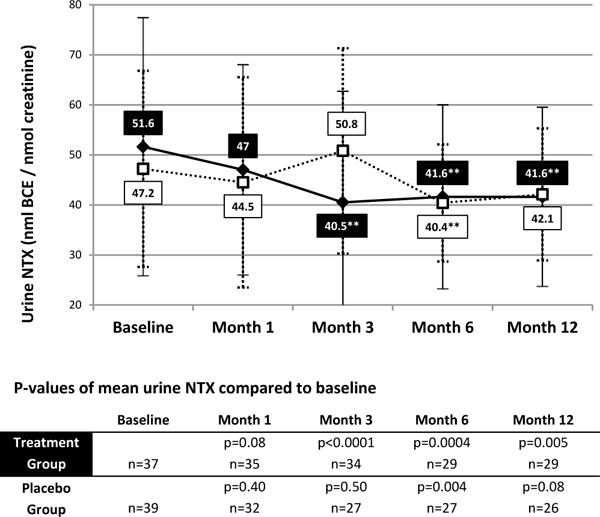
K-citrate decreased both u-NTX (P = .005) and serum P1NP (P<.001) starting at month 1 and continuing through month 12. No significant change was seen in BSAP or OC. No significant change was seen in lumbar or hip BMD between the 2 groups.
In women with postmenopausal osteopenia, treatment with K-citrate for 1 year resulted in a significant decrease in markers of turnover. The effect on markers of bone formation was not consistent. K-citrate may serve as a potential treatment for bone loss that is well tolerated and without any significant known long-term consequences.
富含动物蛋白的饮食,如典型的美国饮食,被认为会产生高酸负荷。酸负荷与骨质流失之间的关联促使人们认为,提供正碱性盐疗法可能对骨代谢有有益影响。本研究的目的是调查每日40毫当量柠檬酸钾(K-柠檬酸盐)治疗1年对骨吸收和形成的影响。
对83名绝经后骨质减少的女性进行一项随机、双盲、安慰剂对照试验。比较骨转换标志物的水平,特别是尿I型胶原N-端肽(u-NTX)、I型前胶原氨基端前肽(P1NP)、骨特异性碱性磷酸酶(BSAP)和骨钙素(OC)。还检查了骨密度(BMD)的变化。
从第1个月开始直至第12个月,K-柠檬酸盐降低了u-NTX(P = .005)和血清P1NP(P<.001)。BSAP或OC未见显著变化。两组之间腰椎或髋部骨密度未见显著变化。
对于绝经后骨质减少的女性,用K-柠檬酸盐治疗1年可导致骨转换标志物显著降低。对骨形成标志物的影响并不一致。K-柠檬酸盐可能作为一种潜在的骨质流失治疗方法,耐受性良好且无任何显著的已知长期后果。