Keeney Jeriel Thomas-Richard, Ibrahimi Shaher, Zhao Liqin
Department of Pharmacology and Toxicology, School of Pharmacy, University of Kansas, Lawrence, KS, USA.
Neuroscience Graduate Program, University of Kansas, Lawrence, KS, USA.
J Alzheimers Dis. 2015;48(2):411-24. doi: 10.3233/JAD-150348.
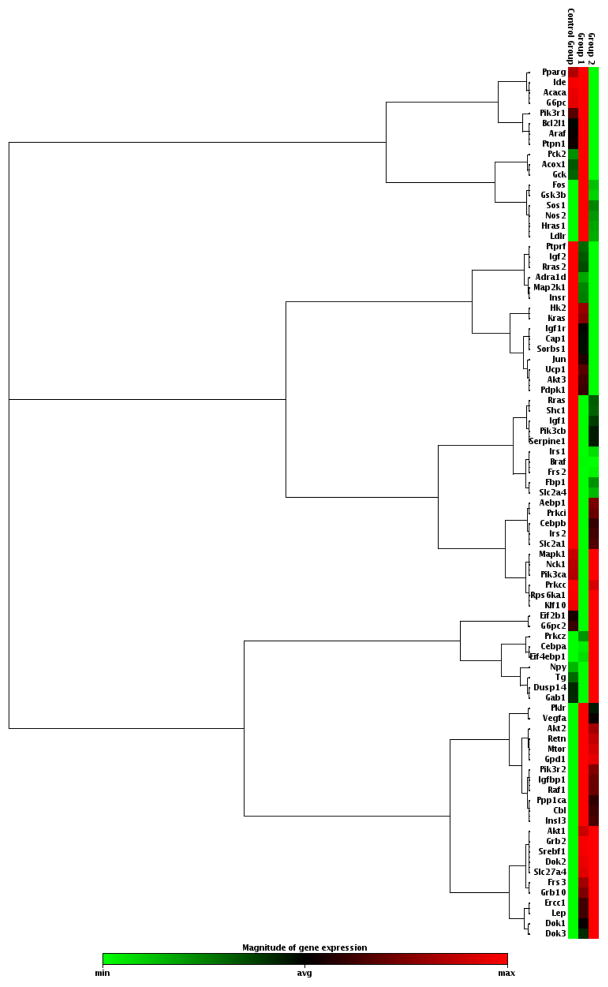
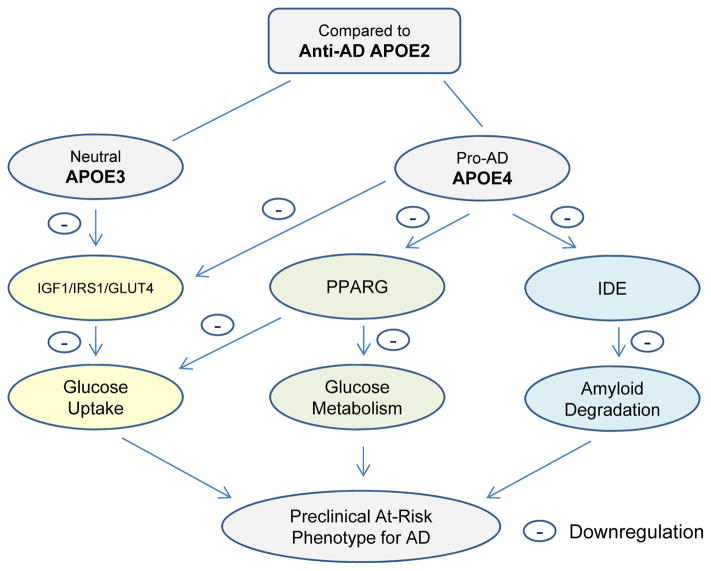
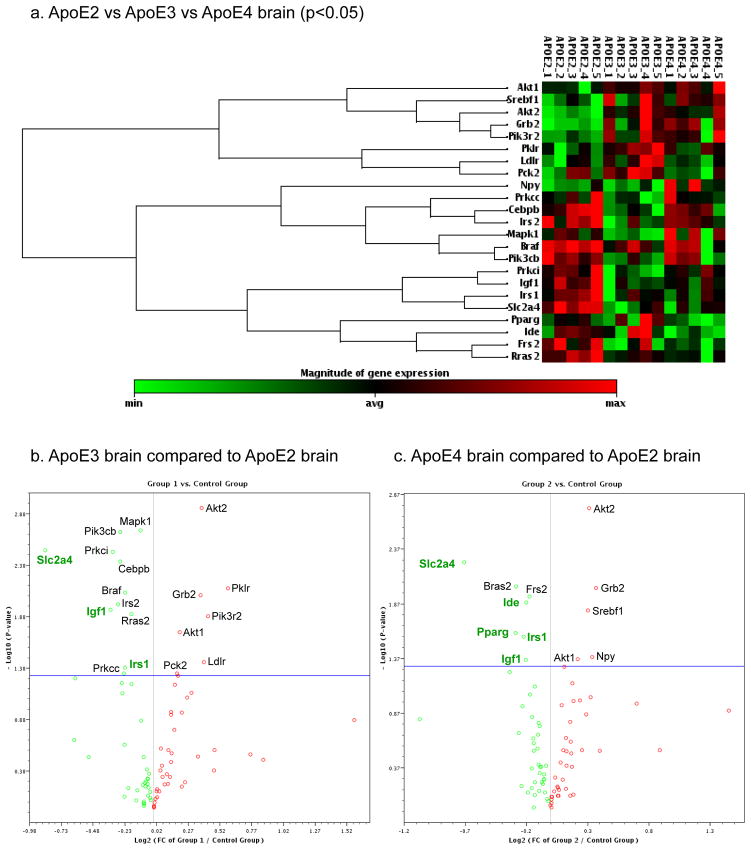
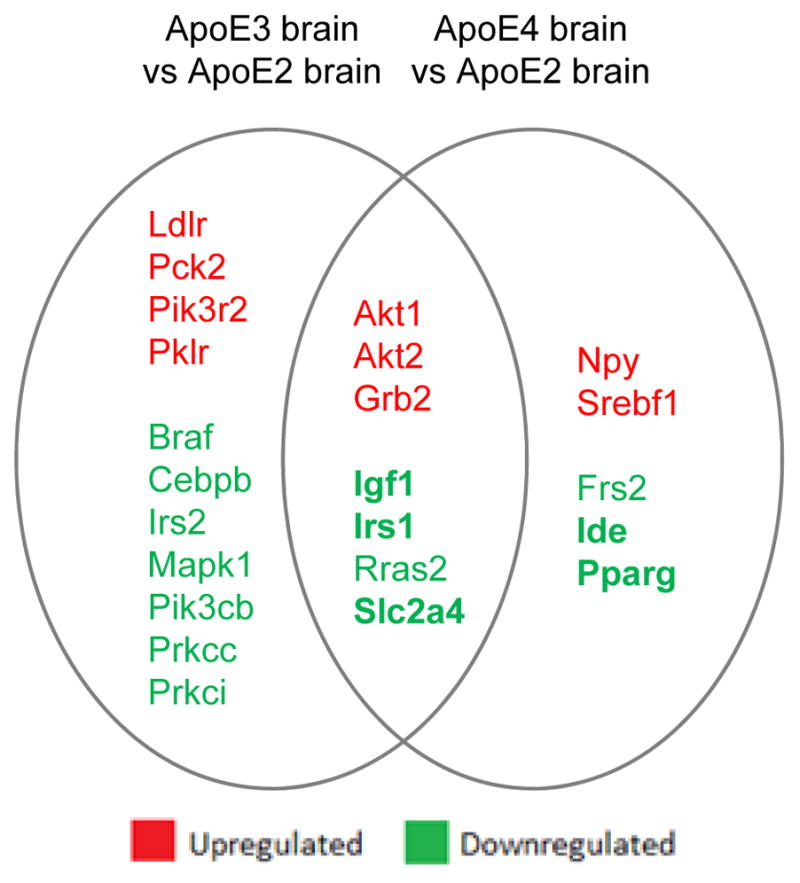
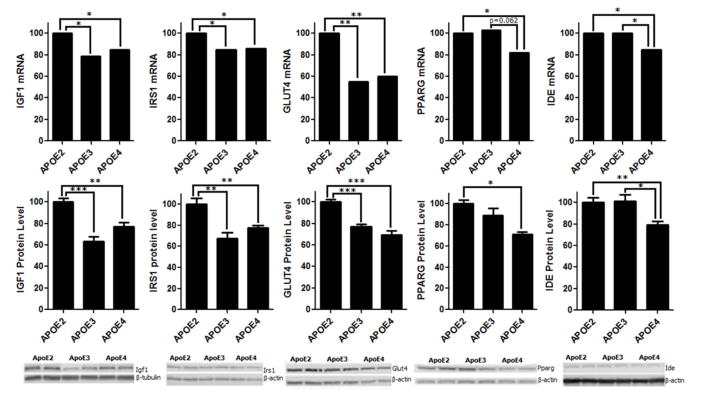
Three major genetic isoforms of apolipoprotein E (ApoE), ApoE2, ApoE3, and ApoE4, exist in humans and lead to differences in susceptibility to Alzheimer's disease (AD). This study investigated the impact of human ApoE isoforms on brain metabolic pathways involved in glucose utilization and amyloid-β (Aβ) degradation, two major areas that are significantly perturbed in preclinical AD. Hippocampal RNA samples from middle-aged female mice with targeted human ApoE2, ApoE3, and ApoE4 gene replacement were comparatively analyzed with a qRT-PCR custom array for the expression of 85 genes involved in insulin/insulin-like growth factor (Igf) signaling. Consistent with its protective role against AD, ApoE2 brain exhibited the most metabolically robust profile among the three ApoE genotypes. When compared to ApoE2 brain, both ApoE3 and ApoE4 brains exhibited markedly reduced levels of Igf1, insulin receptor substrates (Irs), and facilitated glucose transporter 4 (Glut4), indicating reduced glucose uptake. Additionally, ApoE4 brain exhibited significantly decreased Pparg and insulin-degrading enzyme (Ide), indicating further compromised glucose metabolism and Aβ dysregulation associated with ApoE4. Protein analysis showed significantly decreased Igf1, Irs, and Glut4 in ApoE3 brain, and Igf1, Irs, Glut4, Pparg, and Ide in ApoE4 brain compared to ApoE2 brain. These data provide the first documented evidence that human ApoE isoforms differentially affect brain insulin/Igf signaling and downstream glucose and amyloid metabolic pathways, illustrating a potential mechanism for their differential risk in AD. A therapeutic strategy that enhances brain insulin/Igf1 signaling activity to a more robust ApoE2-like phenotype favoring both energy production and amyloid homeostasis holds promise for AD prevention and early intervention.
载脂蛋白E(ApoE)有三种主要的基因异构体,即ApoE2、ApoE3和ApoE4,存在于人类中,并导致患阿尔茨海默病(AD)的易感性存在差异。本研究调查了人类ApoE异构体对参与葡萄糖利用和淀粉样β蛋白(Aβ)降解的脑代谢途径的影响,这两个主要领域在临床前AD中受到显著干扰。对具有靶向人类ApoE2、ApoE3和ApoE4基因替代的中年雌性小鼠的海马RNA样本,使用qRT-PCR定制阵列对参与胰岛素/胰岛素样生长因子(Igf)信号传导的85个基因的表达进行了比较分析。与其对AD的保护作用一致,ApoE2脑在三种ApoE基因型中表现出最强大的代谢特征。与ApoE2脑相比,ApoE3和ApoE4脑均表现出Igf1、胰岛素受体底物(Irs)和易化葡萄糖转运蛋白4(Glut4)水平显著降低,表明葡萄糖摄取减少。此外,ApoE4脑表现出过氧化物酶体增殖物激活受体γ(Pparg)和胰岛素降解酶(Ide)显著降低,表明与ApoE4相关的葡萄糖代谢进一步受损和Aβ失调。蛋白质分析显示,与ApoE2脑相比,ApoE3脑中的Igf1、Irs和Glut4显著降低,ApoE4脑中的Igf1、Irs、Glut4、Pparg和Ide显著降低。这些数据提供了首个文献证据,表明人类ApoE异构体对脑胰岛素/Igf信号传导以及下游葡萄糖和淀粉样蛋白代谢途径有不同影响,阐明了它们在AD中具有不同风险的潜在机制。一种将脑胰岛素/Igf1信号传导活性增强至更强大的类似ApoE2表型的治疗策略,有利于能量产生和淀粉样蛋白稳态,有望用于AD的预防和早期干预。