Xue Xiaoyu, Wang Xiaolei, Lin Ling, Niu Wenjing, Jiang Zhouling, Liu Kehang, Xu Yanli, Liu Youde, Chen Zhihai
Department of Infectious Disease, Peking University Ditan Teaching Hospital, Beijing, China.
The 2nd Affiliated Hospital of Harbin Medical University, Harbin Medical University, Harbin, Heilongjiang, China.
PLoS Negl Trop Dis. 2025 Jan 13;19(1):e0012793. doi: 10.1371/journal.pntd.0012793. eCollection 2025 Jan.
Platelet recovery was an important prognostic indicator in severe fever with thrombocytopenia syndrome (SFTS). This study focused on risk factors affecting platelet recovery in surviving SFTS patients, which can assist clinicians in the early screening of patients associated with a greater risk of mortality.
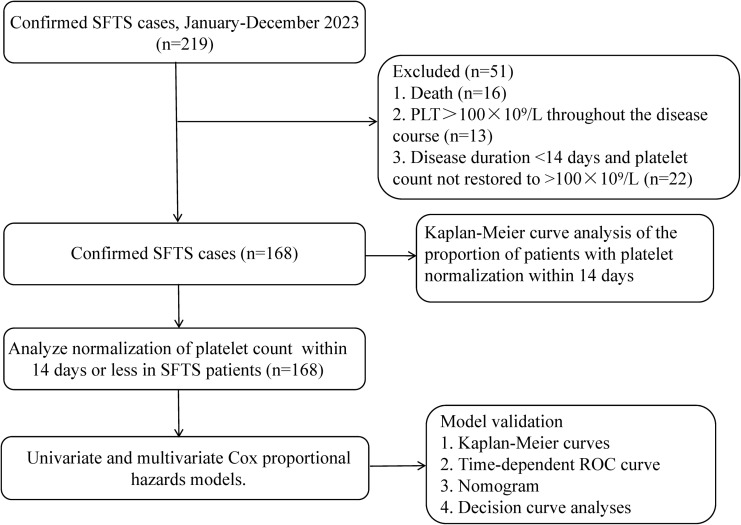
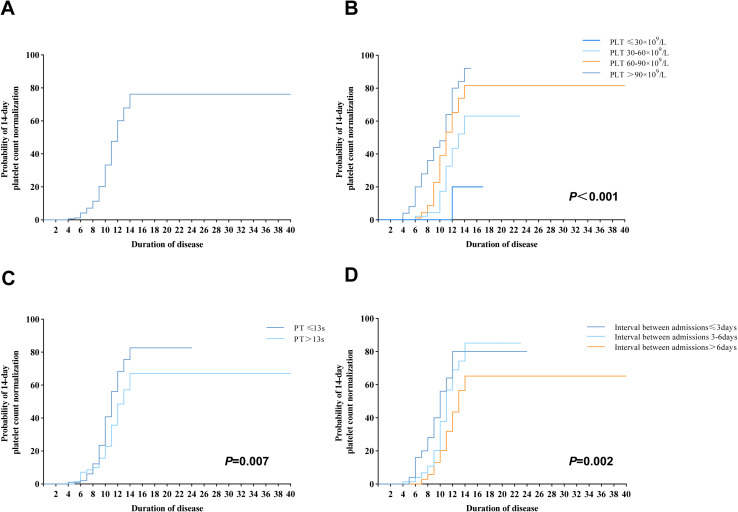
We retrospectively analyzed the clinical data of SFTS patients admitted to Yantai Qishan Hospital throughout 2023. According to the Diagnosis and Treatment Guideline (2023 edition), the platelet recovery in 14 days was set as outcome. The multivariate Cox regression was used to identify independent risk factors affecting platelet recovery and the Kaplan-Meier was performed to evaluate the probability of 14-day platelet recovery, using receiver operating characteristic (ROC) curve and area under the curve (AUC) to measure the model's performance, with clinical benefit assessed by decision curve analysis (DCA).
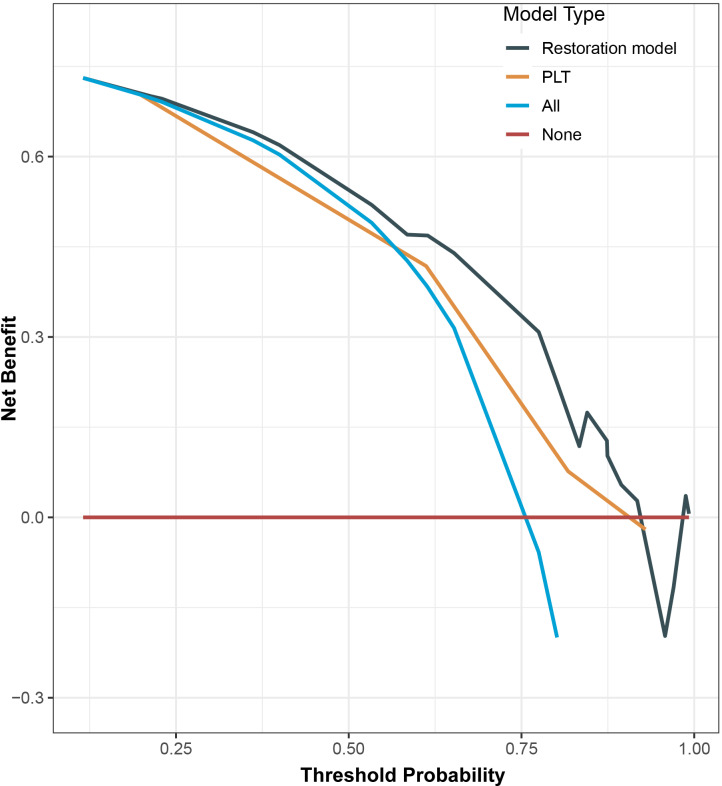
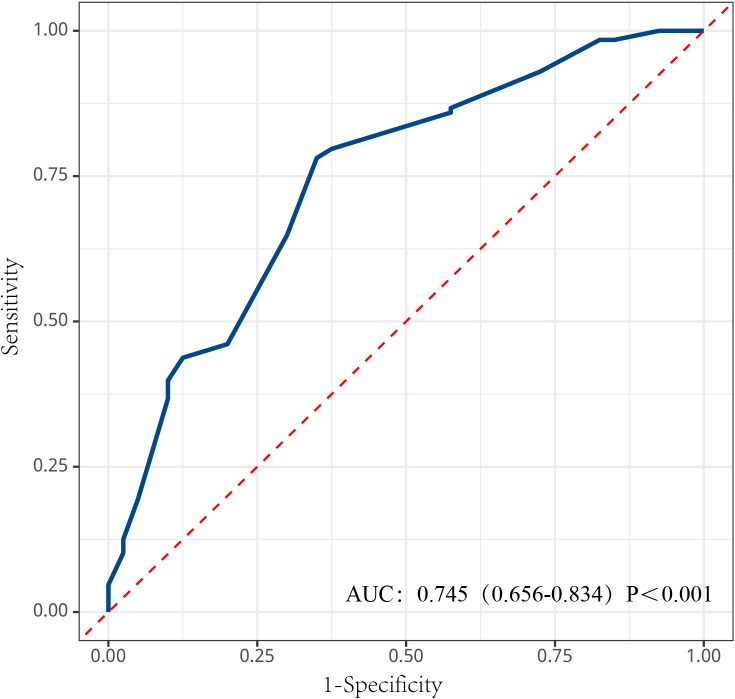
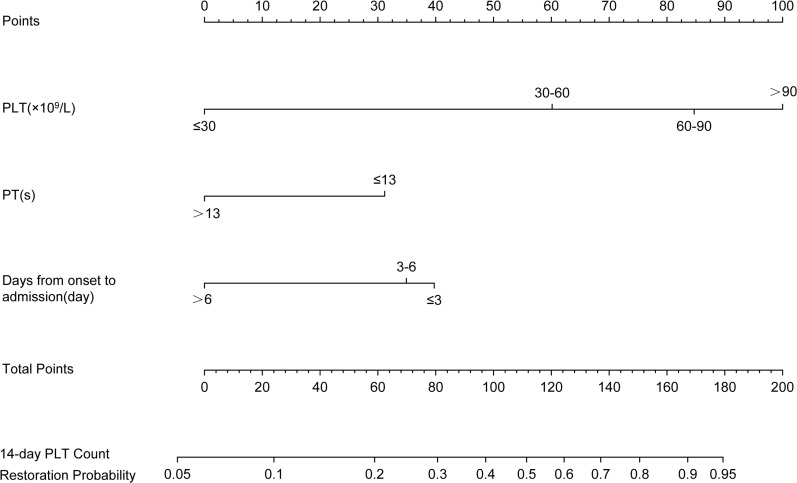
168 SFTS patients were enrolled in the study, with 76.2% (128/168) achieving platelet (PLT) recovery within 14 days. Independent risk factors were baseline PLT > 90 × 109/L (HR: 7.929, 95%CI: 1.066-58.990, P = 0.043), days from onset to admission >6 days (HR: 0.444, 95%CI: 0.259-0.763, P = 0.003) and baseline prothrombin time (PT) >13 s (HR: 0.547, 95%CI: 0.373-0.800, P = 0.002), with an AUC of 0.745 (95% CI: 0.656-0.834, P < 0.001). DCA demonstrated that when the recovery probability beyond approximately 50%, the clinical net benefit from focusing on the PLT stratification model consistently surpassed that from the all-intervention model. The nomogram further visualized the model.
Early diagnosis and timely therapy contributed to recovery during convalescence in SFTS patients, with baseline PT as a strong predictor.
血小板恢复是发热伴血小板减少综合征(SFTS)的一项重要预后指标。本研究聚焦于影响SFTS存活患者血小板恢复的危险因素,这有助于临床医生早期筛查死亡风险较高的患者。
我们回顾性分析了2023年全年入住烟台奇山医院的SFTS患者的临床资料。根据《诊疗指南(2023年版)》,将14天内的血小板恢复情况作为观察指标。采用多因素Cox回归分析确定影响血小板恢复的独立危险因素,并采用Kaplan-Meier法评估14天血小板恢复的概率,使用受试者工作特征(ROC)曲线和曲线下面积(AUC)来衡量模型的性能,通过决策曲线分析(DCA)评估临床获益。
168例SFTS患者纳入本研究,其中76.2%(128/168)在14天内实现血小板(PLT)恢复。独立危险因素为基线血小板计数>90×10⁹/L(HR:7.929,95%CI:1.066 - 58.990,P = 0.043)、发病至入院天数>6天(HR:0.444,95%CI:0.259 - 0.763,P = 0.003)和基线凝血酶原时间(PT)>13秒(HR:0.547,95%CI:0.373 - 0.800,P = 0.002),AUC为0.745(95%CI:0.656 - 0.834,P < 0.001)。DCA表明,当恢复概率超过约50%时,关注血小板分层模型的临床净获益始终超过全干预模型。列线图进一步直观展示了该模型。
早期诊断和及时治疗有助于SFTS患者康复期的恢复,基线凝血酶原时间是一个强有力的预测指标。