Nagaoka K, Fujii K, Zhang H, Usuda K, Watanabe G, Ivshina M, Richter J D
Laboratory of Veterinary Physiology, Department of Veterinary Medicine, Tokyo University of Agriculture and Technology, Tokyo, Japan.
Program in Molecular Medicine, University of Massachusetts Medical School, Worcester, MA, USA.
Oncogene. 2016 Jun 2;35(22):2893-901. doi: 10.1038/onc.2015.350. Epub 2015 Sep 28.
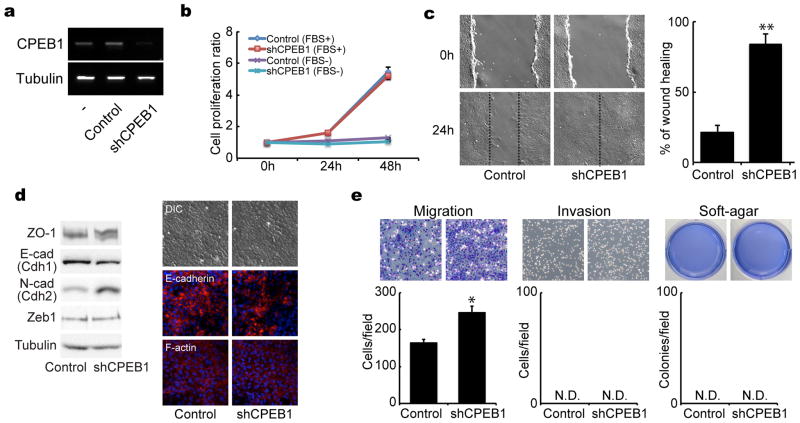
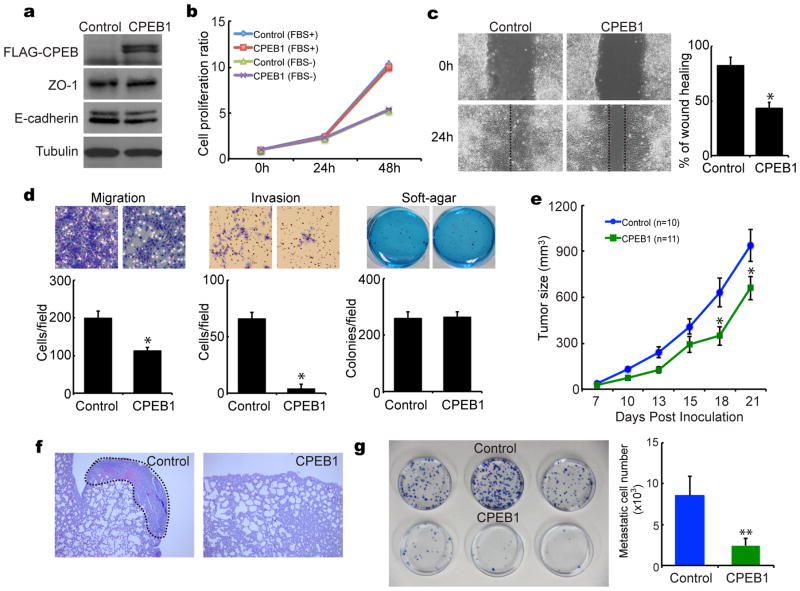
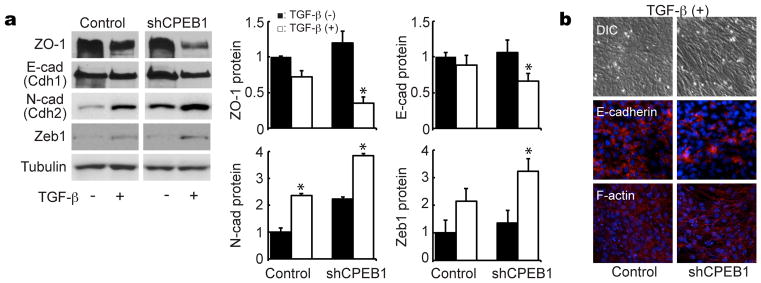
In mouse mammary epithelial cells, cytoplasmic polyadenylation element binding protein 1 (CPEB1) mediates the apical localization of ZO-1 mRNA, which encodes a critical tight junction component. In mice lacking CPEB1 and in cultured cells from which CPEB has been depleted, randomly distributed ZO-1 mRNA leads to the loss of cell polarity. We have investigated whether this diminution of polarity results in an epithelial-to-mesenchyme (EMT) transition and possible increased metastatic potential. Here, we show that CPEB1-depleted mammary epithelial cells alter their gene expression profile in a manner consistent with an EMT and also become motile, which are made particularly robust when cells are treated with transforming growth factor-β, an enhancer of EMT. CPEB1-depleted mammary cells become metastatic to the lung following injection into mouse fat pads while ectopically expressed CPEB1 prevents metastasis. Surprisingly, CPEB1 depletion causes some EMT/metastasis-related mRNAs to have shorter poly(A) tails while other mRNAs to have longer poly(A) tails. Matrix metalloproteinase 9 (MMP9) mRNA, which encodes a metastasis-promoting factor, undergoes poly(A) lengthening and enhanced translation upon CPEB reduction. Moreover, in human breast cancer cells that become progressively more metastatic, CPEB1 is reduced while MMP9 becomes more abundant. These data suggest that at least in part, CPEB1 regulation of MMP9 mRNA expression mediates metastasis of breast cancer cells.
在小鼠乳腺上皮细胞中,细胞质聚腺苷酸化元件结合蛋白1(CPEB1)介导紧密连接蛋白1(ZO-1)mRNA的顶端定位,ZO-1是一种关键的紧密连接成分。在缺乏CPEB1的小鼠以及CPEB被耗尽的培养细胞中,随机分布的ZO-1 mRNA导致细胞极性丧失。我们研究了这种极性的减弱是否会导致上皮-间质转化(EMT)以及转移潜能的增加。在此,我们表明,CPEB1缺失的乳腺上皮细胞以与EMT一致的方式改变其基因表达谱,并且变得具有运动性,当用EMT增强剂转化生长因子-β处理细胞时,这种变化尤为明显。将CPEB1缺失的乳腺细胞注射到小鼠脂肪垫后会转移至肺部,而异位表达的CPEB1可防止转移。令人惊讶的是,CPEB1的缺失导致一些与EMT/转移相关的mRNA的聚腺苷酸尾巴变短,而其他mRNA的聚腺苷酸尾巴变长。编码转移促进因子的基质金属蛋白酶9(MMP9)mRNA在CPEB减少时会发生聚腺苷酸化延长并增强翻译。此外,在转移性逐渐增加的人乳腺癌细胞中,CPEB1减少而MMP9变得更加丰富。这些数据表明,至少部分地,CPEB1对MMP9 mRNA表达的调节介导了乳腺癌细胞的转移。