Abeid Muzdalifat, Muganyizi Projestine, Mpembeni Rose, Darj Elisabeth, Axemo Pia
Department of Women's and Children's Health, International Maternal and Child Health (IMCH), Uppsala University, Uppsala, Sweden.
Department of Obstetrics/Gynecology, Muhimbili University of Health and Allied Sciences (MUHAS), Dar es Salaam, Tanzania;
Glob Health Action. 2015 Sep 25;8:28608. doi: 10.3402/gha.v8.28608. eCollection 2015.
Despite global recognition that sexual violence is a violation of human rights, evidence still shows it is a pervasive problem across all societies. Promising community intervention studies in the low- and middle-income countries are limited.
This study assessed the impact of a community-based intervention, focusing on improving the community's knowledge and reducing social acceptability of violence against women norms with the goal to prevent and respond to sexual violence.
The strategies used to create awareness included radio programs, information, education communication materials, and advocacy meetings with local leaders. The intervention took place in Morogoro region in Tanzania. The evaluation used a quasi-experimental design including cross-sectional surveys at baseline (2012) and endline (2014) with men and women aged 18-49 years. Main outcome measures were number of reported rape cases at health facilities and the community's knowledge and attitudes toward sexual violence.
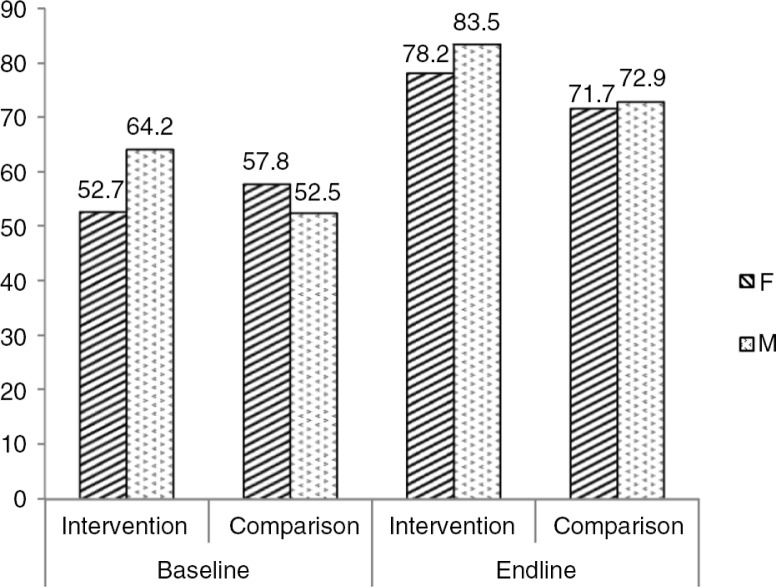
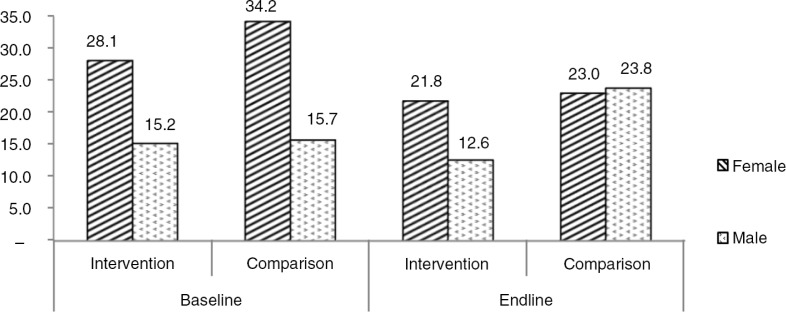
The number of reported rape events increased by more than 50% at health facilities during the intervention. Knowledge on sexual violence increased significantly in both areas over the study period (from 57.3 to 80.6% in the intervention area and from 55.5 to 71.9% in the comparison area; p<0.001), and the net effect of the intervention between the two areas was statistically significant (6.9, 95% CI 0.2-13.5, p=0.03). There was significant improvement in most of the attitude indicators in the intervention area, but not in the comparison area. However, the intervention had no significant effect on the overall scores of acceptance attitudes in the final assessment when comparing the two areas (-2.4, 95% CI: -8.4 to 3.6, p=0.42).
The intervention had an effect on some indicators on knowledge and attitudes toward sexual violence even after a short period of intervention. This finding informs the public health practitioners of the importance of combined strategies in achieving changes.
尽管全球都认识到性暴力是对人权的侵犯,但证据仍表明这是一个在所有社会中普遍存在的问题。在低收入和中等收入国家开展的有前景的社区干预研究有限。
本研究评估了一项基于社区的干预措施的影响,重点是提高社区对暴力侵害妇女规范的认识并降低社会对其的接受度,以预防和应对性暴力。
用于提高认识的策略包括广播节目、信息、教育宣传材料以及与当地领导人的宣传会议。干预在坦桑尼亚的莫罗戈罗地区进行。评估采用准实验设计,包括在基线(2012年)和终线(2014年)对18 - 49岁的男性和女性进行横断面调查。主要结局指标是医疗机构报告的强奸案件数量以及社区对性暴力的认识和态度。
在干预期间,医疗机构报告的强奸事件数量增加了50%以上。在研究期间,两个地区对性暴力的认识均显著提高(干预地区从57.3%提高到80.6%,对照地区从55.5%提高到71.9%;p<0.001),两个地区之间干预的净效应具有统计学意义(6.9,95%可信区间0.2 - 13.5,p = 0.03)。干预地区的大多数态度指标有显著改善,但对照地区没有。然而,在最终评估中,比较两个地区时,干预对接受态度的总体得分没有显著影响(-2.4,95%可信区间:-8.4至3.6,p = 0.42)。
即使经过短期干预,该干预措施对性暴力的一些知识和态度指标仍有影响。这一发现告知公共卫生从业者联合策略在实现改变方面的重要性。