Department of Population, Family and Reproductive Health, School of Public Health, College of Health Science, University of Ghana, Legon, Accra, Ghana.
College of Health and Medical Sciences, Haramaya University, Po. Box 235, Harar, Ethiopia.
Reprod Health. 2017 Nov 21;14(1):155. doi: 10.1186/s12978-017-0414-2.
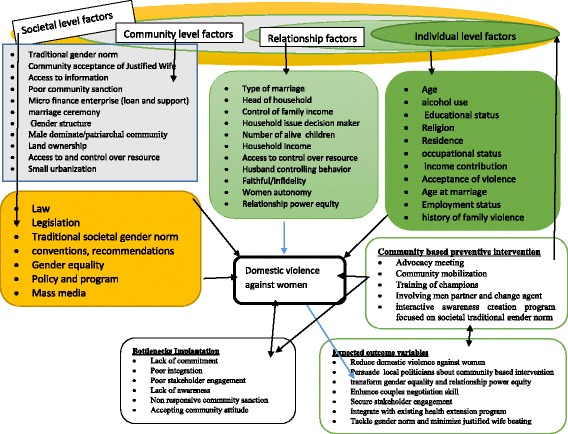
Violence against women is a well understood devastating global pandemic, and human right violation. One in three women experienced intimate partner violence worldwide. In Ethiopia, the level of domestic violence against women is one of the highest in the world. However, Ethiopia is signatory for various conventions and incorporated in legal frameworks. Nevertheless, effective implementation of the existing policy documents, and engaging different stakeholders is very limited. Therefore, we aimed to pilot feasibility of implementing available research evidence and policy documents at community level to prevent domestic violence against women in Awi zone, northwestern Ethiopia.
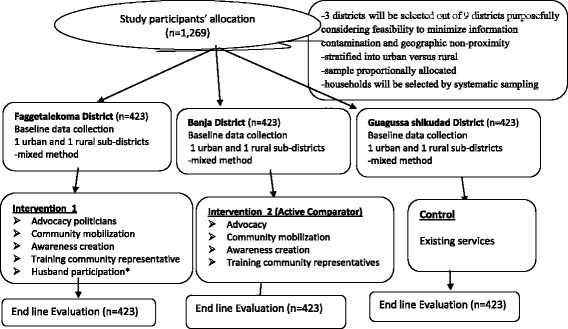
A community-based quasi-experimental study design will be employed using mixed method. Multistage stratified systematic sampling and purposive sampling will be used to recruit quantitative and qualitative study participants, respectively. A total of 1,269 women will be participated in the intervention, active comparator and control groups. Pre and post-test quantitative data will be collected using face-to-face interview. Qualitative data will be collected through in-depth, key informant interview and focus group discussions.
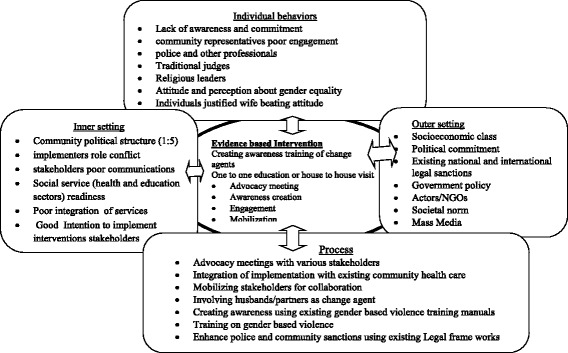
advocacy meeting will be held to persuade local politicians and sustain the implementation of community based intervention to prevent domestic violence against women. Community representatives will be trained to enhance peer education to promote community awareness and engage stakeholders to transform the traditional gender norm within local context. Awareness creation and husband involvement will be made through integrating the intervention with community health extension program. Only husband involvement will not be promoted in the active comparator to test the role of husband involvement on the domestic violence prevention activities. Intervention progress will be monitored regularly. Gathered data will be entered in Epidata and exported to SPSS (23.0) software for analysis. Descriptive statistics, logistic regressions, intention to treat analysis and difference in differences will be computed. Qualitative data will be transcribed, color coded, thematically analyzed and arranged using Nvivo.
This interventional study is aimed to design, pilot and translate proven research evidence, agreed conventions and country policy document to real setting implementation. We are expecting to initiate implementation of culturally acceptable intervention through engaging stakeholders. Policy makers, planners and any concerned bodies will be benefited.
ClinicalTrials.gov ID: NCT03265626.
针对妇女的暴力行为是一种广为人知的毁灭性全球大流行病,也是一种侵犯人权的行为。全世界每三名妇女中就有一人曾遭受亲密伴侣的暴力。在埃塞俄比亚,针对妇女的家庭暴力程度位居世界前列。然而,埃塞俄比亚签署了各种公约,并将其纳入法律框架。尽管如此,有效执行现有的政策文件,并让不同的利益攸关方参与的工作却非常有限。因此,我们旨在试点在社区一级实施现有研究证据和政策文件的可行性,以防止在埃塞俄比亚阿瓦什地区发生针对妇女的家庭暴力。
本研究将采用基于社区的类实验设计,使用混合方法。多阶段分层系统抽样和目的抽样将分别用于招募定量和定性研究参与者。共有 1269 名妇女将参加干预组、对照组和活性对照组。通过面对面访谈收集干预前和干预后的定量数据。定性数据将通过深入访谈、关键知情人访谈和焦点小组讨论收集。
将举行宣传会议,说服地方政治家并维持基于社区的干预措施的实施,以防止针对妇女的家庭暴力。培训社区代表,以加强同伴教育,提高社区意识,并让利益攸关方参与进来,以改变当地传统的性别规范。通过将干预措施与社区卫生推广计划相结合,开展提高认识和丈夫参与活动。在活性对照组中,不会只提倡丈夫参与,以检验丈夫参与对预防家庭暴力活动的作用。将定期监测干预进展情况。收集到的数据将输入 Epidata 并导出到 SPSS(23.0)软件进行分析。将计算描述性统计、逻辑回归、意向治疗分析和差异差异。定性数据将被转录、颜色编码、主题分析,并使用 Nvivo 进行排列。
这项干预性研究旨在设计、试点和转化经过验证的研究证据、商定的公约和国家政策文件,以实现实际的实施。我们希望通过让利益攸关方参与,开始实施文化上可接受的干预措施。政策制定者、规划者和任何有关机构都将从中受益。
ClinicalTrials.gov ID:NCT03265626。