Holmgaard Rikke B, Zamarin Dmitriy, Li Yanyun, Gasmi Billel, Munn David H, Allison James P, Merghoub Taha, Wolchok Jedd D
Swim Across America/Ludwig Collaborative Laboratory, Memorial Sloan Kettering Cancer Center, New York, NY 10065, USA.
Swim Across America/Ludwig Collaborative Laboratory, Memorial Sloan Kettering Cancer Center, New York, NY 10065, USA; Department of Medicine, Memorial Sloan Kettering Cancer Center, New York, NY 10065, USA.
Cell Rep. 2015 Oct 13;13(2):412-24. doi: 10.1016/j.celrep.2015.08.077. Epub 2015 Sep 24.
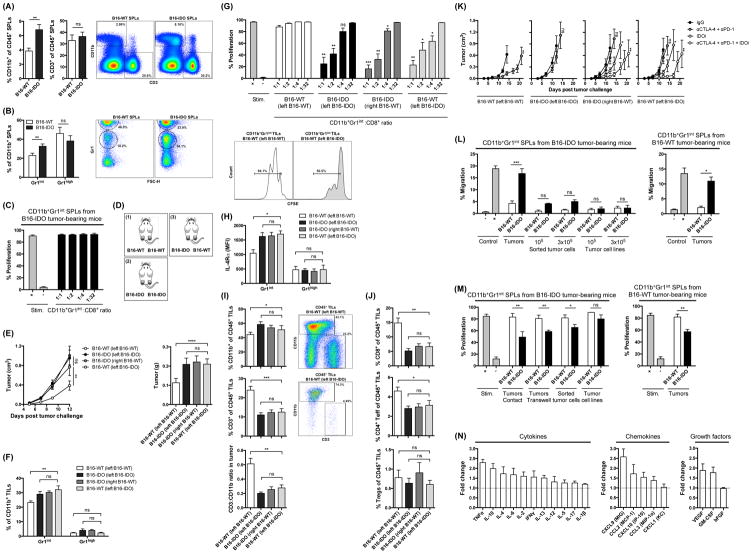
Indoleamine 2,3-dioxygenase (IDO) has been described as a major mechanism of immunosuppression in tumors, though the mechanisms of this are poorly understood. Here, we find that expression of IDO by tumor cells results in aggressive tumor growth and resistance to T-cell-targeting immunotherapies. We demonstrate that IDO orchestrates local and systemic immunosuppressive effects through recruitment and activation of myeloid-derived suppressor cells (MDSCs), through a mechanism dependent on regulatory T cells (Tregs). Supporting these findings, we find that IDO expression in human melanoma tumors is strongly associated with MDSC infiltration. Treatment with a selective IDO inhibitor in vivo reversed tumor-associated immunosuppression by decreasing numbers of tumor-infiltrating MDSCs and Tregs and abolishing their suppressive function. These findings establish an important link between IDO and multiple immunosuppressive mechanisms active in the tumor microenvironment, providing a strong rationale for therapeutic targeting of IDO as one of the central regulators of immune suppression.
吲哚胺2,3-双加氧酶(IDO)被认为是肿瘤免疫抑制的主要机制,但其具体机制尚不清楚。在此,我们发现肿瘤细胞表达IDO会导致肿瘤的侵袭性生长以及对靶向T细胞的免疫疗法产生抗性。我们证明,IDO通过募集和激活髓源性抑制细胞(MDSC)来协调局部和全身的免疫抑制作用,该机制依赖于调节性T细胞(Treg)。支持这些发现的是,我们发现人黑色素瘤肿瘤中IDO的表达与MDSC浸润密切相关。体内使用选择性IDO抑制剂进行治疗可通过减少肿瘤浸润的MDSC和Treg数量并消除其抑制功能来逆转肿瘤相关的免疫抑制。这些发现建立了IDO与肿瘤微环境中多种活跃的免疫抑制机制之间的重要联系,为将IDO作为免疫抑制的核心调节因子之一进行治疗性靶向提供了有力的理论依据。