Pearson Joel, Naselaris Thomas, Holmes Emily A, Kosslyn Stephen M
School of Psychology, The University of New South Wales, Sydney, Australia.
Department of Neuroscience, Medical University of South Carolina, Charleston, SC, USA.
Trends Cogn Sci. 2015 Oct;19(10):590-602. doi: 10.1016/j.tics.2015.08.003.
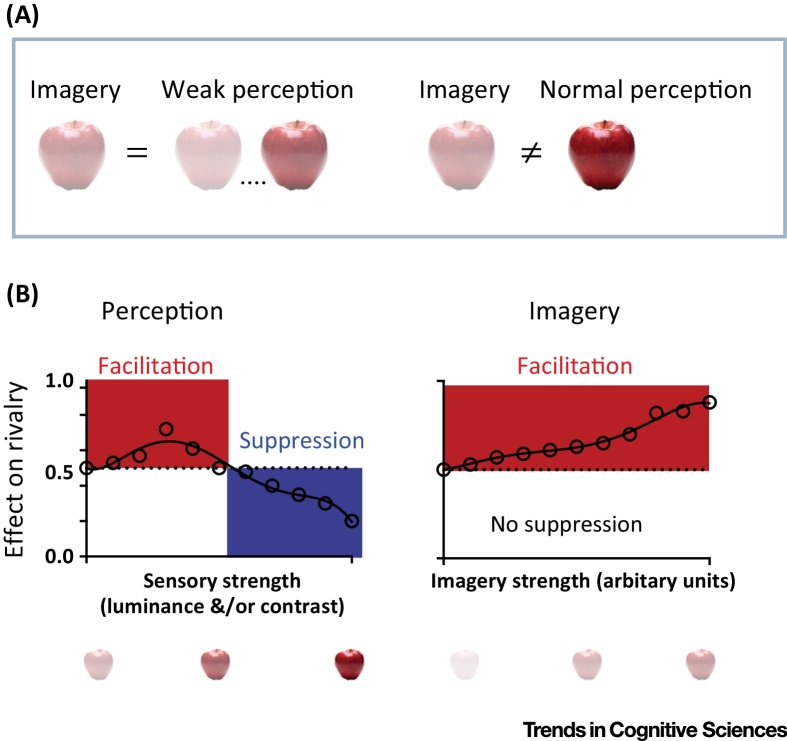
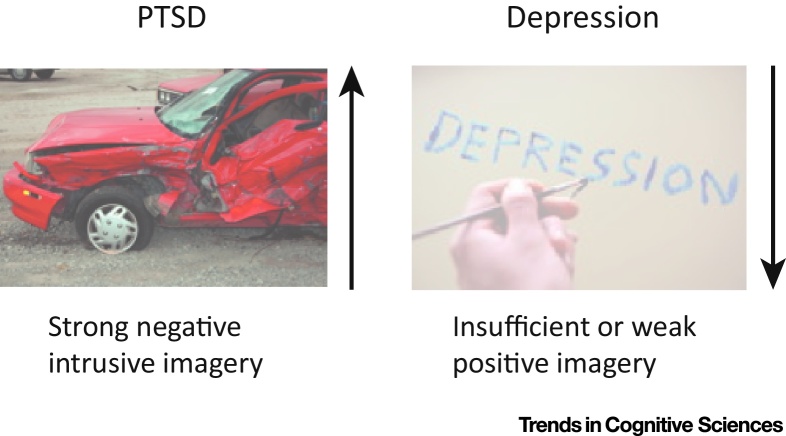
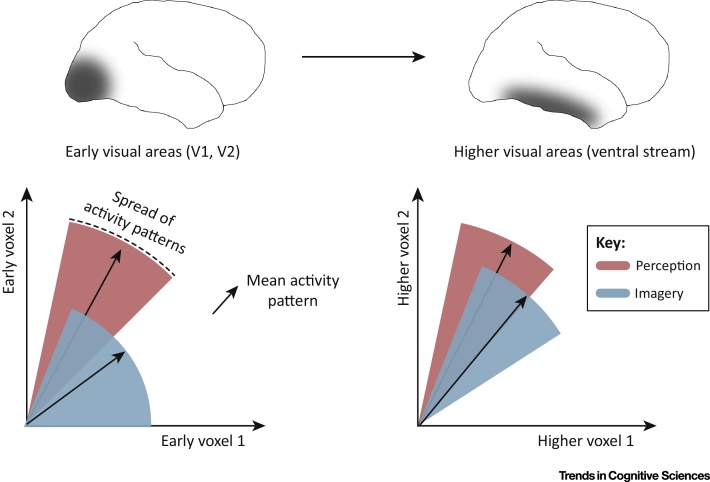
Mental imagery research has weathered both disbelief of the phenomenon and inherent methodological limitations. Here we review recent behavioral, brain imaging, and clinical research that has reshaped our understanding of mental imagery. Research supports the claim that visual mental imagery is a depictive internal representation that functions like a weak form of perception. Brain imaging work has demonstrated that neural representations of mental and perceptual images resemble one another as early as the primary visual cortex (V1). Activity patterns in V1 encode mental images and perceptual images via a common set of low-level depictive visual features. Recent translational and clinical research reveals the pivotal role that imagery plays in many mental disorders and suggests how clinicians can utilize imagery in treatment.
心理意象研究历经了对该现象的怀疑以及固有的方法学局限性。在此,我们回顾近期的行为学、脑成像及临床研究,这些研究重塑了我们对心理意象的理解。研究支持了这样的观点,即视觉心理意象是一种描绘性的内部表征,其功能类似于一种较弱形式的感知。脑成像研究表明,心理意象和感知意象的神经表征早在初级视觉皮层(V1)就彼此相似。V1中的活动模式通过一组共同的低层次描绘性视觉特征对心理意象和感知意象进行编码。近期的转化研究和临床研究揭示了意象在许多精神障碍中所起的关键作用,并为临床医生如何在治疗中利用意象提供了建议。