Pallav Kumar, Xu Hua, Leffler Daniel A, Kabbani Toufic, Kelly Ciaran P
Celiac Center, Beth Israel Deaconess Medical Center and Harvard Medical School, Boston, Massachusetts, USA.
Division of Digestive Diseases, University of Mississippi Medical Center, Jackson, Mississippi, USA.
J Gastroenterol Hepatol. 2016 Jan;31(1):133-7. doi: 10.1111/jgh.13176.
Multiple European studies report increased prevalence of selective immunoglobulin A deficiency (SIgAD) and partial immunoglobulin A deficiency (PIgAD) in patients with celiac disease (CD). However; prospective data representing North American adults are lacking. While SIgAD precludes the use of IgA-tissue-transglutaminase antibody (IgA-tTG), the effect of PIgAD on IgA-tTG sensitivity is not well documented. We aim to determine the prevalence and impact of IgA deficiency on CD presentation and diagnosis in North American adult patients.
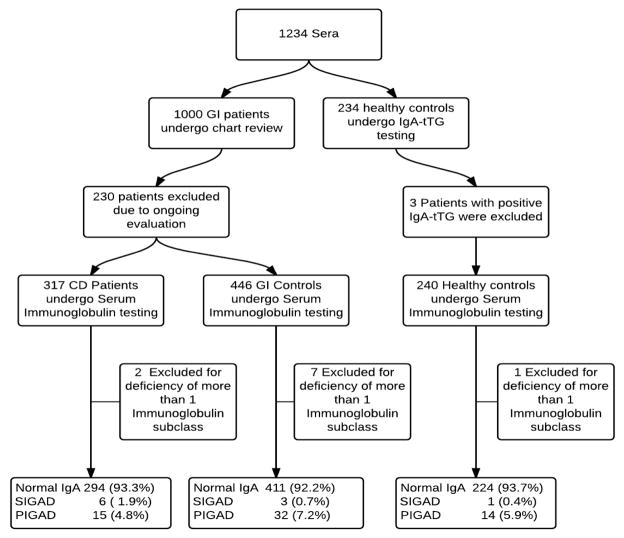
We reviewed 1000 consecutive patients undergoing IgA-tTG testing and 243 healthy controls. Eligible sera were tested for IgA-tTG, serum immunoglobulins, and IgA/IgG-deamidated gliadin peptide (IgA/IgG-DGP).
Prevalence of SIgAD was marginally higher in patients with CD (1.9%) compared with healthy controls (0.4%, P = 0.24) and patients without CD (0.7%, P = 0.173). Prevalence of PIGAD was similar in patients with CD (4.8%) compared with healthy controls (5.9%, P = 0.57) and patients without CD (7.2%, P = 0.22). One (16.7%) of 6 patients with CD with SIgAD and all 15 (100%) with PIGAD tested IgA-tTG positive prior to gluten-free diet initiation. Patients with CD with SIGAD showed lower frequency of gastrointestinal symptoms (33% vs 82%, P = 0.01) and more co-morbid autoimmune disease (67% vs 23%, P = 0.03) when compared with patients with CD with normal IgA.
The prevalence of SIgAD in North American patients with CD is comparable with European data but not significantly different than control populations. Patients with CD with SIgAD exhibit decreased IgA-tTG sensitivity and lack of gastrointestinal symptoms. PIgAD is common in patients with gastrointestinal disorders but does not alter CD presentation or IgA-tTG sensitivity.
多项欧洲研究报告称,乳糜泻(CD)患者中选择性免疫球蛋白A缺乏症(SIgAD)和部分免疫球蛋白A缺乏症(PIgAD)的患病率有所增加。然而,缺乏代表北美成年人的前瞻性数据。虽然SIgAD排除了使用IgA组织转谷氨酰胺酶抗体(IgA-tTG)的可能性,但PIgAD对IgA-tTG敏感性的影响尚无充分记录。我们旨在确定北美成年患者中IgA缺乏症对CD表现和诊断的患病率及影响。
我们回顾了连续接受IgA-tTG检测的1000例患者和243例健康对照。对符合条件的血清进行IgA-tTG、血清免疫球蛋白和IgA/IgG-去酰胺化麦醇溶蛋白肽(IgA/IgG-DGP)检测。
与健康对照(0.4%,P = 0.24)和非CD患者(0.7%,P = 0.173)相比,CD患者中SIgAD的患病率略高(1.9%)。与健康对照(5.9%,P = 0.57)和非CD患者(7.2%,P = 0.22)相比,CD患者中PIgAD的患病率相似(4.8%)。6例CD合并SIgAD患者中有1例(16.7%),所有15例(100%)CD合并PIgAD患者在开始无麸质饮食前IgA-tTG检测呈阳性。与IgA正常的CD患者相比,CD合并SIgAD患者出现胃肠道症状的频率较低(33%对82%,P = 0.01),合并自身免疫性疾病的情况较多(67%对23%,P = 0.03)。
北美CD患者中SIgAD的患病率与欧洲数据相当,但与对照组无显著差异。CD合并SIgAD患者的IgA-tTG敏感性降低,且无胃肠道症状。PIgAD在胃肠道疾病患者中很常见,但不改变CD的表现或IgA-tTG敏感性。