Flodin P, Martinsen S, Mannerkorpi K, Löfgren M, Bileviciute-Ljungar I, Kosek E, Fransson P
Department of Clinical Neuroscience, Karolinska Institutet, Stockholm, Sweden.
Department of Rheumatology and Inflammation Research, Institute of Medicine, Sahlgrenska Academy, Gothenburg University, Gothenburg, Sweden.
Neuroimage Clin. 2015 Aug 18;9:134-9. doi: 10.1016/j.nicl.2015.08.004. eCollection 2015.
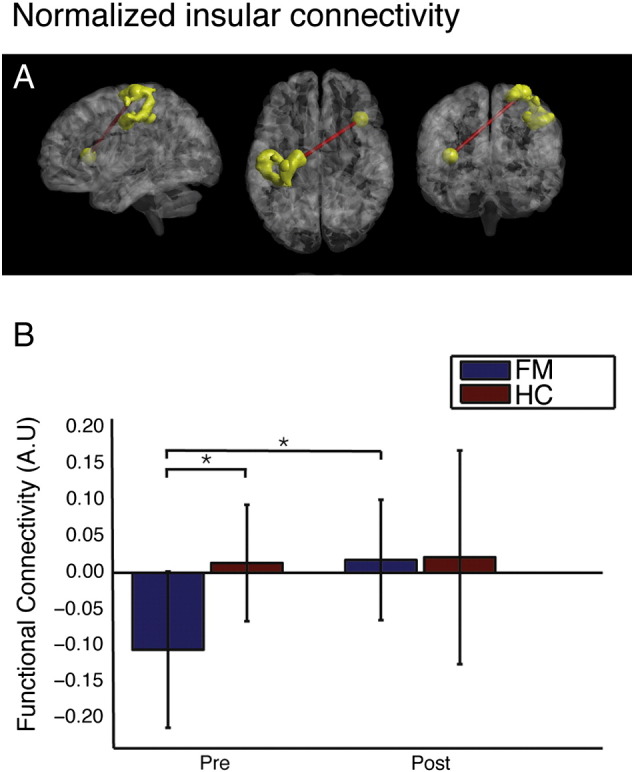
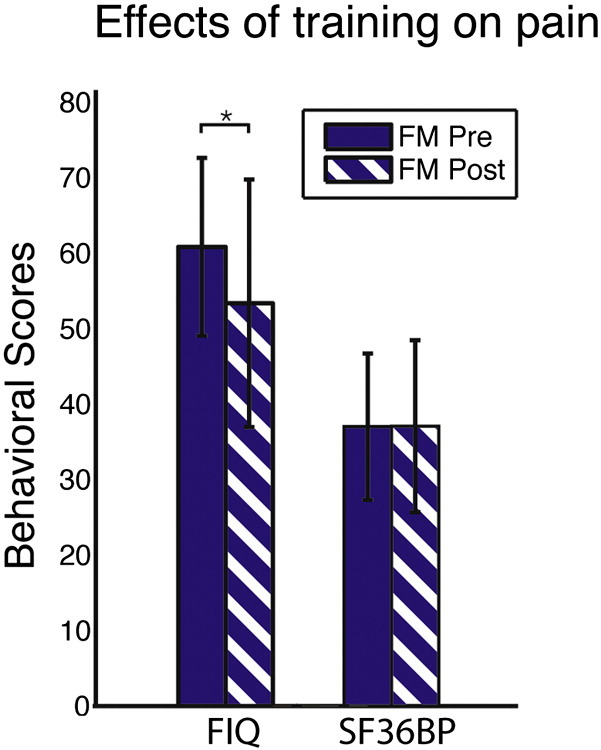
Physical exercise is one of the most efficient interventions to mitigate chronic pain symptoms in fibromyalgia (FM). However, little is known about the neurophysiological mechanisms mediating these effects. In this study we investigated resting-state connectivity using functional magnetic resonance imaging (fMRI) before and after a 15 week standardized exercise program supervised by physical therapists. Our aim was to gain an understanding of how physical exercise influences previously shown aberrant patterns of intrinsic brain activity in FM. Fourteen FM patients and eleven healthy controls successfully completed the physical exercise treatment. We investigated post- versus pre-treatment changes of brain connectivity, as well as changes in clinical symptoms in the patient group. FM patients reported improvements in symptom severity. Although several brain regions showed a treatment-related change in connectivity, only the connectivity between the right anterior insula and the left primary sensorimotor area was significantly more affected by the physical exercise among the fibromyalgia patients compared to healthy controls. Our results suggest that previously observed aberrant intrinsic brain connectivity patterns in FM are partly normalized by the physical exercise therapy. However, none of the observed normalizations in intrinsic brain connectivity were significantly correlated with symptom changes. Further studies conducted in larger cohorts are warranted to investigate the precise relationship between improvements in fibromyalgia symptoms and changes in intrinsic brain activity.
体育锻炼是缓解纤维肌痛(FM)慢性疼痛症状最有效的干预措施之一。然而,介导这些效应的神经生理机制却鲜为人知。在本研究中,我们在由物理治疗师监督的为期15周的标准化锻炼计划前后,使用功能磁共振成像(fMRI)研究静息态连接性。我们的目的是了解体育锻炼如何影响先前在FM中显示的异常脑内固有活动模式。14名FM患者和11名健康对照成功完成了体育锻炼治疗。我们研究了治疗后与治疗前脑连接性的变化,以及患者组临床症状的变化。FM患者报告症状严重程度有所改善。尽管几个脑区显示出与治疗相关的连接性变化,但与健康对照相比,在纤维肌痛患者中,只有右侧前岛叶与左侧初级感觉运动区之间的连接性受体育锻炼的影响更为显著。我们的结果表明,先前在FM中观察到的异常脑内固有连接模式通过体育锻炼疗法部分得到了正常化。然而,观察到的脑内固有连接性的正常化均与症状变化无显著相关性。有必要在更大的队列中进行进一步研究,以调查纤维肌痛症状改善与脑内固有活动变化之间的确切关系。